AEO vs SEO: The Strategic Guide to Running Both in 2026
SEO and AEO share infrastructure but reward different things. What each one wins, when to prioritise which, and a 12-month plan for running both.
Author
Lead GTM
Cynthia J is part of the GTM team at Paprik AI with 2+ years of experience helping brands understand and improve their visibility across AI search platforms.
The Core Difference
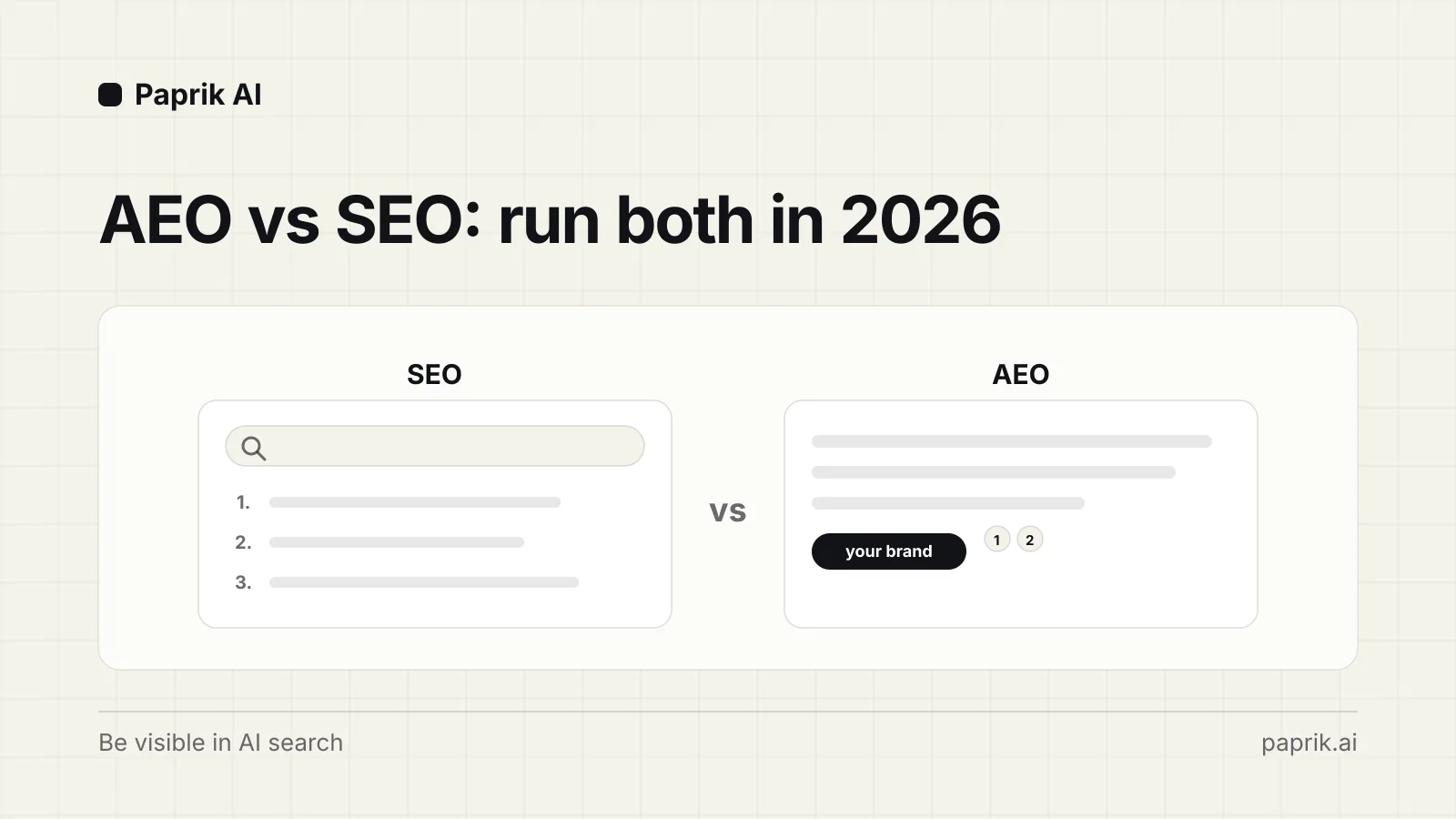
SEO earns a ranked position; AEO earns inclusion in the AI-generated answer itself. Success in SEO is measured in clicks - how many users saw your link and chose it. Success in AEO is measured in citations - how often an AI engine names or quotes your brand when answering a question in your category.
There is no position 1 through 10 in AEO. You are cited or you are not. ChatGPT does not display a ranked list of sources for users to choose from; it names the brands it considers authoritative and ignores the rest. Google AI Overviews typically pulls from one to three sources. The winner-take-most dynamic in AEO is structurally more aggressive than traditional search.
This changes what optimisation means. In SEO, incremental gains in ranking produce incremental gains in traffic. In AEO, a brand moves from invisible to cited - there is no partial credit, no consolation placement, no position 4 that still earns something. The strategic stakes of AEO entry are binary.
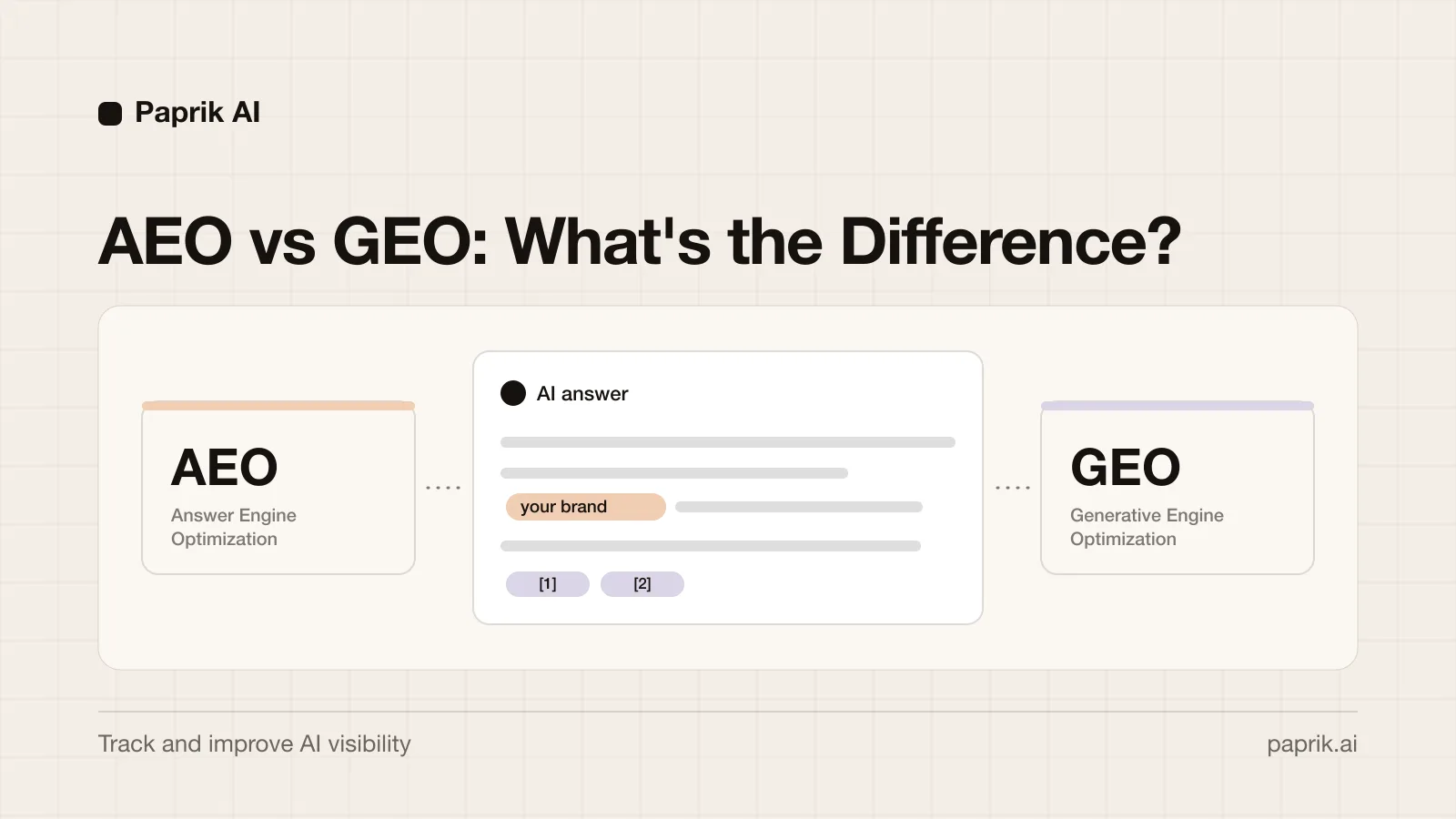
One naming note before the comparison: AEO is also called Generative Engine Optimization (GEO). The two are names for the same discipline, so the contrast in this guide is between SEO and the AEO/GEO practice, whatever your team calls it. AEO vs GEO: What's the Difference? covers the terminology.
SEO | AEO | |
Primary goal | Rank on results pages | Be cited in AI-generated answers |
Success metric | Position, CTR, organic traffic | Brand mention rate + content citation rate + AI share of voice |
Content format | Keyword-optimised pages | Directly answering, structured content |
Authority signals | Backlinks, domain rating | Entity trust, third-party mentions, E-E-A-T |
Visibility output | Blue link on a SERP | Brand mentioned in answer text (mention) and/or URL listed as source (citation) - often one without the other |
User action | Clicks through to site | May never visit site |
Two Types of AEO Win - And Why Most Teams Confuse Them
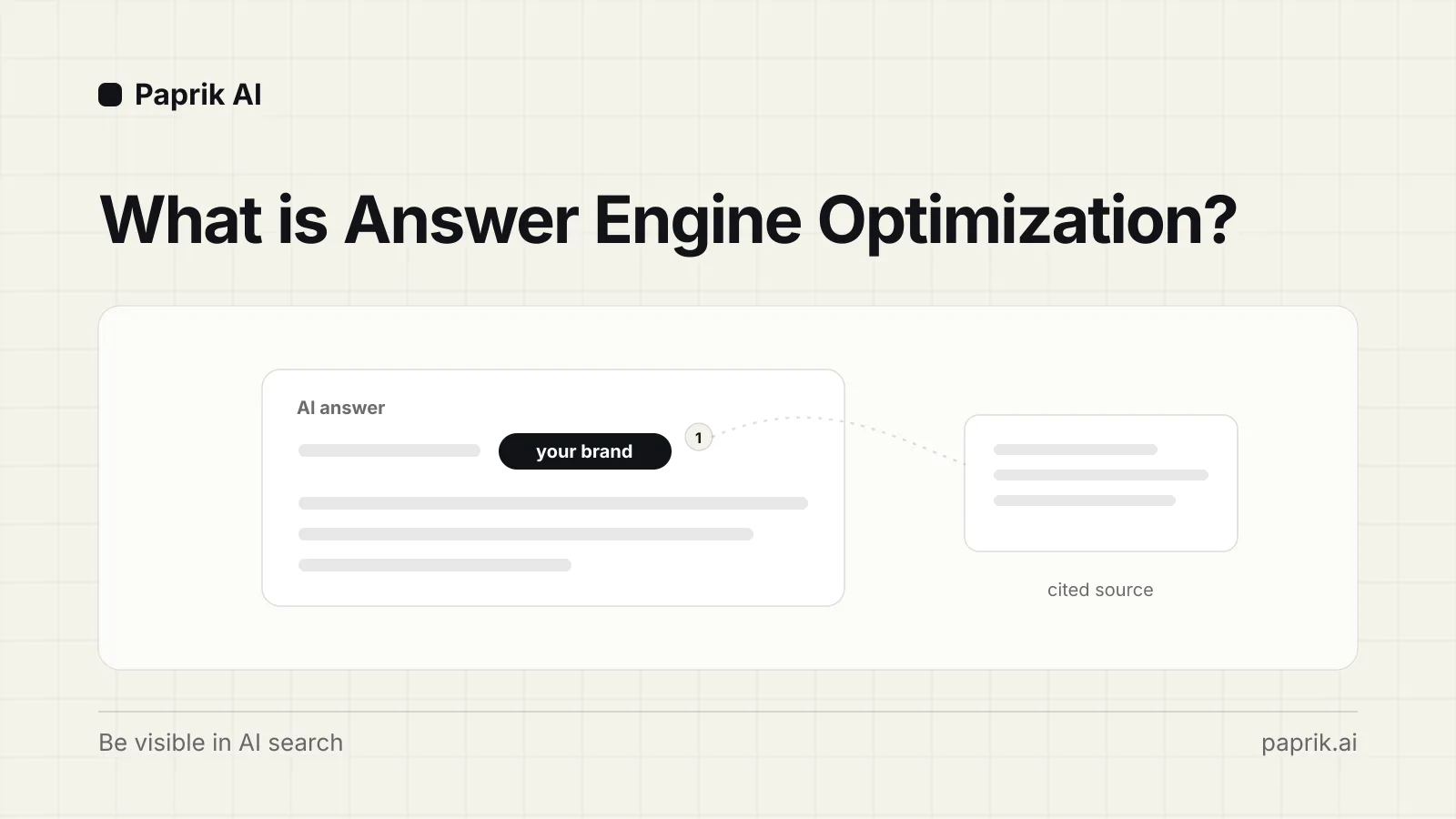
AEO is not a single outcome. There are two distinct ways a brand can win in an AI-generated answer, and treating them as the same thing produces confused strategy and incomplete measurement.
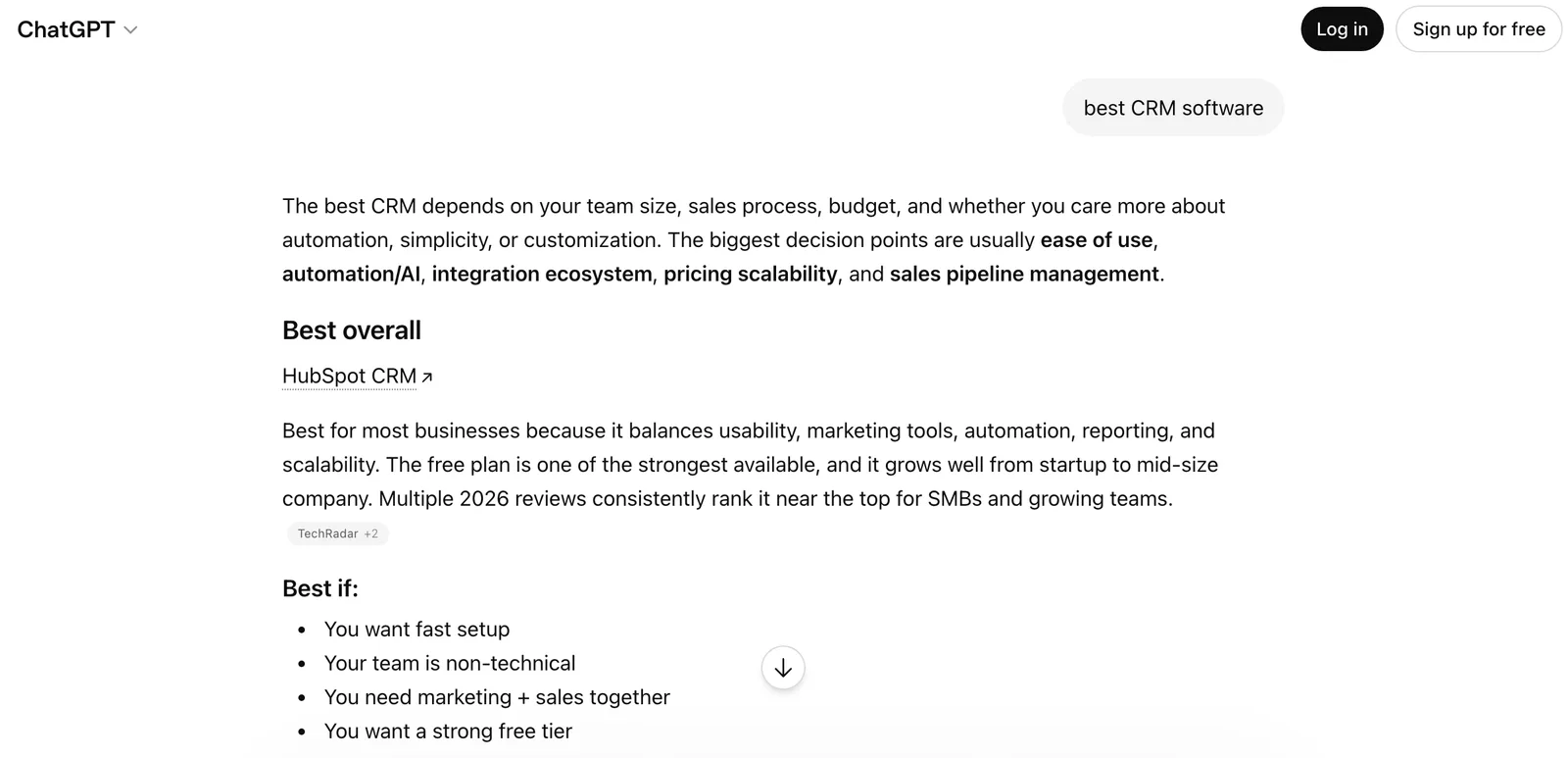
The first is a brand mention. This is when an AI engine explicitly names your company or product in the answer text itself. 'HubSpot is a strong option for small sales teams.' The brand name appears in the generated answer, and a user reading it encounters your brand directly. This is the outcome most teams visualise when they think about AEO - and it is only half the picture.
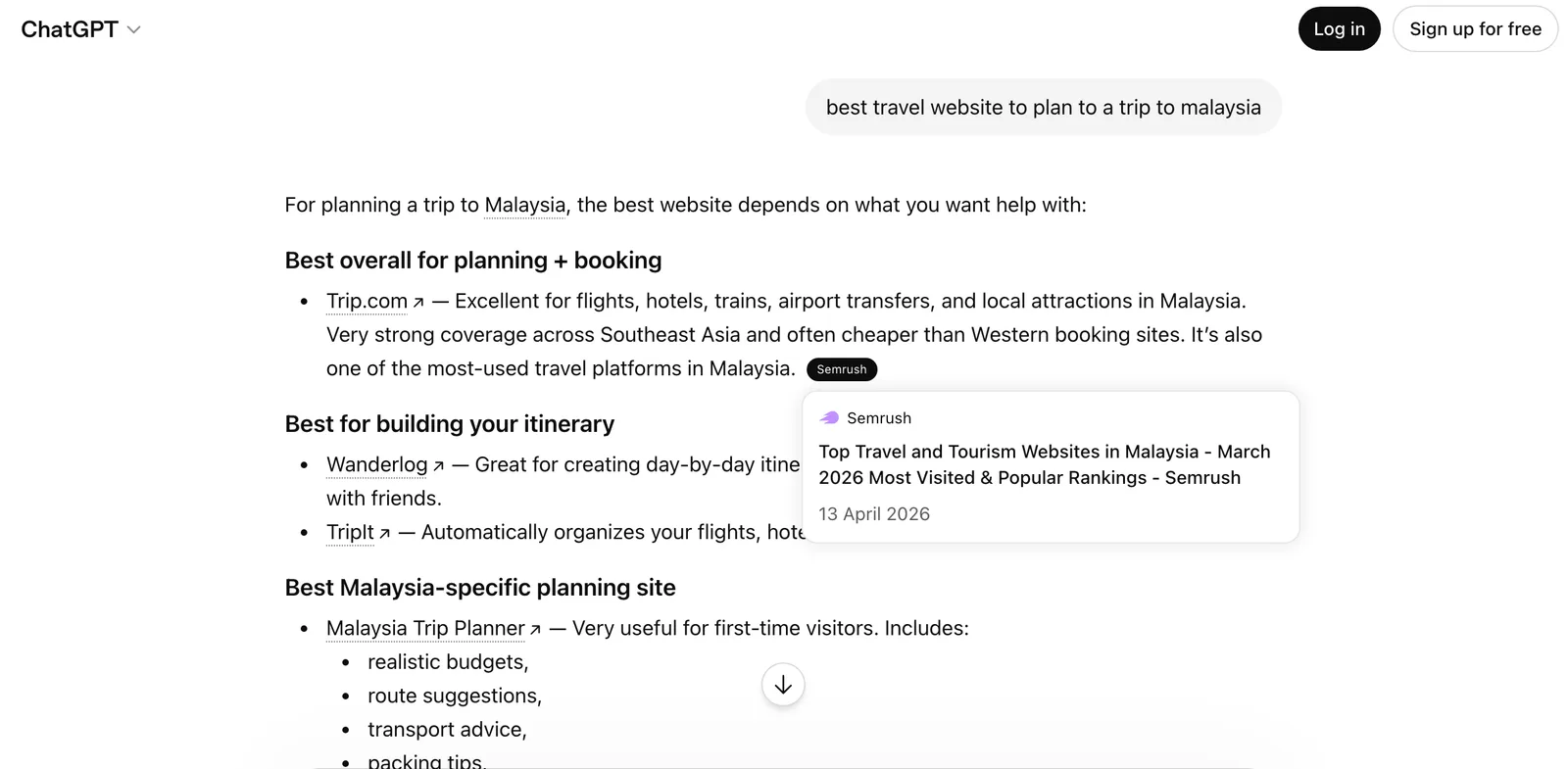
The second is a content citation. This is when an AI engine retrieves your content as a reference that informed the answer and lists your URL or domain as a source - without necessarily naming your brand anywhere in the answer text. A ChatGPT response about 'best travel website to plan to a trip to malaysia' might draw directly from a Semrush blog post and list Semrush.com in its sources panel, while the generated answer body never mentions Semrush at all. The brand is invisible to any user who reads the answer without clicking through to sources. The content did the work; the brand got no credit.
HubSpot might be explicitly recommended in an answer → brand mention. A Semrush blog post might be listed as a source that informed the answer, but Semrush’s name never appears in the answer text → content citation. Often you get one without the other. Optimising for each requires different tactics.
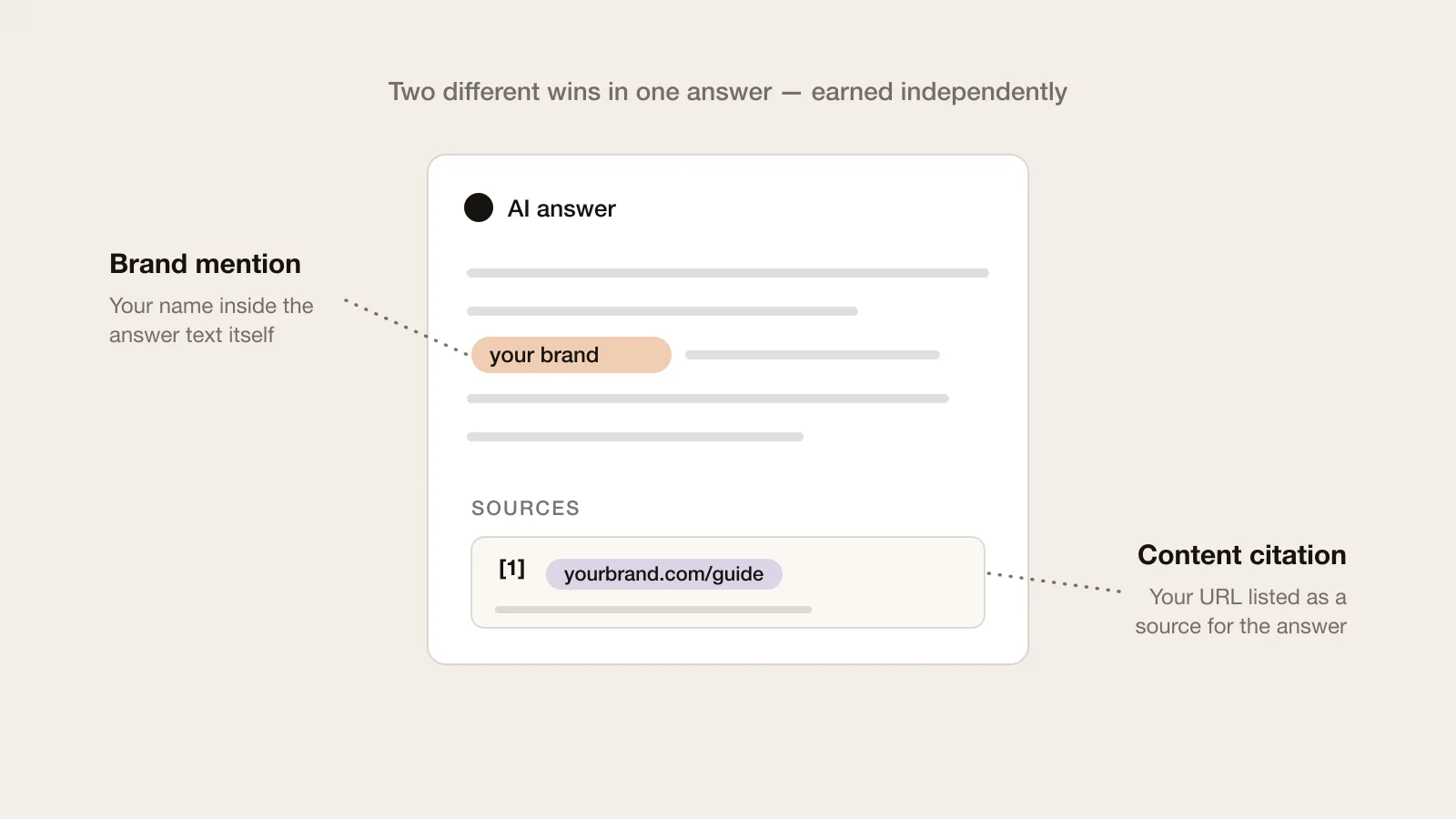
The distinction matters strategically because the two outcomes have different root causes. Brand mentions are typically driven by brand salience and entity confidence-how consistently AI systems encounter your brand in connection with a category across training data, real-time retrieval results, third-party reviews, comparison articles, news coverage, and structured entity signals such as schema markup and business directories. The more consistently your brand appears as a legitimate answer to a category question, the more likely it is to be explicitly mentioned. A brand that is widely discussed in press, forums, and review sites accumulates brand mention visibility even without exceptional content.
Content citations are driven by answer quality and structural clarity - whether a specific page provided the clearest, most retrievable answer to a query at the moment of retrieval. A brand with no name recognition but one unusually well-structured article can earn content citations while never earning a single brand mention.
Most teams measure only brand mentions, because these are the intuitive, visible metric. This means they miss the content citation channel entirely - which means they miss the signal that tells them which specific pages are actually being used by AI engines, independent of brand recognition. Complete AEO measurement requires tracking both.
Where They Align - Why This Matters for Strategy
Both SEO and AEO reward quality, expertise, authority, and technical health - meaning every investment your team has made in SEO transfers directly to AEO. Page speed, crawlability, strong backlink profiles, E-E-A-T signals, structured content - none of that work is wasted. These are shared inputs that improve performance in both channels simultaneously.
Brands with existing SEO investment have a useful head start - their pages are indexed, trusted, and known to crawlers. But new domains and startups are not locked out of AEO. A newly launched company that publishes an unusually clear, well-structured answer to a niche question can earn AI citations before it ranks for anything. AI engines have cited blog posts published days earlier, Reddit threads from unknown accounts, and documentation pages from companies with near-zero domain authority - because the answer was the clearest available for that specific query.
The compounding effect remains real and significant. SEO investment that builds domain authority increases the likelihood of AI citation - more indexed pages, more trusted signals, more retrieval candidates. But this is a probability improvement, not a binary gate. AEO investment and SEO investment reinforce each other at every level; they are not sequential dependencies.
Where They Diverge - Where Most Teams Go Wrong
SEO rewards keyword coverage and click-through optimisation. AEO rewards structural clarity and citation-readiness. The divergence is in what you optimise within a piece of content - not whether you create it. A 2,000-word guide on project management software might rank well for its target keyword while completely failing in AEO because the direct answer to the most important question is buried in paragraph 14.
A page ranking number 2 with a buried answer will lose AI citations to a page ranking number 5 with a clear first-paragraph answer. AI retrieval engines - particularly Perplexity and Google AI Overviews - scan retrieved pages rapidly and extract the most directly stated answer. Position in search results often influences whether the page enters the retrieval candidate set; answer structure determines whether it gets cited. Both matter. Neither is sufficient alone.
Two failure modes appear repeatedly in teams navigating this shift. The first is abandoning SEO entirely to chase AI citations - teams that deprioritise link building, technical maintenance, and keyword strategy in favour of 'AEO content' find they lose long-term compounding in both channels simultaneously. The second is treating AEO as a separate campaign - a quarterly initiative, a set of designated 'AI-optimised' pages - and missing the compounding effect of systematic integration. AEO is not a campaign. It is an upgrade to how every piece of content is structured.
When to Prioritise SEO
The clearest decision rule is a funnel-stage test. At the transaction and navigation layer - booking a hotel, purchasing a product, finding a specific brand's website, calling a local service - SEO remains the dominant channel. These actions require a destination. AI answers do not make the booking, initiate the checkout, or direct users to a physical location. The click is the point, and the pathway to that click runs through search ranking.
It is tempting to assume that commercial intent queries belong exclusively to SEO. This was accurate five years ago; it is no longer the full picture. Queries like 'best CRM for small teams', 'best accounting software for freelancers', 'best project management tools under $50 per month', and 'best laptop under $1,000' carry strong purchase intent - but AI engines increasingly answer them. Users turn to ChatGPT or Perplexity to build a shortlist before they comparison-shop or purchase. The final transaction action may happen via search; the shortlist creation increasingly does not. Treating all commercial intent as SEO territory misreads where discovery and consideration now happen.
Prioritise SEO most heavily when: the user goal requires a specific site visit to complete (purchase, booking, form fill, navigation); the category is dominated by local or service-area intent; or the brand is building long-term organic traffic moats in highly competitive keyword spaces where ranking defensibility matters. SEO's compounding nature - rankings that, once won, defend themselves - makes it the right long-term infrastructure investment regardless of category.
When to Prioritise AEO Investment
Informational and educational content is where AI is displacing clicks fastest. 'What is a good credit score?', 'how does two-factor authentication work?', 'what should I look for in a project management tool?' - these queries increasingly resolve in AI answers without a click. If your content strategy is built on ranking for informational queries, you are already losing traffic to AI, and the trajectory will not reverse.
Category and query structure matter more than domain authority as the entry criterion for AEO. Brands in low-competition categories - new software verticals, niche B2B tools, emerging service categories - regularly find that well-structured, directly-answered content earns AI citations early, before meaningful domain authority accumulates, simply because the existing content landscape for those queries is weak. The bar for citation is not an absolute authority threshold; it is the quality of the best available answer to that specific question. Weaker categories raise your probability of citation even with a new domain.
SaaS, fintech, health, and education are categories where AI comparison and recommendation queries are already dominant. 'Best CRM for small teams', 'how does a health savings account work', 'top accounting software for freelancers', 'best project management tools for remote teams', 'best protein powder for weight loss' - these are high-purchase-intent queries increasingly resolved in AI answers. If your category is defined by comparison and evaluation content, AEO is not optional. It is where consideration happens.
The queries that signal AEO priority follow a consistent pattern: 'what is X', 'how does Y work', 'best Z for W use case', 'X vs Y comparison'. These are the prompt types AI engines handle most confidently and where they have most aggressively captured informational and early-consideration intent. Invest in these query types regardless of your domain's age or authority level.
Timeline: Why AEO Is the Right First Move for Startups
SEO's central challenge for new companies is not execution - it is time. Domain authority compounds slowly. Backlinks take months to accumulate and signal trust. Content takes time to index, age, and rank. The typical SEO timeline from first investment to meaningful organic traffic runs 6 to 18 months, often longer in competitive categories. For a startup trying to generate awareness and inbound leads in its first year, SEO is frequently the wrong first channel - not because it is unimportant, but because the payoff arrives too late to fuel early growth.
AEO operates on a different clock. Real-time retrieval engines like Perplexity and Google AI Overviews retrieve from the live web - a page published yesterday can be retrieved and cited today if it answers a query more clearly than anything else available. There is no authority accumulation requirement for retrieval; there is only answer quality and structural clarity. Feedback loops are fast: teams see citation changes within weeks of publishing or restructuring content, compared to months of waiting for SEO rankings to move.
Three scenarios where startups consistently earn early AEO citations before their SEO matures:
Niche or emerging categories
If your product category is new or sparsely covered, the bar for citation is exceptionally low - the competition for that answer space simply does not exist yet. A cybersecurity startup focused on a new threat vector, a SaaS company in a nascent vertical, or a fintech product addressing an underserved use case can publish authoritative content on their specific niche and earn citations from day one. Paprik itself - as an AEO platform - can earn citations for 'how to track AI search visibility' before any major SEO publication has covered the topic in depth, simply because the question is recent and the available answers are thin. The correct move is not to wait; it is to own that answer space immediately.
Unique proprietary data or insights
AI engines cite sources that contain information unavailable elsewhere. A startup that publishes original research - a usage study, a benchmark report, a dataset derived from its own product - creates a citation signal that domain authority cannot replicate. When a user asks Perplexity 'what percentage of AI chatbot responses include brand mentions?', the source with the actual study gets cited; the high-authority publication without the data does not. Proprietary data is the single fastest path to citations for a new company, because it gives AI engines no alternative.
Highly specific technical or how-to content
Niche technical questions - how to configure a specific integration, how to implement a particular API pattern, how to solve a narrowly defined operational problem - are answered poorly by generalist publications. A startup publishing a definitive, step-by-step answer to a specific question it understands better than anyone can own that citation territory before any established player notices the opportunity. Stack Overflow threads, GitHub documentation, and niche SaaS knowledge bases earn AI citations at rates that vastly exceed their domain authority - because their answers are specific, accurate, and unavailable at the same quality elsewhere.
The strategic implication: a new company should not wait for SEO to mature before investing in AEO. Publish clear, direct answers to the questions your buyers are asking AI engines about your category - in month one, not month twelve. The citations earned before domain authority builds are not wasted; they compound alongside SEO over time and deliver awareness in the channel your buyers are increasingly using for discovery.
AEO is the right first channel for startups. SEO is the right long-term compounding moat. The correct sequence: launch AEO content immediately on day one; build SEO infrastructure in parallel; let both compound together over 12 to 18 months.
The Unified 12-Month Roadmap
Running SEO and AEO simultaneously requires a phased integration, not two separate workstreams. The four phases below build on each other - each creates the conditions for the next. The emphasis shifts across phases, but both disciplines are active from month one.
Months 1–3: Foundation
Technical SEO audit and remediation - crawlability, indexation, Core Web Vitals, mobile performance. Entity setup - Wikipedia (where eligible), Wikidata entries, Google Knowledge Panel claim, schema.org Organisation markup. Keyword architecture - map existing content against target queries, identify AEO-ready informational content that could be retrofitted, flag new content needs. For startups and new domains, this phase is also where the first AEO-targeted content should launch - direct-answer pieces targeting low-competition niche queries where early citations are achievable regardless of domain authority.
Months 4–6: Structural Optimisation
Retrofit direct answers to the top 20 highest-traffic informational pages - add a Quick Answer paragraph in the opening, restructure content to answer the primary question in under 50 words before expanding. Implement FAQ schema, Article schema, and HowTo schema across all eligible pages. Build author credentialing - author bio pages with demonstrated expertise signals, author schema markup, byline consistency across all published content. This phase is where citation gains typically accelerate across the existing content base.
Months 7–9: Citation Targeting
Create targeted content for the 20 to 30 queries your audience is most likely to ask AI engines about your category. Each piece is built around a specific question, with a direct answer in the first paragraph, FAQ schema, and clear E-E-A-T signals. Expand entity signals through earned media - press coverage, analyst relationships, industry directory listings, guest bylines in authoritative publications. This is the phase where proactive brand-building in the training data corpus begins.
Months 10–12: Measurement and Iteration
Establish an AI share of voice baseline - run your core 30 to 50 queries across ChatGPT, Perplexity, and Google AI Overviews monthly and record citation rates for your brand and key competitors. Track citation frequency over time as the primary AEO KPI. Review which content investments produced citation gains and scale those patterns. Review which competitors are gaining share and audit the source infrastructure driving their citations. The brands that systematise measurement in this phase outperform those that optimise by instinct.
The governing principle across all four phases: every SEO improvement that builds authority and clarity also improves AEO probability. The two workstreams share infrastructure - they are not in competition for budget.
How to Measure Each
SEO measurement is mature and well-tooled. Track keyword rankings, organic click-through rate, session traffic from organic search, domain rating, and referring domain count. These metrics have clear benchmarks, established tools, and reliable historical data for comparison. The measurement problem in SEO is not what to measure - it is execution.
AEO measurement splits into two distinct tracks that require separate instrumentation. Brand mention tracking asks: how often does our brand name appear in AI answers across our target queries? This is measured by running queries across engines, recording which brand names appear in the generated text, and calculating share of voice - your brand's appearances as a percentage of all brand mentions for those queries. It is the AEO equivalent of keyword ranking: it tells you where you stand in the competitive landscape for a given category. The full method - metrics, a manual baseline and run cadence - is in how to track AI visibility.
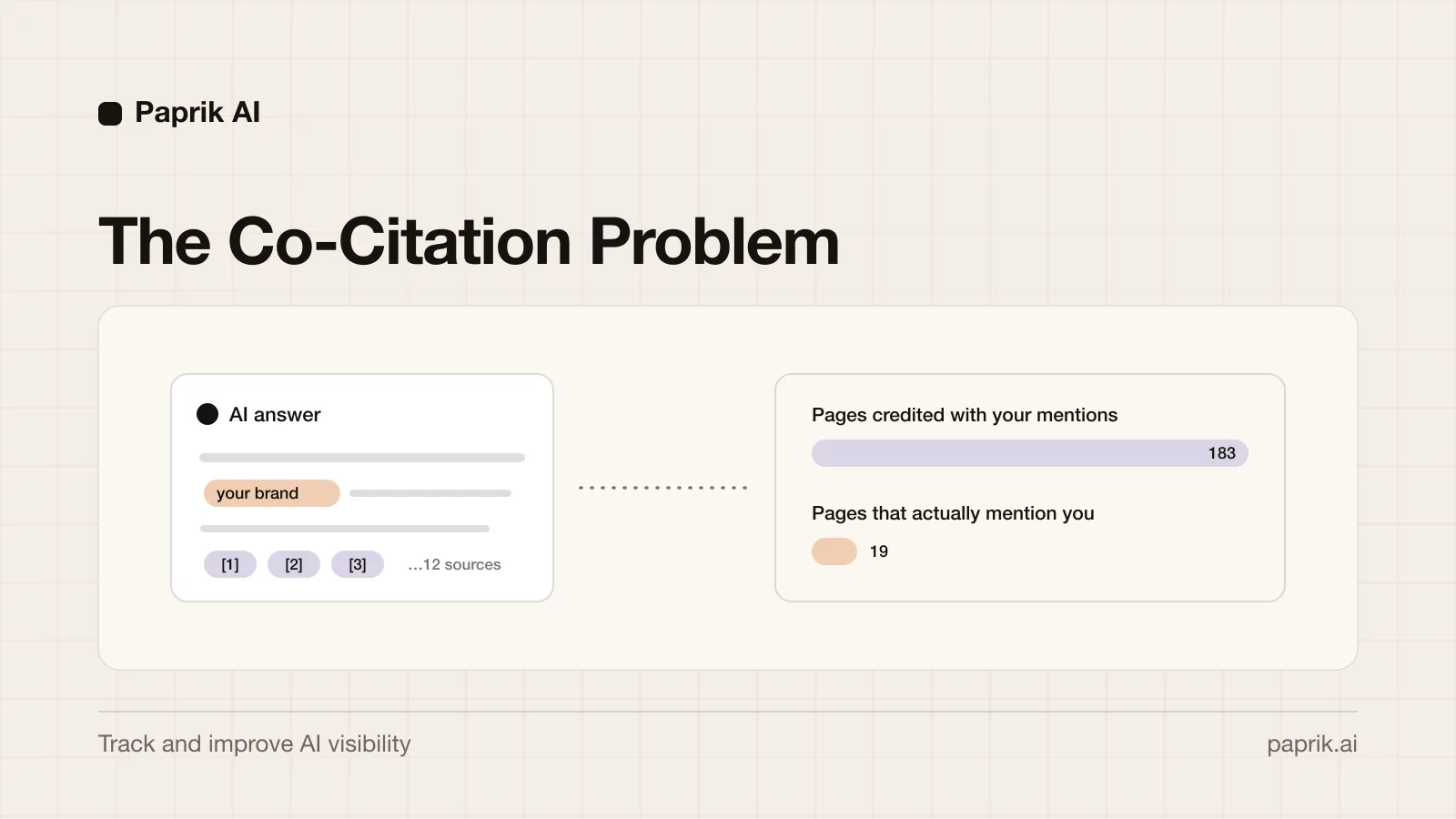
Content citation tracking asks a different question: which of our URLs are being retrieved and listed as sources by AI engines? A brand can have strong mention visibility but weak content citation rates (widely known brand, content that isn't retrieved because it is poorly structured or not indexed). A brand can have strong content citation rates and low mention visibility (useful content, brand not yet recognised as a category authority). Both gaps require different fixes. Treating them as one metric hides which problem you actually have.
Perplexity referral traffic in Google Analytics 4 provides the only direct traffic signal from AI-native retrieval - a proxy for content citation volume. The measurement gap across both tracks is significant: mature SEO tools have existed for over a decade, while AEO measurement at scale requires dedicated tooling. Paprik automates daily tracking of both brand mentions and content citations across ChatGPT, Google AI Overviews, and Perplexity, with competitor benchmarking built in. Start your 7-day free trial at paprik.ai - no credit card required.