How Google AI Overviews Choose Citations
Most pages cited in AI Overviews don't rank in the top 10 for the query. How the two-step selection actually works, and how to earn the citation.
Author
Founder
Abhilash is the Founder of Paprik AI. He writes about AEO, AI search visibility, and how brands can win in AI-driven discovery.
Google AI Overviews - the AI-generated summaries appearing above traditional search results - look like a new surface with its own rules. The reality is more nuanced than early assumptions suggested. AI Overviews are built on top of Google's search infrastructure, but they do not simply promote the top-ranked result. Research across millions of AI Overview citations shows that the majority of cited pages do not rank in the top 10 for the original query - they are discovered through related sub-queries, or rank further down organic results. Understanding this changes where you should focus your effort.
The Two-Step Selection Process
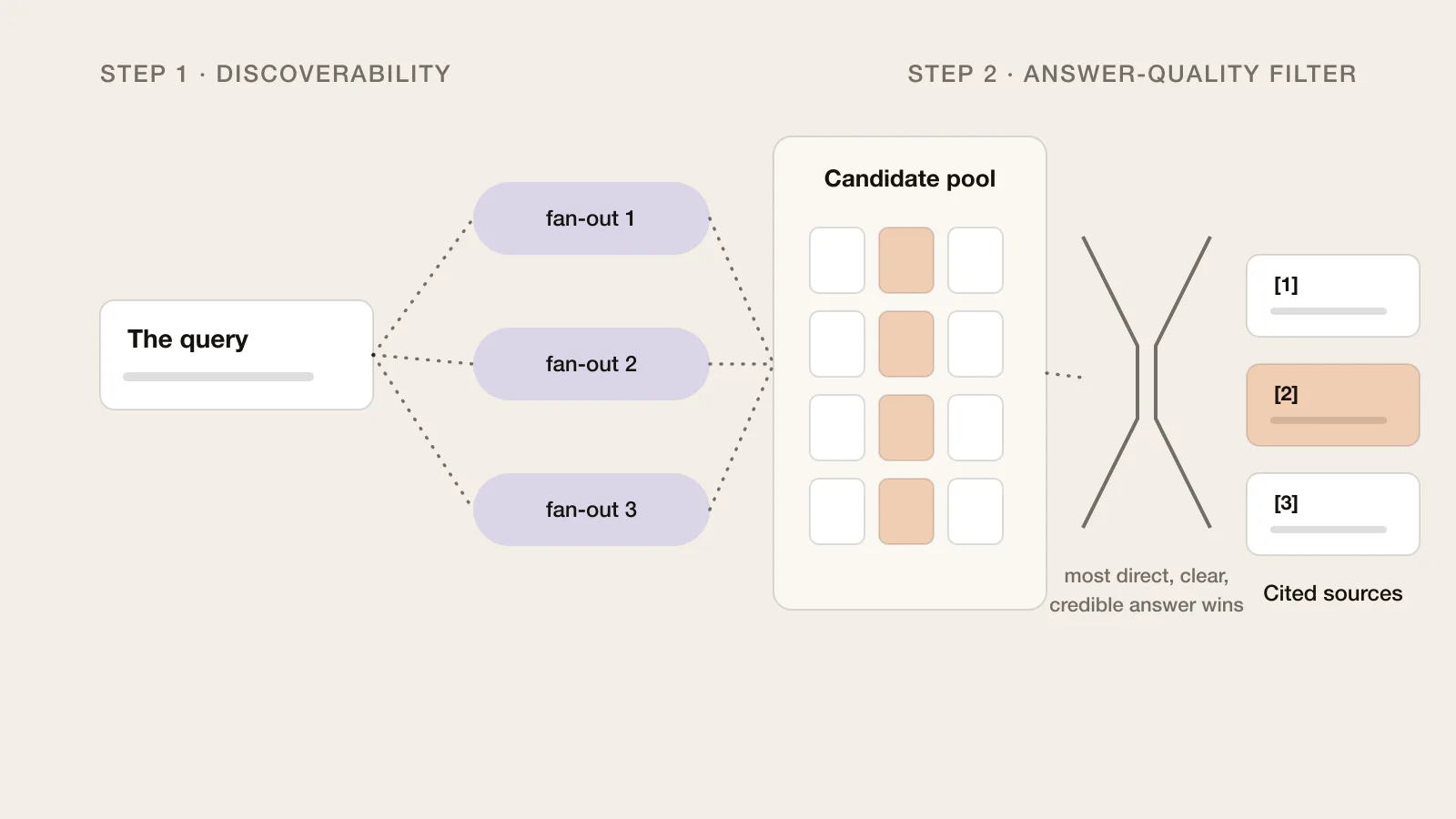
Step 1 - Discoverability: The Query and Its Fan-Outs
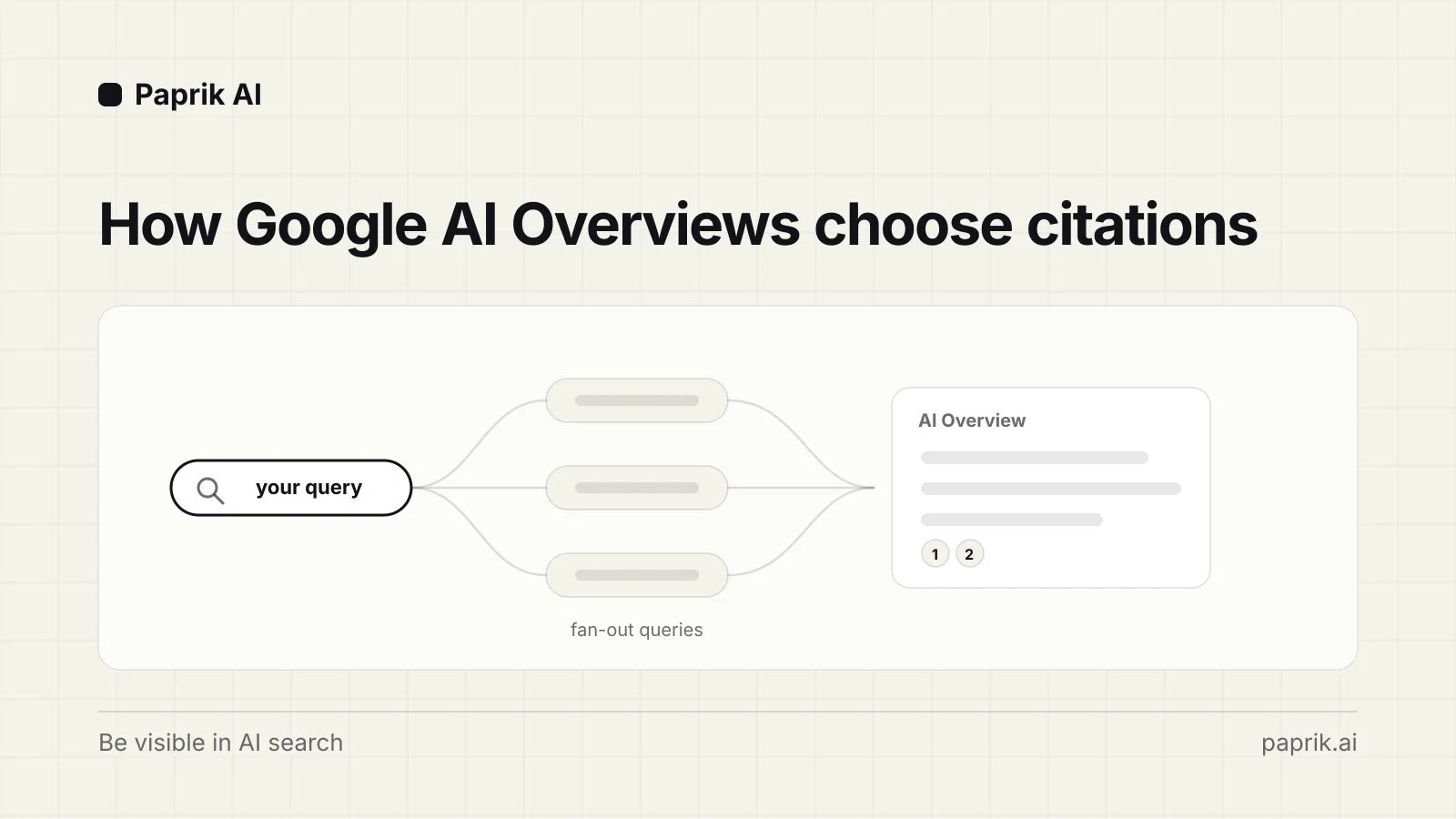
When an AI Overview is triggered, Google does not simply look at the top 10 results for the original query. Google has officially confirmed that it uses a "query fan-out" technique - the original search is automatically expanded into multiple related sub-queries, and the sources that rank across those sub-query SERPs become the candidate pool. This fundamentally changes what it means to compete for AIO citations.
The data makes this clear. An Ahrefs analysis of 4 million AI Overview URLs (March 2026) found that only 38% of cited pages rank in the top 10 for the original query - down from 76% in July 2025 as Google has leaned more heavily into fan-out retrieval. The remaining citations are split between pages ranking in positions 11–100 (31%) and pages that don't rank in the top 100 for the original query at all (31%). Surfer SEO's independent analysis found that 67.82% of cited pages don't rank in the top 10 for either the original query or its fan-out queries - though this figure reflects the difficulty of perfectly replicating Google's internal fan-out logic.
Traditional SEO signals - backlinks, domain authority, topical relevance, technical health, crawlability - all improve the odds of being discovered across the main query and its fan-outs. They are not irrelevant. But they are probability-raising inputs, not hard gates. Google cites pages it finds relevant and useful across the expanded query landscape, not only pages it has already promoted to the top of organic results.
Step 2 - The Answer Quality Filter
From within the ranked candidate pool, the AI model selects the source that answers the question most directly, clearly, and credibly. This is where AEO-specific optimization creates advantage over competitors who rank similarly but are less citation-ready. Two pages with equivalent ranking can have dramatically different AI Overview citation rates based on how well each one clears the answer quality filter.
Think of it as the difference between being invited to the room and being handed the microphone. Step one gets you into the room. Step two determines who speaks.
The Citation Checklist - What Gets You Selected From the Pool
Once you are in the ranking pool, these are the signals that determine citation selection. Every item is actionable without waiting for ranking improvements.
Direct answer in the first paragraph - not after three sentences of context-setting or introduction.
FAQ schema implemented and validated in Google's Rich Results Test.
Article schema with visible author name, credentials, and publication date.
Author bio page with demonstrated expertise in the relevant topic area.
HowTo schema on instructional or step-by-step content.
Inbound links from authoritative third-party sources in your industry.
Each section answerable as a standalone paragraph without requiring surrounding context.
Content regularly updated with visible revision dates - not just original publication dates.
Clean semantic HTML; page loads under 2 seconds.
No paywalls or login walls on content you want cited.
YouTube: Ahrefs data (March 2026) identifies YouTube as the most cited domain in AI Overviews, accounting for 5.6% of all citations and growing 34% in six months. YouTube mentions - in titles, transcripts, and video descriptions - are the strongest single correlating factor with AI Overview visibility across brands studied. If you produce video content, optimise titles and transcripts for the same direct-answer principles that apply to written pages.
E-E-A-T and AI Overviews - More Decisive Than Ever
E-E-A-T - Experience, Expertise, Authoritativeness, Trustworthiness - has always mattered for Google rankings. For AI Overview citation specifically, it is even more decisive. AI Overviews are selecting sources to be quoted and attributed by name. The credibility bar is higher than it is for organic ranking alone.
Experience:
First-person demonstration that the author has actually performed the task or holds the relevant direct experience. "I tested this across 12 client accounts over 6 months" outperforms "experts recommend." For AI Overview selection, experience signals that can be demonstrated in the content itself carry additional weight.
Expertise:
Credentials, institutional affiliations, published work, and demonstrated domain depth. An author bio page that establishes why this person is qualified to write about the topic is not decoration - it is a citation signal. Credential-thin or anonymous content covering the same topic is systematically disadvantaged.
Authoritativeness:
How often is this author or domain cited by other authoritative sources? Third-party coverage in industry publications, links from recognized institutions, and consistent citation by domain experts all contribute. This is where off-page authority and AEO overlap most directly.
Trustworthiness:
Accurate claims with attributable sources. No misleading framing. Correct information on verifiable facts. Content that misrepresents or overstates will be excluded even if it ranks.
The tactical implication: bylines matter. Author bio pages matter. First-person experience signals matter more in AEO than in traditional SEO. Anonymous or credential-thin pages that rank may rank for some time - but they are unlikely to be cited in AI Overviews where Google is choosing who to quote.
Diagnosing Why You Are Not Getting Cited
Given that most AI Overview citations come from pages that don't rank #1 - or don't rank in the top 10 at all - the diagnostic splits into two separate problems. If you rank for the query but aren't cited, you have a step-two problem: answer quality. If you don't rank for the query but want to appear, the question is whether you rank for any of its fan-out sub-questions - and whether those pages answer those sub-questions directly. Both problems are addressable.
Check: Is your answer in the first paragraph?
The most common failure mode. Strong, accurate content buried after a long introduction. Read the first 100 words of your page against the query it ranks for. Does it answer the question directly? If the answer is in paragraph four, rewrite the opening section.
Check: Do you have FAQ schema, and is it valid?
Run your URL through Google's Rich Results Test. FAQ schema errors - malformed markup, missing required properties - mean Google cannot reliably parse the structured data even if the content is there. Fix validation errors before any other schema work.
Check: Is authorship clear?
Is there a visible byline? Does it link to an author bio page? Does the bio page establish why this author is qualified to write about this specific topic? An author name without a bio page or credentials is a weak signal. A credentialed author with a linked bio is a strong one.
Check: Are your paragraphs extractable?
Read each paragraph in complete isolation from the rest of the page. Does it make a complete, useful point on its own? AI Overview selection systems extract paragraphs - not pages. If a paragraph requires surrounding context to make sense, it will not be selected. Rewrite paragraphs that depend on what came before them.
Check: For instructional queries, is HowTo schema implemented?
Queries asking "how to" or "how do I" that trigger step-by-step AI Overviews specifically favor pages with HowTo schema. If your instructional content lacks it, you are competing without using an available advantage.
Run the structural comparison:
Search your target query in Google. Note which source gets cited in the AI Overview. Open that page and yours side by side. Compare: where does their answer appear? What schema do they have? Who is the author? What does their first paragraph look like? The gap between their page and yours is your priority action list.
How to Monitor Your AI Overview Appearances
Google Search Console does not yet have a dedicated AI Overview report. However, performance data showing impressions with very low CTR on queries where you rank in the top 3 can indicate AI Overview presence - the Overview is answering the query before users reach your organic result.
Manual monitoring: run your 20 most important queries weekly in Google. Look for the AI Overview label above organic results. Record which sources are cited for each query. Track changes over time as you implement content improvements.
Important: AI Overview appearances are not consistent. The same query can trigger different cited sources on different days, as content freshness, recent crawls, and rolling model updates all affect selection. Monitoring needs to be ongoing, not a single snapshot.
Paprik tracks AI Overview citation appearances daily across your target query set - flagging when competitors gain or lose citations and identifying which content changes coincide with citation shifts. Manual monitoring is viable at small query volumes; at scale, daily automated tracking is more reliable.
Citation rate tracking: for each target query, record what percentage of weekly monitoring runs your brand appears in the AI Overview. A 40% citation rate means you were cited in 2 of 5 checks. Trend this over time. Upward movement after a content change confirms the change worked.
How the other engines pick sources: how ChatGPT surfaces and mentions brands and how Perplexity ranks and cites sources.