How Perplexity AI Ranks and Cites Sources: The Complete Guide
Perplexity searches the web on every query and rewards the most direct answer. What its selection logic favours, and the technical bar for being cited.
Author
Founder
Abhilash is the Founder of Paprik AI. He writes about AEO, AI search visibility, and how brands can win in AI-driven discovery.
How Perplexity's Real-Time Retrieval Works
Perplexity performs a live web search (using both its own web crawler as well as third party search engines) with every single query.
This makes Perplexity far more responsive to new content than training-based models. Publish something authoritative today and it can surface in Perplexity answers within days of being crawled and indexed.
But real-time does not mean open access. Ranking in web search remains a prerequisite. Perplexity cannot cite a page it cannot retrieve, and pages do not get retrieved if they do not rank. The responsiveness of Perplexity's retrieval does not remove the requirement for a strong SEO foundation - it compresses the timeline between investment and result.
What Perplexity Actually Selects For
Perplexity does not favour the most authoritative source in a general sense. It favours the source that gives the most direct, precise answer to the specific question being asked. Those are not the same thing, and the distinction matters for how you write.
A well-known publication that hedges its claims, buries its answer in three paragraphs of context-setting, and writes in roundabout academic prose will lose to a lesser-known source that answers directly, uses clear language, and makes the key information easy to locate in the first paragraph. The source's general reputation still matters - but directness is a decisive tiebreaker.
Being authoritative is necessary but not sufficient. Perplexity's selection logic is looking for the fastest path to a precise, accurate answer. Content that makes that path long and complicated is penalised in practice, regardless of the domain's standing.
Writing style is a ranking factor. Hedged, heavily qualified prose that reads well for academic audiences is actively disadvantaged in Perplexity's selection logic. Direct, factual, declarative language - the kind that commits to a position and backs it with specific evidence - is consistently rewarded.
The Three Visibility Layers
Visibility in Perplexity is determined by three distinct signal layers. Strength in one layer cannot fully compensate for weakness in another. All three are required.
Content Quality
Content quality is the primary selection signal - the factor that determines whether your page answers the question well enough to be chosen from the candidate set.
Direct answers in the first paragraph. If the answer to the question appears in paragraph four, Perplexity may move on before reaching it. The first paragraph does a disproportionate share of the selection work.
Factual precision: specific statistics, named examples, and declarative claims. Vague, hedged statements are deprioritised across every major AI engine.
Clear section headers that accurately describe what each part covers. Structural markers help Perplexity locate the relevant section within a longer page.
Standalone paragraphs - each one answering a sub-question completely, without requiring the surrounding paragraphs for context. Perplexity frequently extracts a single paragraph as a citation; that paragraph needs to work on its own.
Technical Accessibility
Technical signals determine whether Perplexity can retrieve and parse your content at all. A page with excellent content that fails on technical accessibility is invisible.
All key content must be accessible without JavaScript rendering. If a page requires client-side execution to display its text, Perplexity sees an empty page. Server-side rendering or static HTML is required.
Page load time. Fast-loading pages are processed more reliably. Pages that time out or load slowly may be skipped in favour of faster alternatives in the candidate set.
No paywalls or login walls. Perplexity cannot retrieve content behind subscription gates or authentication requirements.
Clean, semantic HTML. Well-structured markup improves parsing accuracy and reduces the likelihood of content being misread or missed.
PerplexityBot must be explicitly allowed in robots.txt, or at minimum not explicitly blocked.
Domain Authority
Domain authority and backlink quality can improve your chances of being cited in Perplexity because they act as trust signals-but they are not hard gating factors the way many SEOs assume.
A strong domain may be more likely to enter Perplexity’s retrieval pool, especially for competitive commercial queries, but authority alone does not guarantee citation. Perplexity often prioritizes pages that answer the query more directly, provide fresher information, or are easier to extract-even when those pages come from smaller websites.
High-authority domains can still lose citations if their content is generic, bloated, or poorly structured.
Lower-authority domains can still earn citations when they provide highly specific, well-structured answers for niche queries.
Authority appears to matter more for broad, competitive topics than for long-tail informational searches.
In Perplexity, trust helps-but relevance and answer quality often matter more than raw domain strength.
Writing Style as a Ranking Factor - Perplexity's Unique Characteristic
Writing style is worth calling out separately because it operates differently in Perplexity's selection logic than in traditional search or other AI engines. The distinction has direct, actionable implications for how you edit content.
Perplexity's user base is research-oriented. They arrive with a specific question and want a precise, citable answer - not an engaging narrative, not a conversational tone designed for scanning, and not an academic hedging of claims. The engine's selection reflects this. It is pattern-matching for content that would satisfy a researcher, not a general reader.
Academic-style hedging - "it may potentially be argued that," "some evidence suggests," "research indicates this could" - is actively penalised in Perplexity's selection logic. These phrases signal epistemic caution to a human reader, but they signal imprecision to Perplexity's retrieval system. A source that hedges looks less reliable than a source that commits to a specific, evidenced claim.
Direct, factual, declarative writing is rewarded. "X increases Y by Z%" beats "some studies suggest X may have positive effects." Named examples beat vague categories. Specific numbers beat ranges. Committed positions backed by evidence beat careful qualifications.
The Citation Visibility Advantage
Perplexity was one of the earliest AI engines to make citations highly visible, and it still remains one of the most citation-forward interfaces today. While ChatGPT, Google AI Overviews and Gemini now surface sources more frequently than they did earlier, Perplexity continues to make citations a central part of the user experience. Sources are typically displayed prominently alongside responses, making it easy for users to see where information came from and click through to the original page.
That matters because visibility drives behavior. When your content is cited in Perplexity, users can directly associate your brand with the answer they just received. They can click through immediately, verify the source, and continue their research on your website.
In some other AI interfaces, citations may still be less prominent, appear only in certain response types, or require additional clicks to view source attribution. Perplexity tends to make that attribution more consistently visible.
For brands, this makes Perplexity citations valuable not just for referral traffic, but for brand credibility. Your brand appears at the exact moment a user is consuming information and evaluating sources. That visibility can meaningfully influence trust and consideration.
Technical Requirements Checklist
The following technical conditions must be met for a page to be eligible for Perplexity citation. These are not optimisation suggestions - they are baseline requirements. Failing any one of them effectively removes the page from consideration.
PerplexityBot listed as allowed in robots.txt (or not explicitly blocked)
All key content visible without JavaScript execution - server-side rendered or static HTML
Page loads under 2.5 seconds from a clean request
No login wall or paywall on cited content
Clean semantic HTML structure throughout
Published and last-updated dates visible on the page
Author attribution visible - byline with name and credentials
Direct answer in the first paragraph of each section
FAQ schema implemented where applicable
Mobile-responsive layout
How to Track Your Perplexity Citations
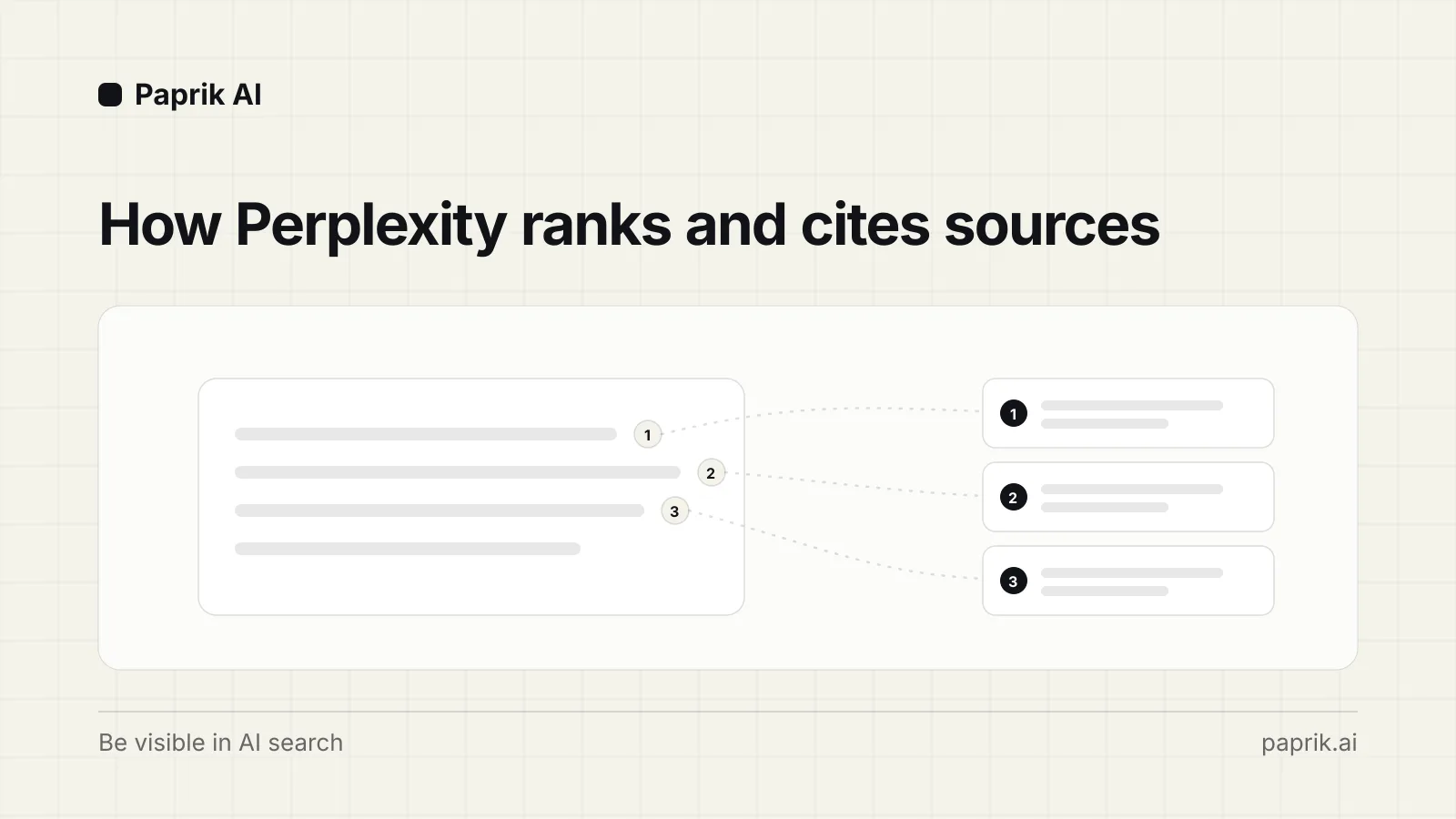
Perplexity is the most trackable AI engine for referral traffic. Because its citations are numbered and clickable, users who follow a citation link generate a measurable referral visit - making Perplexity citation performance visible in standard analytics.
In Google Analytics 4, add perplexity.ai as a referral source segment and track volume on a monthly basis. A rising referral line from Perplexity is a direct signal that citation frequency is increasing. A flat or declining line, despite stable content output, signals a citation gap worth investigating.
Manual monitoring requires running your twenty most important queries in Perplexity on a weekly basis and recording which sources are cited. When your site appears, note the specific page and paragraph cited. When it does not appear, identify which competitor is cited in your place and examine that page's structure, first-paragraph answer quality, and technical setup.
Competitor monitoring is particularly valuable. When a competitor appears in a Perplexity answer where you are absent, the cited page is showing you exactly what Perplexity's selection logic rewarded. Reverse-engineer it: what does the first paragraph do that yours does not? Is the structure cleaner? Is the answer more specific? Is there a technical advantage?
Automated tracking at scale - across your full query set, with competitor benchmarking and trend analysis - requires tooling. Paprik monitors Perplexity citations daily across your target query set, tracks competitor citation rates alongside yours, and identifies the content gaps driving the difference.
Frequently asked questions
How is Perplexity different from ChatGPT for brand visibility?+
Perplexity relies more consistently on live web search and prominently displays citations in most responses, so new content improvements can impact visibility relatively quickly. ChatGPT now also uses live web retrieval and shows citations more often than before, but this varies by query and response type. As a result, Perplexity visibility tends to be more predictable, while ChatGPT visibility is less consistent.
Does Perplexity use Google's search index?+
Perplexity uses multiple web indexes, including Bing and its own crawler - it is not dependent exclusively on Google's index. This means pages indexed by Bing but not yet prominently ranked in Google can still appear in Perplexity answers. It also means that Google-specific optimisation decisions do not automatically transfer to Perplexity; technical accessibility for PerplexityBot specifically is required.
Can any website get cited in Perplexity?+
In principle, yes, any publicly accessible page can be cited if it directly answers the query and is easy for Perplexity to access and extract. In practice, stronger domains may have an advantage for broad competitive topics, but smaller websites can still earn citations when they provide highly relevant, well-structured answers - especially for niche or long-tail queries. Relevance and answer quality usually matter more than domain size alone.
How often does Perplexity update its citations?+
With every query. Perplexity performs a fresh web search for each question, which means its citations are as current as the web's index at the moment of the query.
Why does writing style matter so much for Perplexity?+
Perplexity's selection algorithm favours precision and directness because its user base is research-oriented - they want citable facts, not narrative engagement. The model penalises hedged, over-qualified prose because it signals imprecision to the retrieval system. A source that commits to a specific, evidenced claim looks more reliable than a source that qualifies every statement. Many content writers use hedging to sound appropriately cautious, but in Perplexity's context it reduces citation likelihood.
Does Perplexity Pro work differently from the free version?+
Perplexity Pro offers more detailed answers, access to additional AI models, and a higher query limit. The underlying citation logic - which sources get selected - is the same across both tiers. The difference is in answer depth and user experience, not source selection methodology. Optimising for Perplexity citation in the free version produces the same results in Pro.
How important is schema markup for Perplexity?+
Schema markup is meaningful but secondary to content quality and technical accessibility. Perplexity's primary selection signal is whether a page directly answers the question being asked. Schema helps parsing accuracy and can improve how content is interpreted, but it does not compensate for buried answers, poor first-paragraph structure, or technical barriers to retrieval.
How do I find out if my site is being cited by Perplexity?+
Check Google Analytics 4 for referral traffic from perplexity.ai - this captures users who clicked through from a Perplexity citation link. For non-click visibility (your brand mentioned or quoted but not clicked), manual query monitoring or dedicated tools provide systematic tracking. Paprik monitors Perplexity citations daily across your full query set with competitor benchmarking, covering both the referral traffic signal and the broader citation presence.
Start your 7-day free trial at paprik.ai - no credit card required.