What is Answer Engine Optimization (AEO)? The Complete Guide
The complete guide to Answer Engine Optimization: how AI engines choose sources, how AEO differs from SEO, and the four layers of work that earn citations.
Author
Lead GTM
Cynthia J is part of the GTM team at Paprik AI with 2+ years of experience helping brands understand and improve their visibility across AI search platforms.
What is AEO?
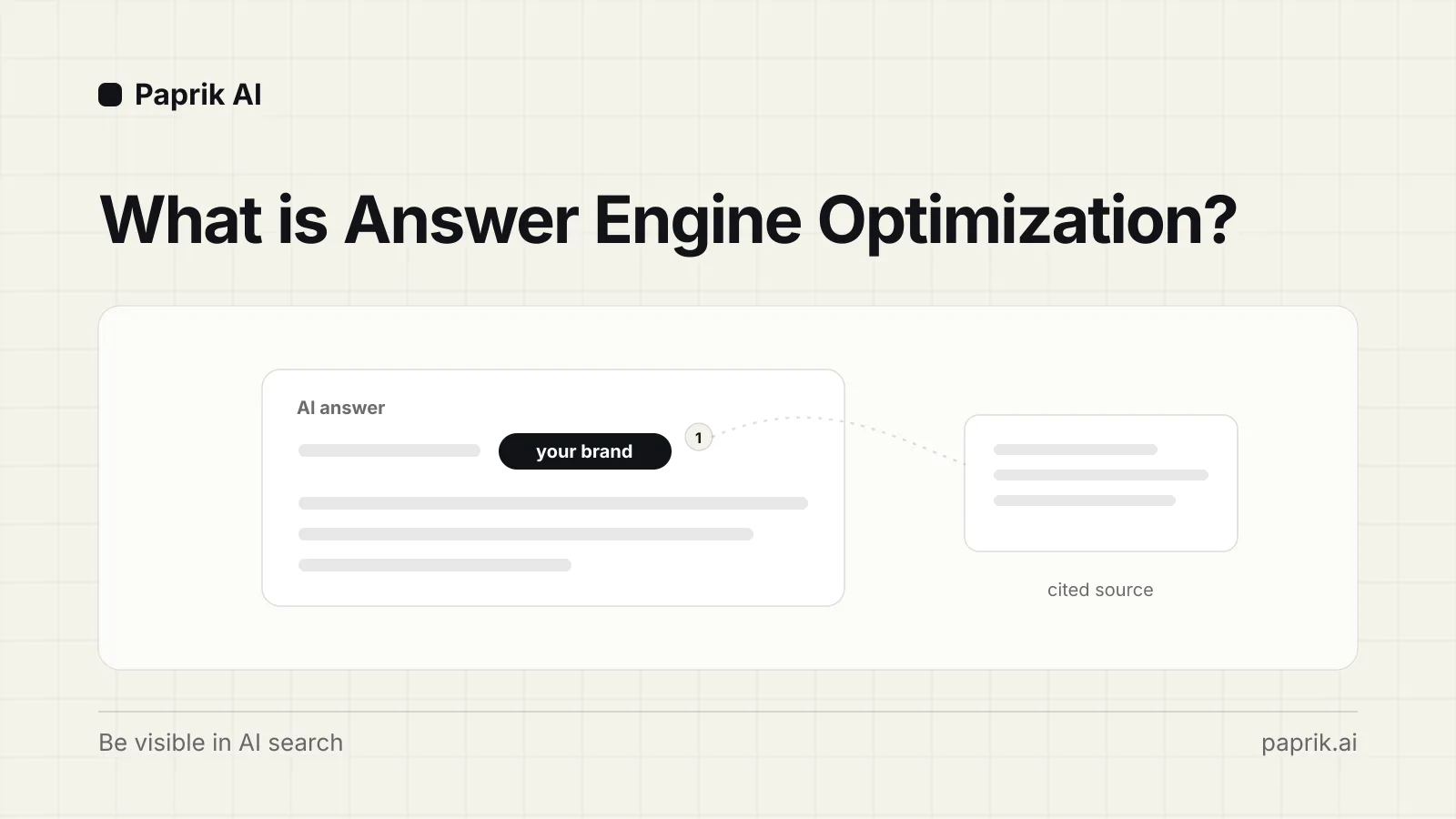
Answer Engine Optimization is the practice of structuring, formatting, and positioning content so that AI-powered answer engines cite or surface it in direct responses to user queries. Where SEO asks "can Google find and rank this page?", AEO asks "will an AI engine trust and cite this content when a user asks a relevant question?" The output is not a click - it is a citation, a brand mention, or a direct quote inside an AI-generated response.
The core shift: in SEO you compete for position. In AEO you compete for inclusion. There is no rank 1 through 10. There is cited or not cited. A brand absent from AI-generated answers is invisible to a growing proportion of users who never progress to a traditional search results page.
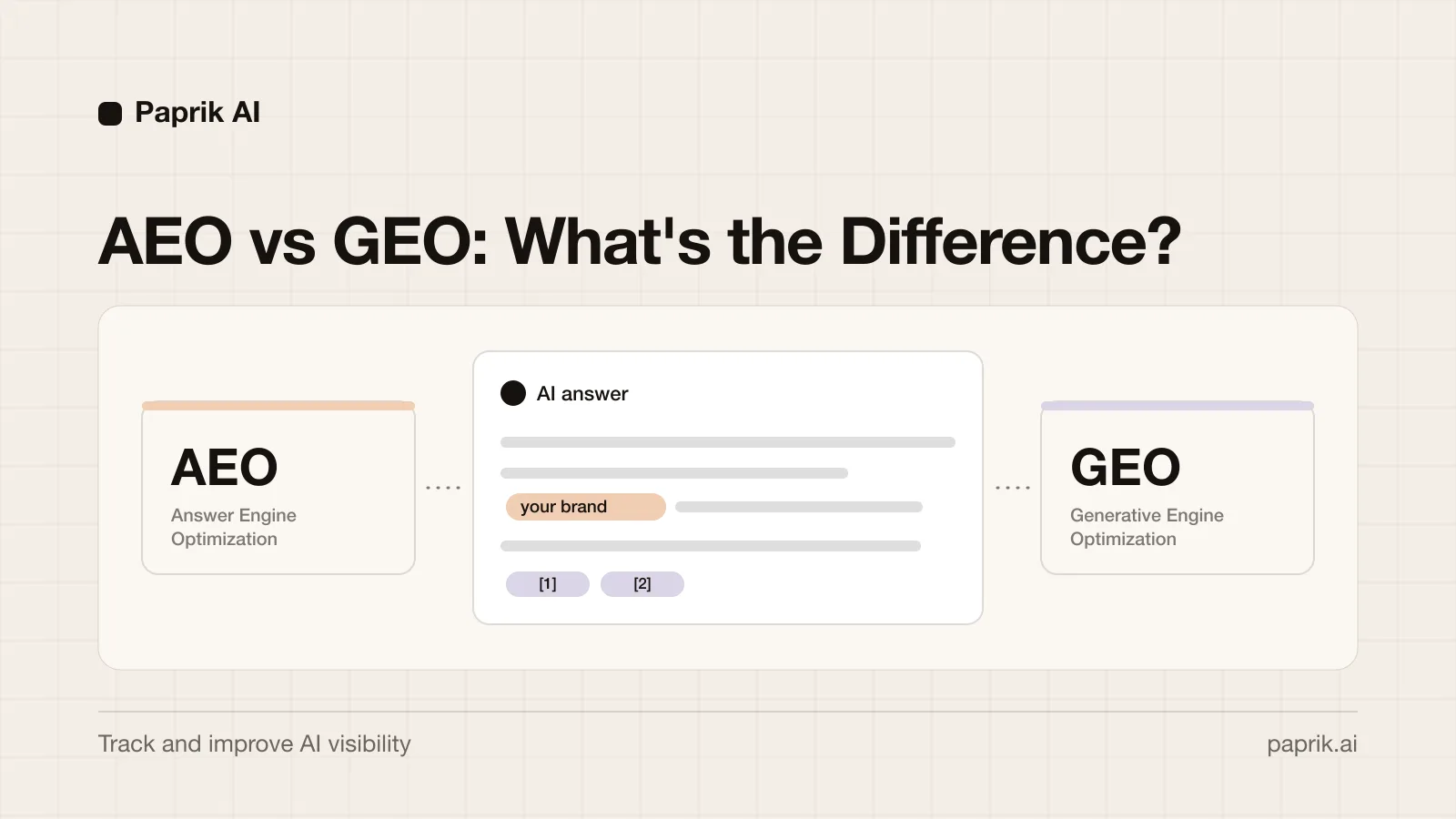
AEO also travels under a second name: Generative Engine Optimization (GEO), a term coined in a 2023 academic paper and adopted by part of the industry. Both names describe the same discipline, and everything in this guide applies under either - AEO vs GEO: What's the Difference? covers how the two terms relate.
The engines AEO applies to:
ChatGPT - the world's most widely used AI assistant. Draws primarily from training data encoded at model-training time; in browsing mode, adds a layer of real-time retrieval. Citation frequency is a function of how well your brand was represented in the pre-cutoff web.
Google AI Overviews - AI-generated summaries appearing above traditional search results, now triggered on the majority of informational queries. Built directly on Google's ranking infrastructure: only pages Google has already indexed and ranked enter the candidate pool.
Perplexity AI - a real-time retrieval engine that runs a live web search for every query and synthesizes answers from retrieved results. Shows users numbered, clickable citations - making brand mentions visible and actionable in a way other engines do not.
Microsoft Copilot - integrated into Bing and across Microsoft's product suite. Combines Bing's search index with generative AI. Traditional Bing ranking is a prerequisite for citation.
Claude - Anthropic's AI assistant, increasingly used for research and synthesis tasks. Draws on training data with optional real-time retrieval; rewards authority, directness, and entity consistency.
Why AEO Matters Now
ChatGPT reached 800 million weekly active users by early 2026. A significant share of those sessions are informational queries - product research, how-to questions, definitions, comparisons, recommendations - that previously would have gone to Google. Those users receive an answer without ever visiting a website. If your brand is not part of that answer, you are invisible to them.
Google AI Overviews now appear on the majority of informational searches. Publishers in health, finance, education, and technology have reported organic traffic drops of 20-60% on pages that still rank position one - the ranking held, but clicks moved to the AI-generated summary above it. This is not a temporary fluctuation; it is a structural reallocation of where answers live.
Perplexity AI processed over 100 million queries per day by late 2025. It has become the default research tool for knowledge workers and students who prefer synthesized, sourced answers over a list of links. Its visible citation model means brand mentions are user-facing endorsements, not invisible model outputs.
The underlying dynamic: AI engines have captured the informational layer of search. Transactional, local, and navigational queries still send users to websites. But awareness, education, and consideration - the top of every funnel - are increasingly mediated by AI. Brands invisible at that layer are removed from the decision-making process before users reach a stage where traditional search might find them. AEO is not optional for informational content.
How Answer Engines Choose Sources
Retrieval - Two Modes
Before an AI engine can cite a source, it first needs to find it. This typically happens through two different mechanisms depending on the engine.
Training-based retrieval (ChatGPT base model, Claude without browsing):
The model’s knowledge is encoded during training from a large corpus of web content up to a cutoff date. Brands that appear consistently across high-quality publications, Wikipedia, forums, review sites, and authoritative third-party sources become embedded in the model’s training data. Brands absent from that corpus are often invisible, regardless of how strong their current website is. Improving visibility here is slower and requires building durable digital presence through repeated third-party mentions and authoritative coverage that can influence future training cycles.
Real-time retrieval (Perplexity, ChatGPT browsing mode, Google AI Overviews):
The engine retrieves information live at query time. This often includes traditional search indexes, but increasingly extends beyond standard SERP rankings to sources like Reddit, product marketplaces, review platforms, documentation sites, UGC forums, proprietary datasets and API-connected sources. Ranking well in Google still improves your chances of being discovered, but it is no longer a strict prerequisite. What matters more is whether your content is easily retrievable, clearly structured, trusted and directly relevant to the user’s query. Because this happens in real time, improvements to content quality, structure and distribution can influence citation frequency relatively quickly once content is crawled and accessible.
Citation Selection - What Tips the Balance
Once candidate sources are retrieved, the AI model selects which to cite. Consistent signals favor citation across all major engines:
Directness: the answer is in the first paragraph, not buried in preamble. AI systems pattern-match for the most efficient path to an answer. Competitors whose answers surface earlier in the page win citations over content with equally strong arguments buried deeper.
Structural clarity: clear H2/H3 headings, logical section breaks, numbered lists for steps, tables for comparisons. Dense narrative prose without structural markers performs poorly across every major engine.
Factual specificity: declarative, data-backed claims beat hedged generalities. "Studies show X may potentially have some effect" loses to "X increases Y by Z% according to [source]." AI engines optimize for confidence and precision.
Authority signals: domain authority, inbound link quality, E-E-A-T signals (Experience, Expertise, Authoritativeness, Trustworthiness), author credentials, and entity consistency all function as credibility inputs.
Freshness: for real-time retrieval engines, clear publication dates and recent revision dates favor selection over undated or stale content on identical topics.
Entity Trust - The Background Signal
Entity trust is a concept distinct from page-level quality. An entity is a clearly defined, consistently described, verifiably real thing - a person, a brand, an organization, or a concept. AI engines develop trust in entities over time, based on how consistently and authoritatively that entity is described across multiple independent sources.
A brand described consistently across its own website, its Wikipedia page, its press coverage, and third-party reviews is a high-trust entity. A brand that describes itself differently across platforms and appears primarily on its own domain is a low-trust entity - and will be deprioritized in AI citations even when its content quality is high.
High-trust entities receive a background citation advantage independent of any individual page. A competitor with the same content quality but stronger entity trust will be cited more frequently. Entity optimization - ensuring your brand, key people, and core concepts are described consistently and authoritatively across the web - is one of the highest-leverage investments available in AEO. See how entity signals play out inside ChatGPT.
AEO vs SEO - Key Differences
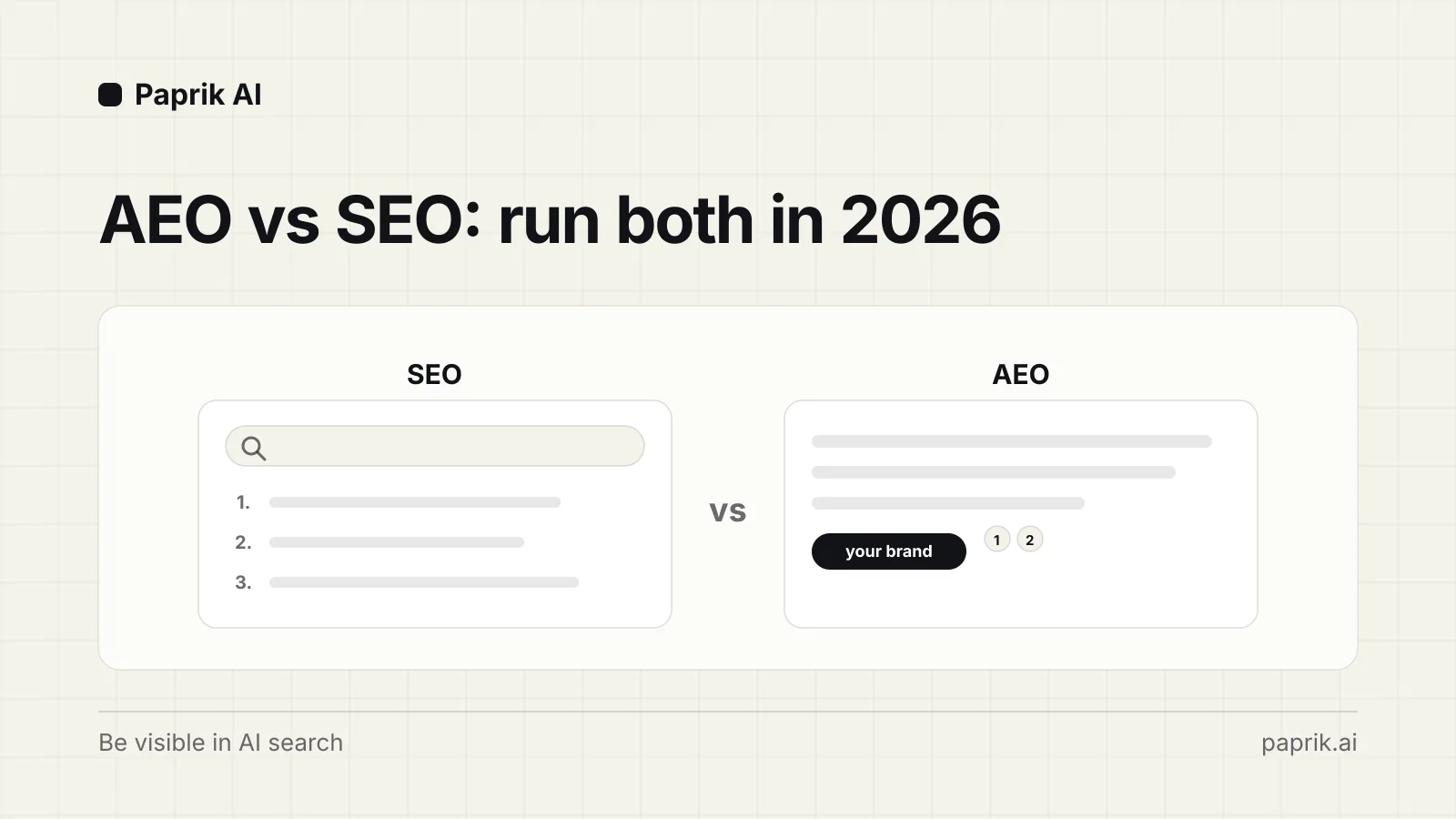
AEO and SEO are not competing disciplines. AEO is built on top of SEO. You cannot be cited by AI engines if you are not first indexed, ranked, and trusted by the underlying search infrastructure those engines depend on. But they diverge meaningfully in what they optimize toward.
Dimension | SEO | AEO |
Primary goal | Rank on search results pages | Be cited in AI-generated answers |
Success metric | Position, click-through rate, organic traffic | Citation frequency, AI share of voice |
Content format | Keyword-optimized pages | Direct-answer, structured content |
Authority signals | Backlinks, domain rating | Entity trust, third-party mentions, E-E-A-T |
Visibility output | Blue link on a SERP | Brand mention or quote in an AI response |
User action | Clicks through to site | May receive the answer without visiting the site |
Both disciplines reward high-quality content, authoritative sourcing, strong technical foundations, and genuine expertise. A brand that has executed SEO well has a structural head start in AEO. Where they diverge: SEO rewards keyword coverage and click-through optimization; AEO rewards structural clarity and citation-readiness. A page can rank position two and never be cited by an AI engine because it buries its answer, lacks schema markup, or has weak entity signals.
For the full strategic guide to running both simultaneously, see AEO vs SEO: The Strategic Guide.
AEO in Real Life - Examples
ChatGPT Citation Example
A user asks: "What is the best project management software for remote teams?" ChatGPT names three to five tools with a one-sentence rationale for each. The brands cited are not necessarily the ones running the most advertising or ranking position one in traditional search. They are the brands that appeared most consistently and authoritatively in training data - in review publications, comparison
articles, software directories, and journalism. A brand that invested in consistent third-party coverage before ChatGPT's training cutoff is structurally advantaged in this answer, often permanently until the next major model retraining.
What drove the citation: training data volume, source authority, entity consistency, Wikipedia presence.
Google AI Overview Citation Example
A user searches: "How do I remove a background from an image?" Google's AI Overview appears above organic results with a step-by-step answer, citing one or two sources inline. The cited pages are not the highest-ranking pages - they are the pages that gave the most direct, structured, step-by-step answer with clear headings, HowTo schema markup, and strong E-E-A-T signals. A page ranking position four with a direct first-paragraph answer and schema implemented regularly outcompetes the position-one page that buries instructions inside a long introduction.
What drove the citation: top-10 ranking, direct first-paragraph answer, HowTo schema, author credentials.
Perplexity Citation Example
Perplexity shows users numbered, clickable citations directly in the response. When your brand is cited, users can see your domain name, read the attributed excerpt, and click through to your page. That makes a Perplexity citation qualitatively different from an invisible AI mention - it is a user-facing endorsement, a public attribution that readers can verify and act on. For brands building AI visibility, Perplexity citations carry credibility value beyond referral traffic: they signal to users, in real time, that your content was precise enough and trustworthy enough to be quoted.
What drove the citation: real-time retrieval ranking, direct first-paragraph answer, declarative writing style, clean technical structure.
How to Optimize for AEO - Four Layers
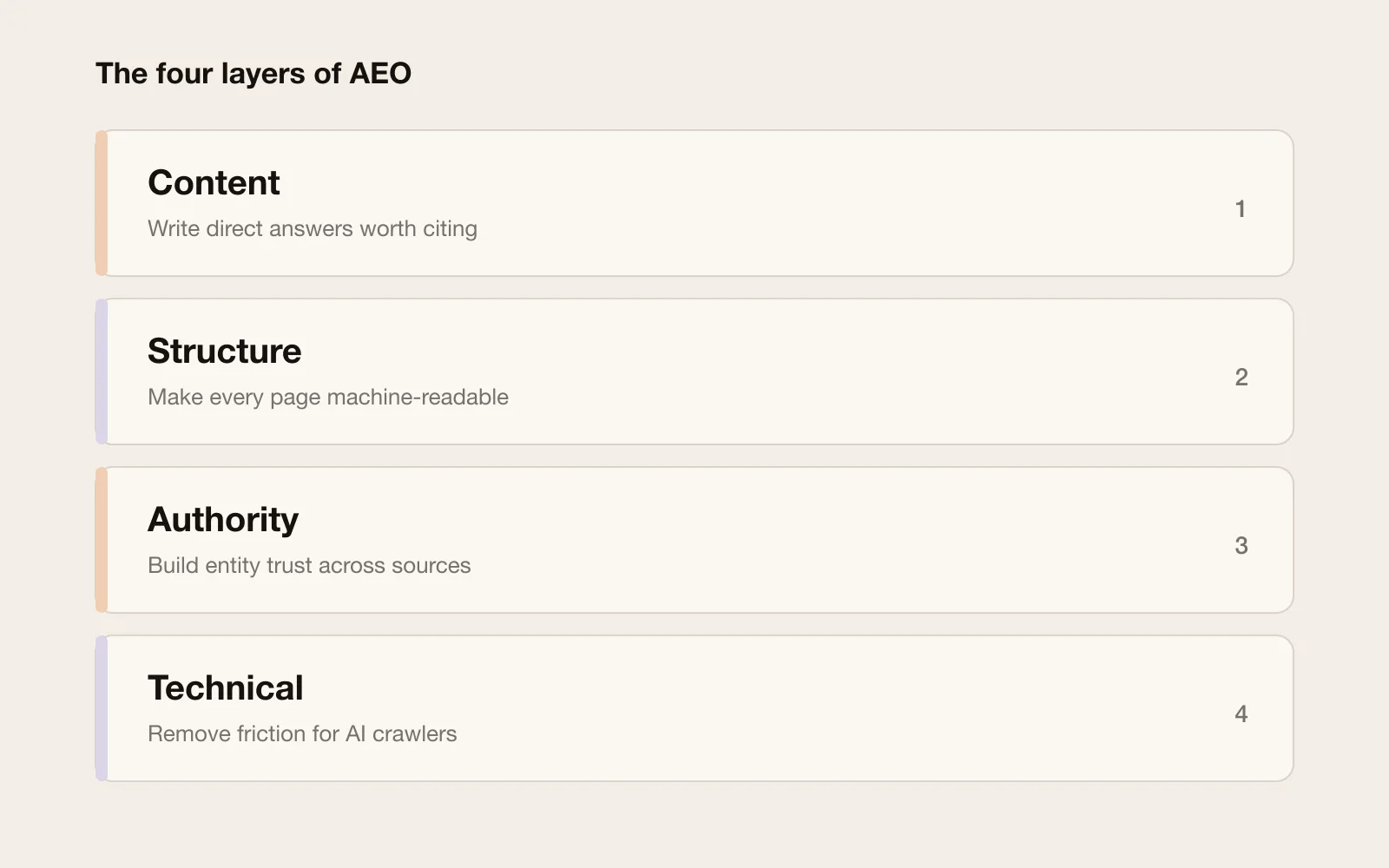
AEO optimization operates across four layers: content, structure, authority, and technical. Strong performance requires investment in all four. Weakness in any one layer limits your ceiling regardless of how strong the others are.
Content - Write for Direct Citation
The single most impactful content change most sites can make is moving the answer to the top. AI engines extract answers most reliably when the response to the section's implied question is in the first paragraph - not after three paragraphs of context-setting or introduction.
Answer the primary question in the first 50-100 words of each section.
Use clear, declarative statements. Avoid excessive hedging, qualification, and passive constructions.
Include specific data points, statistics, and named examples. Specificity is a citation-quality signal.
Write standalone paragraphs that make sense extracted from surrounding context. AI engines often pull a single paragraph as the citation.
Use FAQ format for definitional and how-to content. It directly maps to how users phrase queries.
Keep sentences direct: subject, verb, object. Remove throat-clearing.
Structure - Make Content Machine-Readable
AI models parse content more reliably when it is clearly structured. This is not about formatting aesthetics - it is about signal clarity for automated retrieval systems that scan and extract at high speed.
Use H2 and H3 headings that accurately describe the content of each section - not clever headings that obscure what follows.
Use numbered lists for sequential steps. Use bullet points for parallel items without inherent order.
Use tables for side-by-side comparisons. Tables are one of the highest-extraction-reliability formats for AI systems.
Implement FAQ schema markup on definition and question-based content.
Implement HowTo schema on instructional content with discrete, sequential steps.
Implement Article schema with visible author name, credentials, and publication date.
Authority - Build Entity Trust
Your brand's citation frequency in AI engines is partly determined before anyone reads your content. Entity trust - how consistently and authoritatively your brand is described across the web - operates as a background signal independent of individual page quality.
Create and maintain a Wikipedia page if your brand meets notability criteria. A Wikidata entry is valuable even without a full Wikipedia article.
Ensure your brand description is identical in substance across your website, social profiles, press releases, and third-party directories. Inconsistency creates entity ambiguity that suppresses AI trust.
Earn coverage in authoritative third-party publications in your industry. Volume of authoritative external mentions is the most direct trust signal for training-based engines.
Build author profiles with credentials and institutional affiliations visible on-site for all key contributors.
Monitor for inconsistent or outdated brand descriptions across the web and correct them systematically.
Technical - Remove Friction for AI Crawlers
AI retrieval systems face the same technical barriers that affect traditional search crawlers - but with less tolerance for friction. A perfectly optimized page that requires JavaScript rendering to display its content is, from an AI crawler's perspective, a page with no content.
Ensure pages load under 2 seconds. Slow pages are deprioritized in real-time retrieval contexts.
Avoid content that requires client-side JavaScript rendering to be visible. Server-side render or static HTML for all citable content.
Remove paywalls and login walls from content you want cited. Paywalled content cannot be retrieved.
Use clean, semantic HTML. Proper use of header tags, section elements, and structured markup improves parse reliability.
Audit robots.txt to confirm GPTBot, PerplexityBot, and ClaudeBot are not blocked. A significant proportion of sites inadvertently block AI crawlers through legacy rules.
How to Measure AEO Success
Measurement is not optional. Without it, you cannot know whether your investments are working or where to prioritize next. AEO measurement is newer than SEO measurement but the core metrics are trackable today. For a step-by-step method - the metrics, a manual baseline and the common mistakes - see how to track your brand's AI visibility.
Citation frequency:
How often does your brand or content get cited when AI engines answer relevant queries? Run 20-50 representative queries across ChatGPT, Perplexity, and Google AI Overviews each week. Record which sources are cited. Track your citation rate over time. This is your primary pulse metric.
AI share of voice:
Among all brands cited in AI answers to queries in your category, what percentage are yours? Define a query set of 50-100 representative searches. Run them across major engines. Count total citations by brand. Calculate your share. This is the AEO equivalent of share of voice in traditional brand measurement.
Prompt visibility:
For high-value queries - your primary product category, your brand name, key use cases - does your brand appear, and how is it described? Run a consistent prompt set monthly. Document exact phrasing used in AI responses about your brand. Flag inaccurate characterizations for content and PR response.
Referral traffic from AI engines:
Perplexity drives measurable referral traffic through its visible citation links. ChatGPT browsing mode and Google AI Overviews also generate referral visits. In GA4, segment referral traffic by source: perplexity.ai, chat.openai.com, bing.com. Track volume and trend over time.
Competitor citation monitoring:
Understanding how competitors perform in AI answers is as important as tracking your own. Include competitor brand names in your prompt monitoring. When a competitor is cited and you are not, analyze the cited content: what structural, editorial, or authority factors tipped the selection? Paprik automates this tracking - monitoring daily citation frequency across engines and identifying which third-party sources drive competitor citations. Paprik reads the ChatGPT interface rather than the API - the difference is not small.
Common AEO Mistakes
Optimizing for AEO without SEO foundations.
If your pages do not rank, real-time retrieval engines will not retrieve them. If your domain has weak authority, training-based engines will not trust it. AEO without strong SEO underneath is building on sand. The prerequisite is not optional.
Writing for humans but not for extraction.
Content can be engaging, well-written, and valuable while still being poorly structured for AI citation. Long introductions, buried answers, and dense narrative paragraphs without headers all reduce citation likelihood regardless of content quality. The most common failure: the answer exists on the page but appears in paragraph seven.
Ignoring entity consistency.
Brands that describe themselves differently across their website, LinkedIn, press releases, and third-party directories create entity ambiguity that suppresses AI trust signals. Consistency is a low-effort, high-leverage fix that most brands overlook. Audit every major external description of your brand once per quarter.
Blocking AI crawlers in robots.txt.
Some sites have robots.txt rules that inadvertently block GPTBot, PerplexityBot, or ClaudeBot. If you want to be cited, you need to be crawlable. Audit your robots.txt against the current list of known AI crawler user agents before investing in any other AEO work.
Treating AEO as a one-time project.
AI engines update their models, change retrieval logic, and shift trust signals over time. AEO is an ongoing discipline, not an audit to complete once. Brands that set up measurement systems and iterate continuously will outperform those that treat it as a checklist.
Over-indexing on a single engine.
ChatGPT, Perplexity, and Google AI Overviews have meaningfully different selection logics. The highest-leverage optimizations - directness, structure, entity trust, technical accessibility - work across all engines simultaneously. Engine-specific tactics should be additive to a cross-engine foundation, not a substitute for one.
The Future of AEO
Zero-click will keep rising for informational queries. The trend is structural. As AI Overviews become more comprehensive and AI assistants more capable, the proportion of informational queries resulting in a site visit will continue to decline. Brands that built traffic models on informational content need to restructure around transactional and high-intent content where the click still lives - while building AI citation visibility for the informational layer.
Agentic AI shifts the optimization question from "will AI cite my article?" to "will an AI agent trust my data source?" AI agents that compare vendors, compile research reports, book services, and make recommendations on users' behalf will depend on trusted, structured, machine-readable data sources to do their work. The brands establishing themselves as reliable structured sources of authoritative information now will have a meaningful head start when agentic search becomes the default mode for complex queries.
Measurement tools are maturing rapidly. The gap between what is measurable in SEO and what is measurable in AEO is closing. Dedicated AI visibility platforms, GA4 integrations, and granular citation tracking are becoming standard parts of the marketing measurement stack. The brands investing in measurement infrastructure now will have the historical data to benchmark against when the tooling fully matures.
Related Guides
How ChatGPT Surfaces and Mentions Brands - Live retrieval vs entity associations, and what to do if your brand is absent or misrepresented.
How Google AI Overviews Choose Citations - The two-step selection process, query fan-outs, and the E-E-A-T bar for being quoted.
How Perplexity AI Ranks and Cites Sources - Real-time retrieval logic, technical requirements, and the writing style that earns citations.
AEO vs SEO: The Strategic Guide - Where the two disciplines align, where they diverge, and a 12-month roadmap for running both.
AEO vs GEO: What's the Difference? - Why the two terms describe the same discipline, and which one to use when.
How Accurate Is API-Based AI Visibility Tracking? - Our controlled study: the API surfaced 84% fewer brands than the ChatGPT interface.
Do AEO Tools Mean Anything If AI Personalizes Every Answer? - Why visibility is measurable: personalization reshuffles a stable shortlist.
Do You Need to Invest in AEO? - The data on zero-click search and why AI-driven visitors convert several times better.