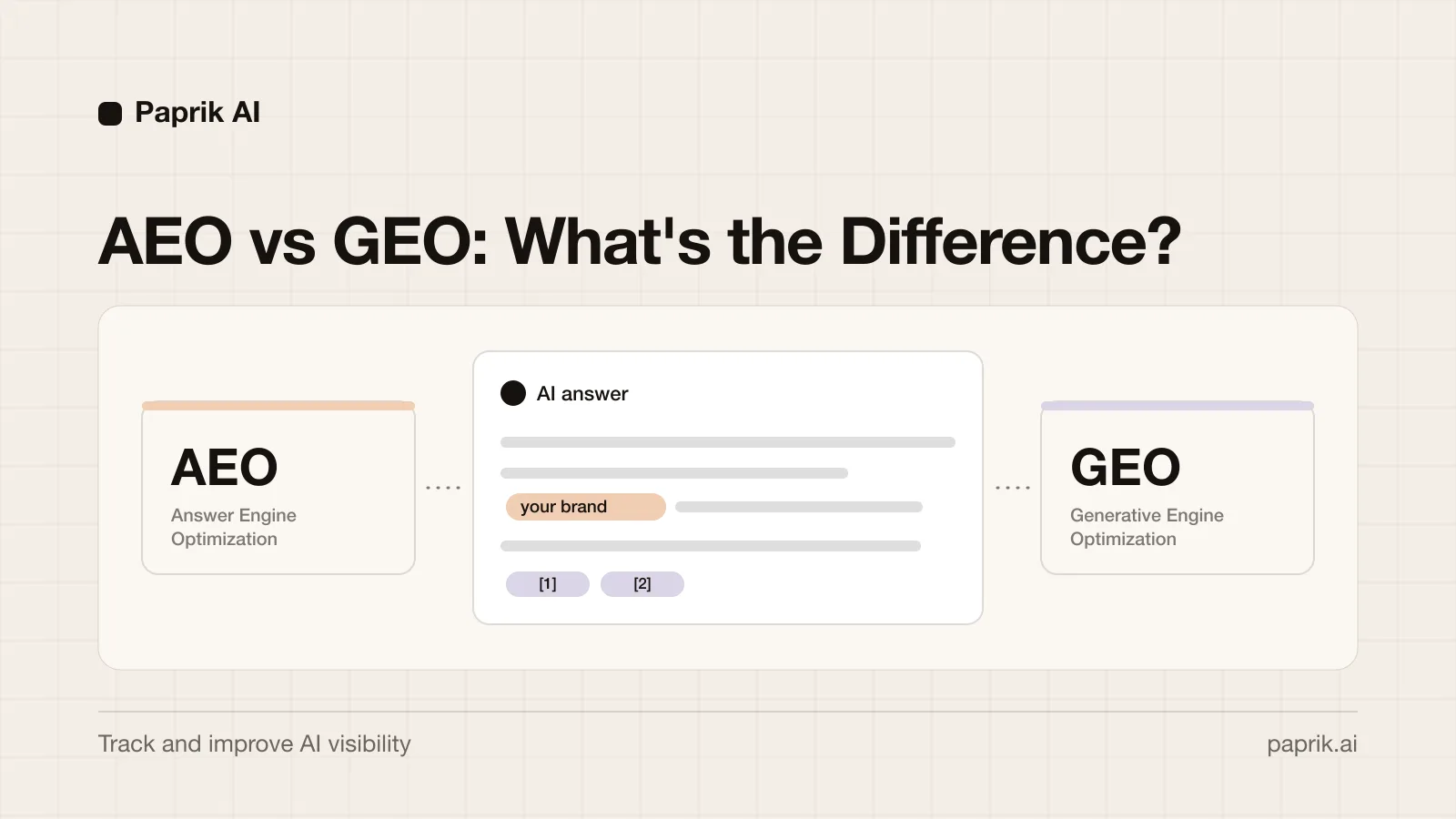
AEO vs GEO: What's the Difference?
AEO and GEO are two names for largely the same discipline. Where each term came from, where they genuinely differ, and why the engines don't care what you call the work.
Author
Founder
Abhilash is the Founder of Paprik AI. He writes about AEO, AI search visibility, and how brands can win in AI-driven discovery.
Answer Engine Optimization (AEO) and Generative Engine Optimization (GEO) describe the same underlying work: improving how often your brand is mentioned, cited and recommended inside AI-generated answers on platforms like ChatGPT, Google AI Overviews, Gemini and Perplexity. The two terms grew up in different corners of the industry, and people who learned the discipline from different sources now use different names for it. If you strip the labels off a competent AEO plan and a competent GEO plan, you get close to the same document.
That makes "AEO vs GEO" an unusual comparison to write. AEO vs SEO is a real contrast between two disciplines with different mechanics and different metrics. AEO vs GEO is mostly a question about vocabulary - but it is worth answering properly, because the vocabulary confuses real budget conversations. Teams delay work while they figure out whether they need "an AEO tool or a GEO tool," and agency briefs filter out capable practitioners who happen to use the other word. We run into this weekly at Paprik: we built the product as an AEO platform, and a meaningful share of the people who buy it arrive asking for GEO. They want the same thing.
Where each term came from
AEO is the older term. "Answer engine" predates the current AI wave - it described systems that return a direct answer instead of a list of links, which originally meant featured snippets, knowledge panels and voice assistants. When ChatGPT and its successors turned direct answers into the default interface for a large share of queries, the term stretched naturally to cover them, and Answer Engine Optimization came to mean earning mentions and citations in AI-generated answers.
GEO has a more precise birthday. A late-2023 academic paper titled "GEO: Generative Engine Optimization" (published at KDD 2024) coined the term, defined "generative engines" as AI systems that synthesize answers from multiple retrieved sources, and benchmarked how changes to content affect visibility in those answers. The name spread from research into marketing, and a set of tools and agencies adopted it as their category label.
Both terms are responses to the same shift: search engines used to rank your pages, and AI engines now speak about your brand. Everything else is downstream of which noun you attach to the engine doing the speaking.
The difference, if you insist on one
There is no standards body for either term, but when people draw a distinction, it usually runs like this:
| AEO | GEO |
|---|---|---|
Expanded name | Answer Engine Optimization | Generative Engine Optimization |
Strict reading | Any system that returns a direct answer - AI chat, AI Overviews, featured snippets, voice assistants | Specifically generative AI systems that synthesize answers with an LLM |
Origin | Grew out of the featured-snippet and voice-search era | Coined by a 2023 academic paper |
Who tends to say it | SEO and content teams who watched answers replace links | Practitioners and vendors who entered via the AI wave |
Under the strict reading, AEO is slightly broader (a featured snippet is an answer but is not generated) and GEO is slightly more specific to LLM-based engines. In practice almost nobody uses the terms that carefully. Both get applied to the same list of engines - ChatGPT, Google AI Overviews and AI Mode, Gemini, Perplexity, Claude, Copilot - and the surfaces where the strict definitions diverge, like voice assistants, are increasingly powered by the same generative models anyway. The distinction is real enough to state and too small to plan around.
The work overlaps almost completely
Whatever you call the discipline, the operating loop is the same:
Measure where you stand. Run the questions your buyers ask across the engines, and track how often you are mentioned, how you rank against competitors, and how much AI-driven traffic actually reaches you.
Find the sources. AI answers are assembled from a small set of pages - your site, review platforms, comparison articles, forums. Both AEO and GEO practice revolve around identifying those pages and earning a presence on them.
Fix the content. Clear entity definitions, direct answers to real questions, structured data, and pages an engine can quote without rewriting.
Watch what the engines claim. Mentions are only half the picture; engines also get facts wrong, and correcting the record is part of the job under either name.
The metrics are identical too: visibility, share of voice, citations, sentiment. We have never seen a task that belongs to GEO but not to AEO, or the reverse. That is the practical answer to the question in the title.
Why two names persist
Category vocabulary settles by audience, not by technical precision. SEO itself beat out several competing labels in the early 2000s for no reason deeper than adoption. Right now the AI-visibility category is young enough that the literature is split: much of the marketing press writes AEO, the academic lineage and a wave of newer vendors write GEO, and a third group skips the acronym debate entirely and says AI visibility, AI search optimization, LLMO or LLM SEO. Every one of those labels points at the same discipline.
For a brand, the sensible response is to treat the terms as synonyms and use whichever one your audience uses - and when you write a brief or a job description, include both, so you are not invisible to half the practitioners in a small field.
Where Paprik sits
Paprik is built for the work rather than the label: it is an Answer Engine Optimization platform and a Generative Engine Optimization platform in the only sense that matters, which is what it does. It tracks your brand daily across seven AI engines, shows the sources shaping the answers, scores sentiment and factual accuracy, and turns the gaps into a prioritised fix list. If you are evaluating the category, our guide to AEO tools in India covers how the platforms differ - the shortlist is the same whichever acronym you searched to find it.
Frequently asked questions
Is GEO the same as AEO?+
For most practical purposes, yes. Both describe improving how your brand appears inside AI-generated answers. Some people reserve AEO for all direct-answer surfaces (including featured snippets and voice assistants) and GEO for LLM-based engines specifically, but the day-to-day work - measurement, source analysis, content fixes, accuracy monitoring - is the same under both names.
Is AEO or GEO part of SEO?+
They inherit a lot from SEO - crawlable sites, authority, clear structure all still matter - but they optimise for a different outcome: inclusion in an AI answer rather than a ranked position, measured in mentions and citations rather than clicks. Our AEO vs SEO guide covers where the two genuinely diverge. Most brands need both.
Do I need separate tools for AEO and GEO?+
No. A platform that tracks your visibility, citations and sentiment across AI engines covers both, because they are the same discipline. Buying an "AEO tool" and a "GEO tool" would mean paying twice for one capability. Paprik supports both use cases in one product.
What about LLMO, AI SEO and LLM SEO?+
More synonyms. LLMO (Large Language Model Optimization), AI SEO and LLM SEO all circulate as names for the same practice. None has clearly won yet. Pick one for internal consistency and expect to keep translating for a while.
Should I use the term AEO or GEO in 2026?+
Use the one your stakeholders already use, and define it once. If you publish content in this category, it is worth mentioning both - the audience searching for GEO and the audience searching for AEO are looking for the same answers.