Paprik vs Otterly: which AI visibility tool should you use for AEO?
Otterly is the cheapest credible way to watch four AI engines. Paprik continues from the recommendation to the drafted asset. Which do you need?
Author
Founder
Abhilash is the Founder of Paprik AI. He writes about AEO, AI search visibility, and how brands can win in AI-driven discovery.
TL;DR: Otterly tells you what to do. Paprik does it. Otterly's Recommendations feature generates a prioritised task list from a fixed catalogue of 15 rule-triggered types, refreshed once a week, and stops at the instruction: create a YouTube video, write a press release, improve existing content. Paprik diagnoses the gap at page level against the competitor pages currently being cited, then drafts the asset, for your own site and for third-party platforms. Buy Otterly if you want the cheapest credible way to watch four AI engines across many brands and markets. Buy Paprik if the bottleneck is not knowing what to fix but getting it written.
Answer Engine Optimization (AEO), also called Generative Engine Optimization (GEO), is the practice of getting your brand cited and recommended inside AI answers on ChatGPT, Google AI Mode, Google AI Overviews, Perplexity, Gemini, Claude and Copilot, instead of ranked in a list of links. Otterly is an Austrian product built for fast, low-friction monitoring, and it is genuinely good at that. Paprik is built around the half of the job that starts after the dashboard tells you that you are losing.
The core difference: one produces a task, the other produces the asset
Both products will tell you that a competitor is cited on Reddit and you are not. Only one of them writes the Reddit reply.
Otterly's Recommendations feature is real and useful, and anyone still describing Otterly as pure monitoring is working from stale information. It generates prioritised, filterable recommendations with reasoning attached, sorted by impact, with a to-do tab and internal notes so a team can track what got done. It covers off-page as well as on-page.
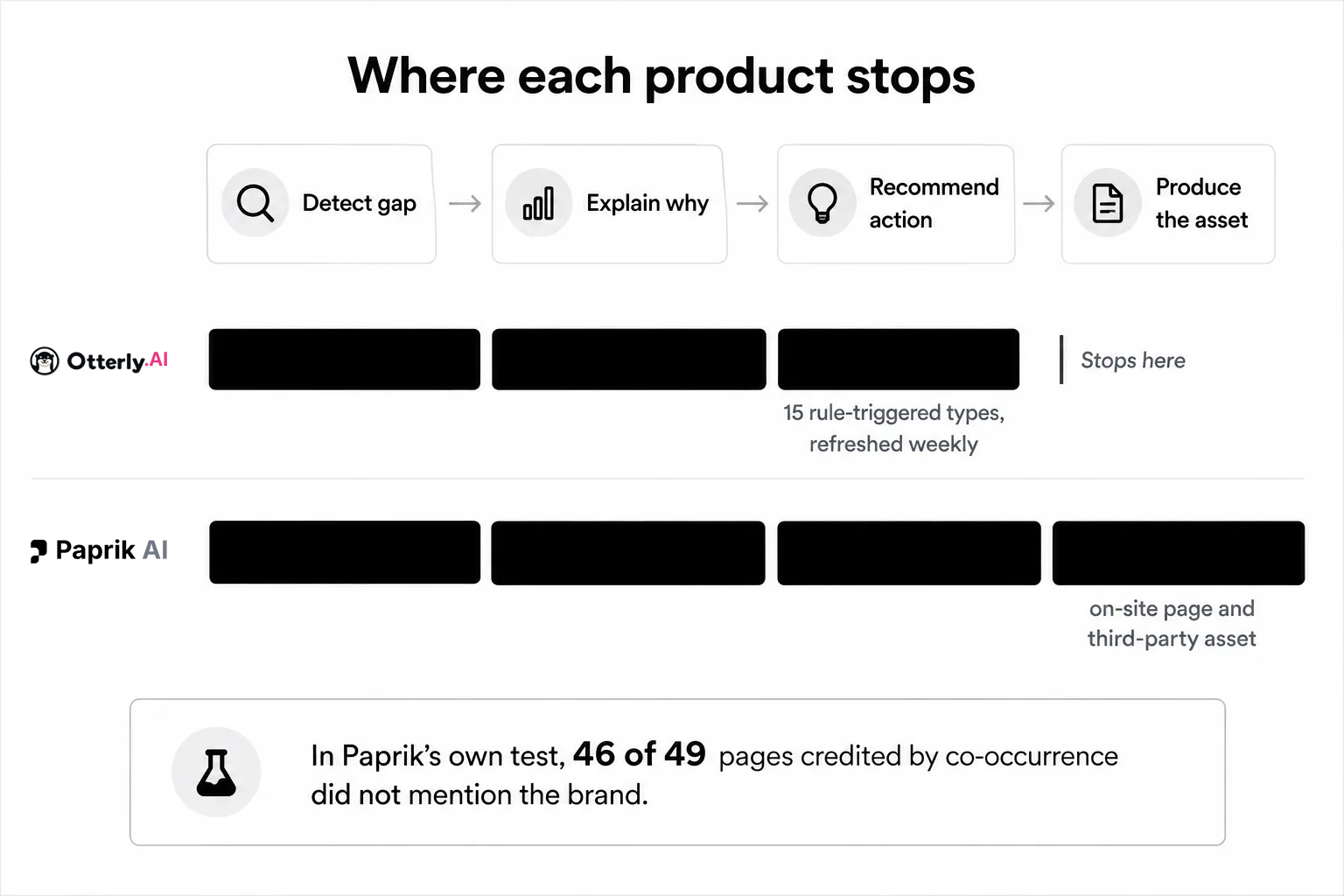
It also stops in a specific place. Recommendations come from a catalogue of exactly 15 types, each fired by a rule. Zero domain citations on an engine triggers a crawlability check. A competitor cited in video sources triggers "Create YouTube Videos." Zero mentions plus zero citations while a competitor is visible triggers "Create Content On-Page." The output is an accurate description of the shape of your problem and an instruction to go and solve it.
Paprik's action layer starts where that instruction ends. It identifies the pages relevant to each tracked prompt, compares them structurally against the competitor pages actually being cited for that prompt, and returns a maximum of five ranked gaps per page with reasoning, evidence and the prompts each one affects. Then it drafts the content, grounded in the brand facts you have uploaded rather than in model guesswork.
Otterly | Paprik | |
|---|---|---|
Tells you a gap exists | Yes | Yes |
Explains why it flagged it | Yes | Yes |
Diagnoses at page level against cited competitor pages | No | Yes |
Drafts the on-site content | No | Yes |
Drafts the third-party asset | No | Yes |
Refresh cadence | Every 7 days | On demand |
On measurement, the two are closer than the price gap suggests. Both track daily. Both report brand mentions, citations, sentiment and competitor position. Both read AI crawler traffic against your site. Both surface the sources feeding AI answers in your category. If you only need to know whether you are winning, this comparison is decided on price and engine mix, and the rest of this page is about the other question.
What Paprik gives you that Otterly does not
The recommendation arrives as a draft
Otterly hands your content team a brief. Paprik hands them a draft.
Paprik's 1-Click generation produces the actual content inside the product, for on-site pages and for third-party platforms, grounded in a Knowledge Hub of your own documents so the draft states your real positioning, pricing and claims rather than what a model assumes about you. Output lands in a content library with an editor and inline rewrite. It is uncapped on Pro, with no credit meter and no per-asset charge.
This is the whole distance between a tool that changes your reporting and a tool that changes your output. A weekly list of fifteen well-reasoned recommendations still needs a writer, a brief, a review cycle and a publishing slot. Most teams evaluating AEO tools do not have a spare writer. They have a marketer who already owns three other channels, which is why so many AEO subscriptions produce a beautiful dashboard and no published pages six months in.
Off-page opportunities sorted by whether you can actually act on them
Knowing a competitor is cited somewhere is not the same as being able to get cited there yourself.
Otterly's off-page recommendations name the surface: Reddit, media articles, YouTube, social, content partnerships. One of its own documented triggers fires when a competitor is cited on another brand's blog, and the suggested action is to get your brand mentioned there, which Otterly's help centre acknowledges may not suit every strategy.
Paprik classifies each third-party opportunity by access model before recommending anything: self-publish, editorial pitch, partnership required, or indirect only. The strategy and the drafted asset both branch on that classification, which is what stops the product from proposing a guest post to a publication that does not accept them, or a partnership play where you could simply post today.
For a challenger brand this is usually where the visibility actually sits, because the pages answering "best X for Y" in most categories are owned by nobody in the category.
Which page actually caused the mention
Most AEO tools credit a cited page with driving your brand mention because both appeared in the same answer. That assumption breaks more often than the category admits.
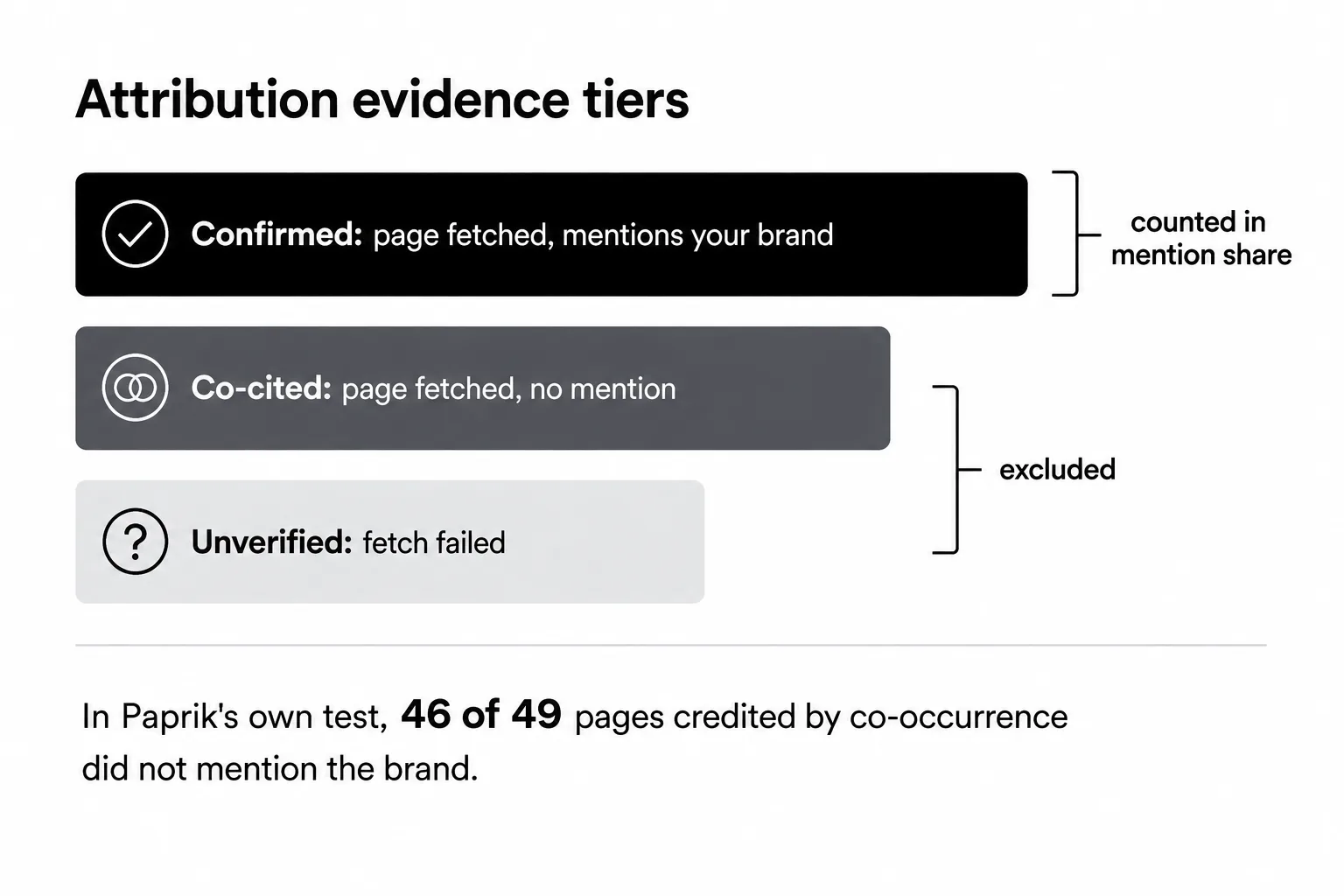
Paprik tested it on its own domain and has kept the test running since. Across six tracked brands, between 41% and 90% of the verified pages that co-occurrence credited with a brand's mentions do not mention that brand, and for Paprik itself the figure is roughly nine in ten - the full study is in the co-citation problem. The cause is plain once you look: answers to comparison and listicle prompts cite about a dozen sources at once, so a brand named in paragraph two and a citation attached to paragraph five sit side by side with nothing connecting them. Proximity is not attribution.
So every page in Paprik's Visibility Sources view carries an evidence tier. Confirmed means the page was fetched and mentions your brand. Co-cited means it was fetched and does not. Unverified means the fetch failed. Mention share ignores Co-cited pages.
Otterly's Link Citations Analysis and Domain Ranking tell you which domains and URLs appear in answers for your prompts, which is the right input for deciding where to earn presence. Neither distinguishes a page that named you from a page that merely appeared alongside you, and acting on that difference is worth a quarter of misdirected work.
Google AI Mode without an add-on line
Otterly's four core engines are the same four on every plan, and the engine you may need most is billed separately. Every Otterly tier covers Google AI Overviews, ChatGPT, Perplexity and Microsoft Copilot. Google AI Mode, Gemini and Claude are paid add-ons, priced per plan, on top of whatever tier you are on.
Paprik Pro tracks any three of seven, chosen by you from ChatGPT, Google AI Mode, Google AI Overviews, Gemini, Perplexity, Claude and Copilot, swapped in settings when your category shifts. AI Mode is one of the seven at no extra charge.
The trade is real in both directions. Otterly gives you four engines running at once on a $29 plan. Paprik gives you three at a time but lets you pick which three, and does not meter the newest surfaces separately. If you want ChatGPT, AI Mode, Gemini and Claude all running together, Otterly sells you that with add-ons and Paprik needs an Enterprise contract.
Paprik vs Otterly at a glance
Paprik | Otterly | |
|---|---|---|
Entry price | $49/month, Solo | $29/month, Lite |
Working tier | $199/month, Pro | $189/month, Standard |
Prompts at working tier | 100, shared across brands | 100, shared across brand reports |
Engines included | 1 on Solo, any 3 of 7 on Pro | 4 on every plan |
Google AI Mode, Gemini, Claude | Included in the 3 of 7 | Paid add-ons on every plan |
Engines tracked at once | 3 per brand, more on Enterprise | 4, plus any add-ons bought |
Brands tracked | 1 Solo, 2 Pro, Enterprise beyond | Unlimited brand reports, every plan |
Seats | Unlimited on every plan | Unlimited on every plan |
Countries | Around 35 | 65+ |
Page-level gap diagnosis | Yes, 5 ranked gaps per page | No |
Recommendation source | Computed per page and prompt | 15 rule-triggered types |
Recommendation refresh | On demand, Pro and above | Every 7 days |
Content generation | Uncapped on Pro, off on Solo | Not offered |
Off-page classified by access model | Yes | Named by surface only |
Attribution evidence tiers | Confirmed, Co-cited, Unverified | Link citations and domain ranking |
Factual accuracy auditing | Enterprise only | Not offered |
AI crawler analytics | Yes, all plans | Yes, event-capped from Standard |
Site audit | No | 1,000 to 10,000 GEO URL audits |
API and MCP | Not shipped | From Standard, request-capped |
Looker Studio connector | No | From Standard |
Local billing in India | Yes, INR pricing | No |
Done-for-you execution | Yes, sold separately | No |
Free trial | 7 days, no credit card | 14 days, no credit card |
What changes in your week
With Otterly, Monday is a list. With Paprik, Monday is a draft.
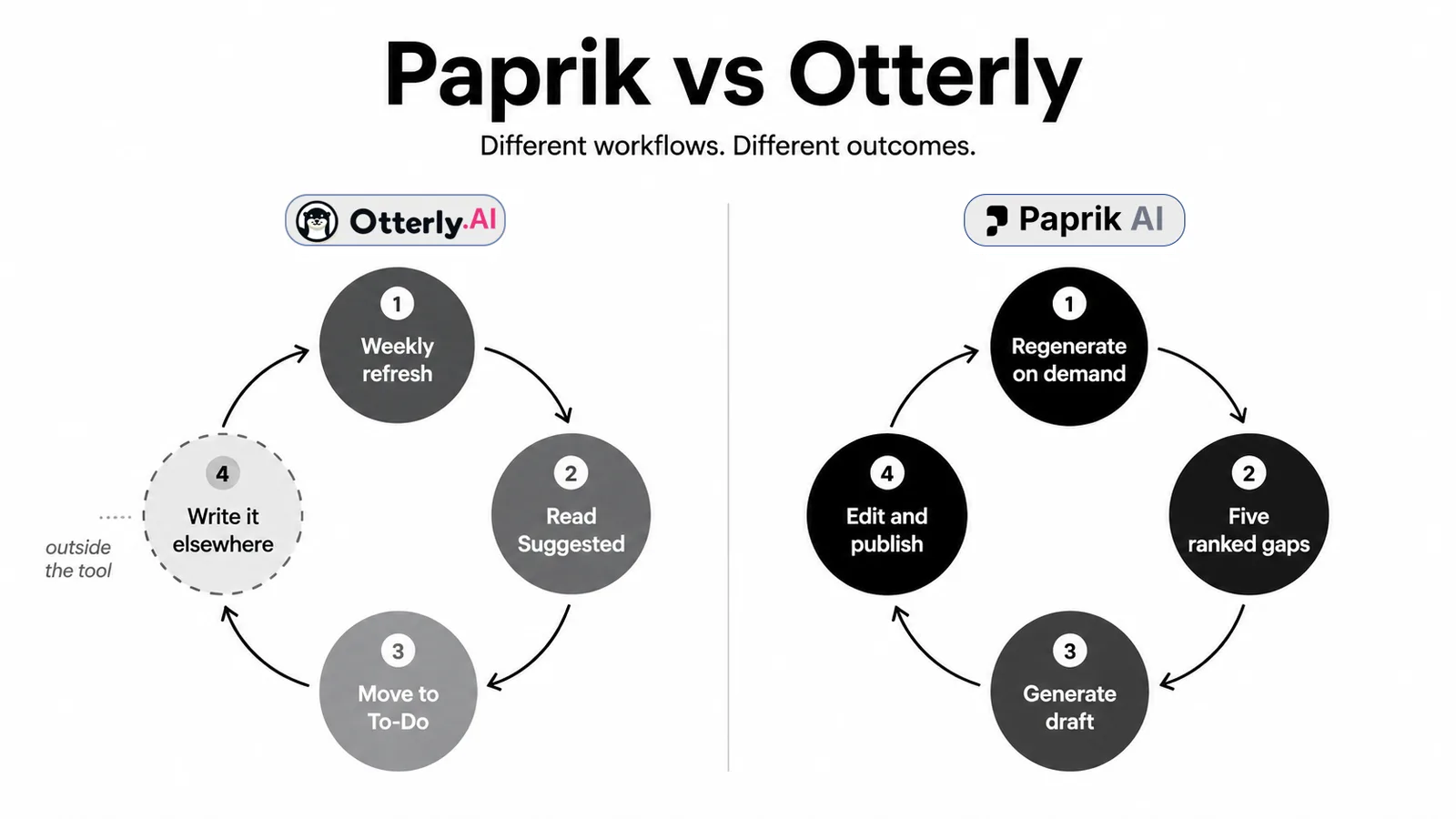
Otterly refreshes recommendations every seven days once you have at least 15 prompts, three competitors and three days of data. You open the Suggested tab, read what fired, move the ones you want into To-Do, add a note for whoever is going to write it, and the work then leaves the tool. There is no on-demand regeneration, so if you ship a change on Tuesday you wait for the next cycle to see the layer respond. The to-do list also does not sync to a task manager, so it stays a second place to check.
With Paprik on Pro, you regenerate when you want, take the ranked gaps for a page, generate the draft, edit it in the content library and publish. The third-party track runs the same way, producing the actual Reddit reply or guest post outline sorted by whether that platform is open to you.
There is also a third option that no tier chart shows. Paprik sells a done-for-you programme, so the work can leave your week entirely: setup, ongoing optimisation, execution across your own site and third-party platforms, and a monthly report. Otterly sells software only. If your honest constraint is that nobody in-house has time to act on any recommendation from any tool, that difference matters more than the feature comparison above it.
What each one costs
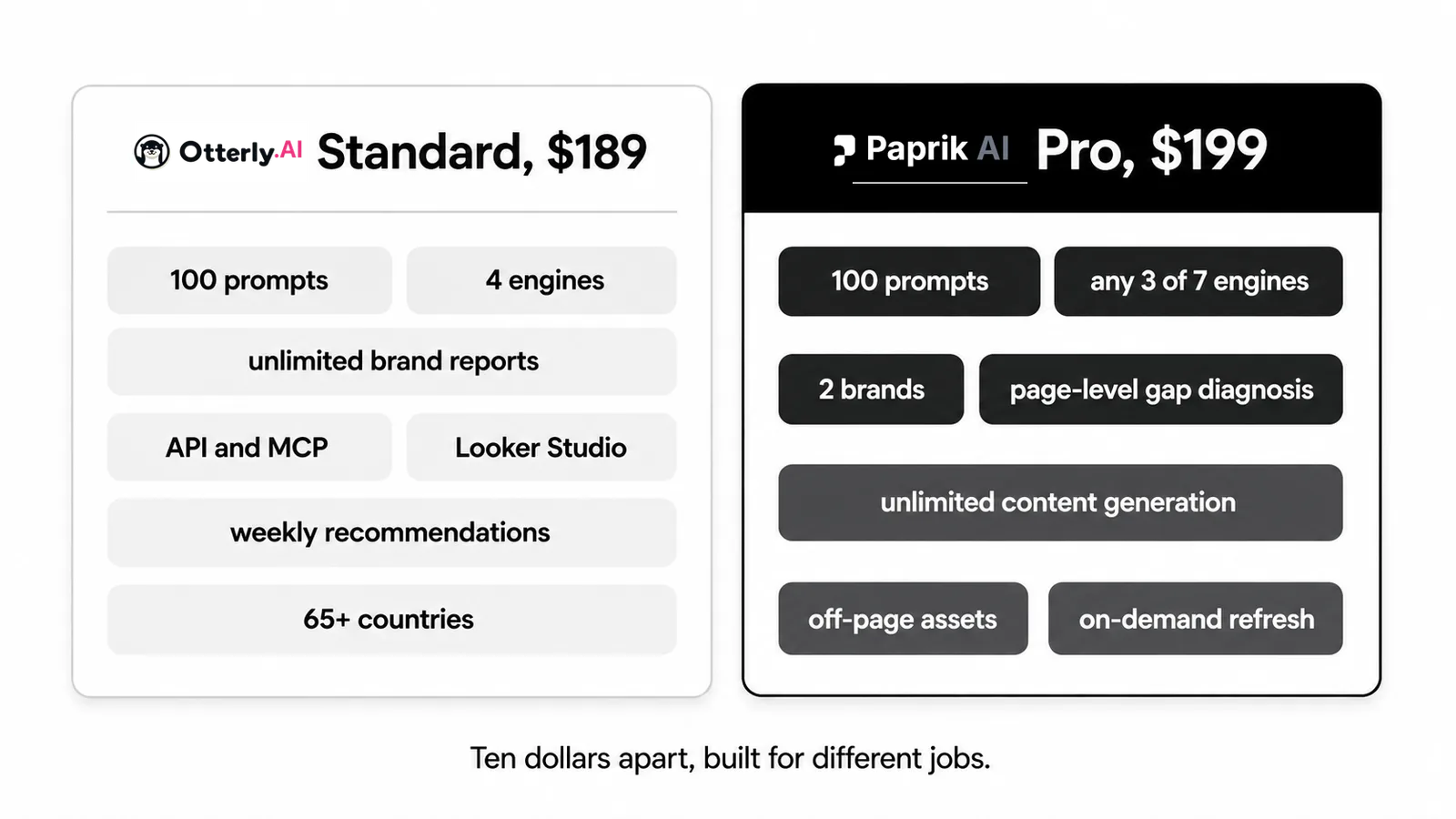
Otterly is cheaper at every tier, and the gap closes to $10 at the tier where most teams land.
What you need | Otterly | Paprik |
|---|---|---|
Entry monitoring | $29/month, 15 prompts, 4 engines | $49/month, 20 prompts, ChatGPT only |
100 prompts at the working tier | $189/month, 4 engines | $199/month, any 3 of 7 |
Google AI Mode tracked | $189 plus an add-on | $199, included in your 3 |
ChatGPT, AI Mode, Gemini and Claude together | Around $416/month reported | Enterprise, since that is 4 at once |
Drafted on-site and off-page content | Not available at any price | Uncapped on Pro |
Five client brands tracked | Included on any plan | Enterprise |
Otterly bills monthly or annually with roughly 15% off for the year, and extra prompts are sold in batches of 100. Paprik is $199 monthly or two months free annually, and ₹11,666 a month for Indian customers billed in rupees.
Read the entry row carefully, because Otterly wins it decisively. For $29 you get 15 prompts running daily across four engines, unlimited brand reports, unlimited team members and 65+ country coverage. Paprik Solo is $49 for 20 prompts on ChatGPT alone with the actions layer switched off entirely. If your budget is under $50 and you want monitoring, buy Otterly and do not think about it further.
The working tier is where the decision gets interesting, because $189 and $199 buy fundamentally different things. Otterly's $189 is a broader measurement instrument: four engines, unlimited brands, an API, a Looker Studio connector and a weekly task list. Paprik's $199 is a narrower instrument attached to a production line: three engines you choose, two brands, page-level diagnosis and unlimited drafted content.
So the cost question is not which is cheaper. At a $10 difference it is what a marketer's week is worth. If Paprik's generation layer saves one commissioned article a month, it has paid for the difference several times over. If you already have writers with spare capacity and a clear brief process, that layer is worth less to you and Otterly's breadth is worth more.
Where Otterly is the better choice
You are running many brands, especially as an agency. Otterly allows unlimited brand reports on every plan, with prompts distributed freely across workspaces and domains. Paprik allows one brand on Solo and two on Pro, and going beyond that means an Enterprise conversation. An agency with six clients and a $189 budget should buy Otterly.
You need an API, an MCP server or Looker Studio. Otterly ships API and MCP access from the $189 tier with monthly request allowances, plus a Looker Studio connector for client reporting. Paprik has neither shipped today. If your reporting runs through a warehouse or a client-facing dashboard, that is disqualifying.
You track many countries, or want a site audit alongside. Otterly covers 65+ countries on every plan and runs between 1,000 and 10,000 GEO URL audits a month depending on tier. Paprik targets around 35 countries and has no site-audit equivalent.
Your budget is under $50 and you want monitoring, not optimisation. The $29 Lite plan is a real plan rather than a teaser: 15 prompts, four engines, daily tracking, unlimited team members. Paprik has nothing that competes with it, and the honest advice is to buy Otterly and revisit when you have someone to act on the data.
Otterly also gives you 14 days to trial against Paprik's 7, both without a card, which is worth knowing if your evaluation needs to survive a holiday week.
Which one should you buy
If you are | Buy |
|---|---|
An agency running several client brands on one budget | Otterly |
Reporting through an API, a warehouse or Looker Studio | Otterly |
Tracking a dozen countries | Otterly |
Spending under $50 a month on monitoring | Otterly |
Sitting on a backlog of AEO recommendations nobody has written | Paprik |
Working an off-page citation gap on Reddit, review sites and comparison pages | Paprik |
Needing Google AI Mode without an add-on line item | Paprik |
Wanting page-level diagnosis rather than category-level triggers | Paprik |
An Indian brand paying in rupees | Paprik |
Without anyone in-house to implement anything | Paprik, with the done-for-you programme |
Four steps settle this faster than a feature list.
Ask who writes the content. If the answer is a person with capacity and a brief process, Otterly's list is enough. If the answer is nobody, a cheaper list does not help you.
Write down the engines that matter to your buyers, then price them. Otterly's four are fixed and the newer surfaces are add-ons. Paprik's three are yours to choose from seven.
Count your brands. This single number decides the comparison for most agencies before any other consideration.
Take one prompt where a competitor is cited and you are not, and follow each tool as far as it goes. Note exactly where it stops and what you would have to do next.
Key Takeaways
Otterly's Recommendations feature generates from a fixed catalogue of 15 rule-triggered types on a weekly cycle and stops at the instruction, while Paprik diagnoses at page level against the competitor pages currently cited and then drafts the asset.
Content generation is the clearest line between the two products: Paprik produces on-site pages and third-party assets uncapped on Pro, and Otterly does not produce content at any price.
Otterly includes four engines on every plan but bills Google AI Mode, Gemini and Claude as add-ons, where Paprik Pro lets you pick any three of seven including AI Mode at no extra charge.
Attribution by co-occurrence is unreliable: in Paprik's ongoing verification, roughly nine of every ten pages credited with driving its mentions do not mention the brand at all.
Otterly is cheaper at every tier and structurally better for agencies, multi-country tracking and API-based reporting, with unlimited brand reports against Paprik's cap of two on Pro.
Choose Otterly when you need broad, cheap measurement across many brands and markets. Choose Paprik when the recommendations are already piling up and nobody has written any of them.
How Paprik compares to the rest of the field: Paprik vs Peec, Paprik vs Profound, Paprik vs Semrush and Paprik vs Writesonic. Or start from the best AEO tools in India guide. New to the terminology? AEO vs GEO: What's the Difference?
Paprik is an AEO platform that tracks how your brand shows up in AI answers across seven engines, identifies which pages actually drive your citations, and generates the on-site and off-page content needed to change the outcome. It is also sold as a done-for-you programme for teams who would rather have the work done than have it recommended. Seven-day free trial on every plan, no credit card, at paprik.ai.