Paprik vs Writesonic: which AI visibility platform should you use for AEO?
Same $199, opposite products: Writesonic buys content capacity, Paprik buys platform choice and an uncapped action layer. A full comparison.
Author
Founder
Abhilash is the Founder of Paprik AI. He writes about AEO, AI search visibility, and how brands can win in AI-driven discovery.
TL;DR: Writesonic meters the writing and gates the seeing. All three of its self-serve plans track the same three AI platforms in one market, sentiment starts at $399, and the Action Center that fixes what you find is an Enterprise feature. Paprik Pro at $199 tracks any three of seven platforms including Google AI Mode, runs the full on-site and off-page action layer, and generates content without a monthly article cap. Buy Writesonic if you want an SEO and content engine with AI visibility attached, and you can live with ChatGPT, Gemini and Google AI Overviews. Buy Paprik if AI visibility is the job and you need to act on it below an enterprise budget.
Answer Engine Optimization (AEO), also called Generative Engine Optimization (GEO), is the practice of getting your brand cited and recommended inside AI answers on ChatGPT, Google AI Mode, Google AI Overviews, Perplexity, Gemini, Claude and Copilot, instead of ranked in a list of links. Writesonic started as an AI writing tool in 2020 and has rebuilt itself around AI search visibility. Paprik started at the AI answer and worked backwards. Both now claim the same category, and the plans they sell tell you which direction each one came from.
The core difference: what each product is generous with
Writesonic gives you a lot of writing and very little seeing. Paprik gives you the seeing and does not ration the writing.
That is not a criticism of either roadmap. It is what happens when an SEO and content platform adds AI visibility, and what happens when an AEO platform adds content generation. It shows up cleanly in what each plan includes and what it withholds.
Writesonic is generous with articles, site audits, SEO data and ads monitoring on every tier. It is strict with the things that make AI visibility measurable.
Capability | Starter $79 | Basic $199 | Growth $399 | Enterprise |
|---|---|---|---|---|
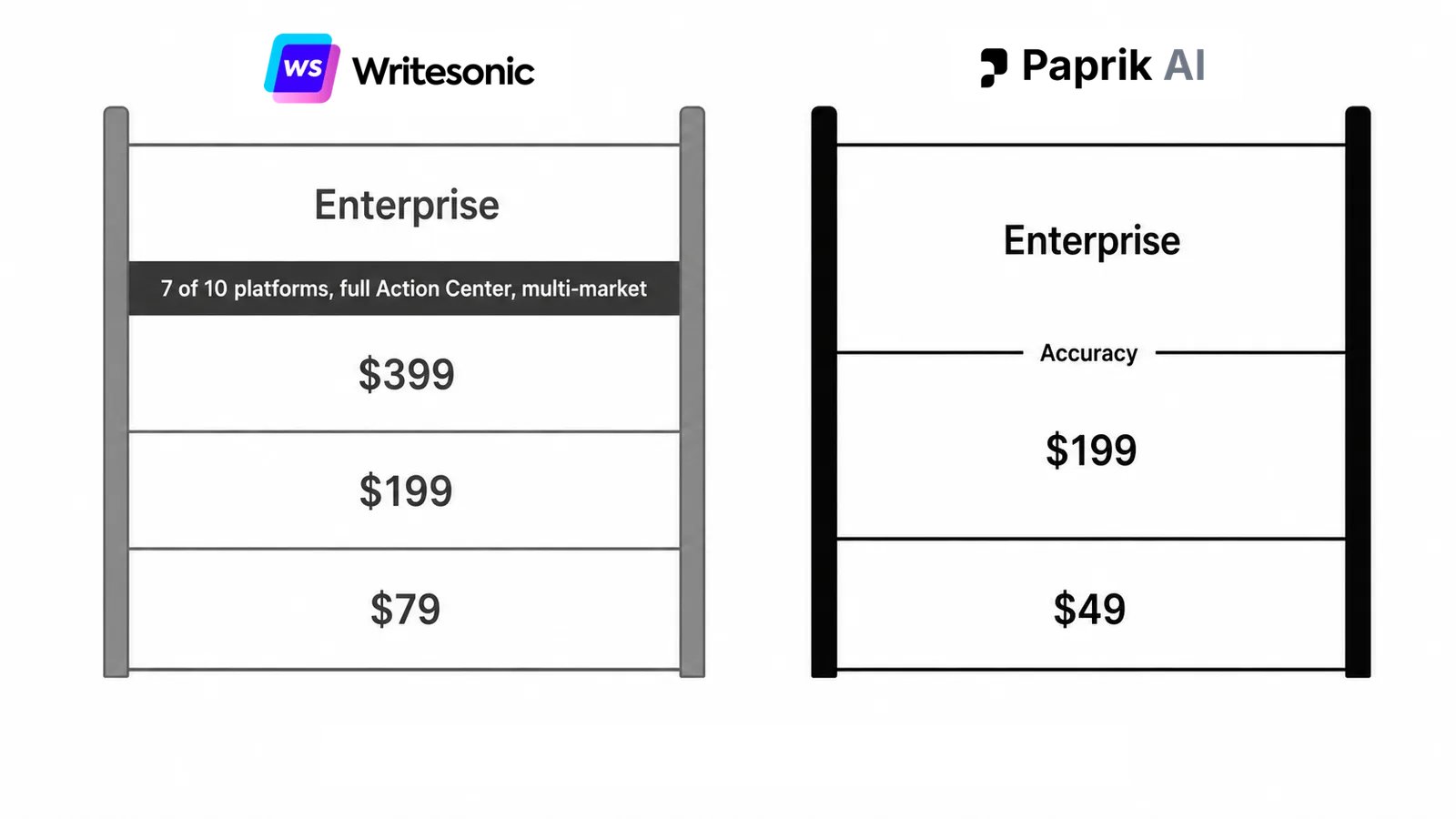
AI platforms tracked | ChatGPT, Gemini, Google AI Overviews | Same three | Same three | All 10 |
Prompts tracked | 50 | 100 | 200 | Custom |
Markets, language plus country | 1 | 1 | 1 | Custom |
Sentiment analysis | No | No | Yes | Yes |
Action Center | No | No | 5 on-page and 5 off-page a month | Full |
Articles per month | 15 | 25 | 50 | Custom |
Included users | 1 | 2 | 3 | Custom |
Prices shown are billed annually. On monthly billing the same tiers are $99, $249 and $499.
Read the platform row twice, because it is the one most buyers miss. The three platforms on Starter are the same three on Growth. Perplexity, Claude, Copilot, Google AI Mode, Grok, DeepSeek and Meta AI all sit on Enterprise. You can spend $399 a month and still not track Perplexity.
Paprik's ladder runs the other way. Solo at $49 is deliberately thin, one brand, 20 prompts, ChatGPT only, with the action layer switched off entirely. Pro at $199 opens almost everything: any three of seven platforms chosen by you, 100 prompts, two brands, unlimited seats, sentiment, the full on-site and third-party action layer, and content generation with no monthly cap. Accuracy, the fact-checking layer, is the one thing held back for Enterprise.
Where the two overlap, they overlap properly. Both track daily from the live browsing surface rather than raw model APIs. Both report visibility, share of voice, citations and competitor position. Both read AI crawler traffic against your site. Both connect to Google Search Console and publish finished content straight to WordPress, so neither leaves you copying drafts between tools.
What Paprik gives you that Writesonic reserves for Enterprise
The platforms your buyers actually use
Writesonic sells the same three AI platforms at every self-serve price. Paprik lets you pick three from seven.
Paprik Pro tracks any three of ChatGPT, Google AI Mode, Google AI Overviews, Gemini, Perplexity, Claude and Copilot, swapped in settings when your category shifts. Writesonic gives you ChatGPT, Gemini and Google AI Overviews, and the only route to any of the others is a sales conversation.
Google AI Mode is the sharpest example. Google AI Overviews and Google AI Mode are different products with different retrieval behaviour, and a brand can hold solid Overviews presence while being absent from AI Mode on the same query. Writesonic tracks Overviews from $79 and puts AI Mode on Enterprise. Paprik includes AI Mode in the three you choose at $199.
Perplexity is the second one to check against your own category. It is small in absolute traffic and heavily weighted toward exactly the research-stage, comparison-shaped questions that decide B2B purchases. If your buyers use it, no self-serve Writesonic plan will show you what it says about you.
An action layer that is not a trial
Writesonic's Action Center is an Enterprise feature, and the version on the $399 plan is capped at five on-page and five off-page actions a month.
Writesonic's own pricing table labels that allowance a trial, which is a fair description. Ten actions a month is enough to evaluate the feature and not enough to run a programme. On the $79 and $199 plans there is no Action Center at all, so those tiers show you the gap and leave the closing of it to your content workflow.
Paprik runs both tracks on Pro. On-site actions find the pages tied to each tracked prompt, then work out how well the page covers the prompt, how it compares structurally to the competitor pages currently being cited, what is structurally missing, and which fan-out sub-queries and entities the page never addresses. You get up to five ranked gaps per page, each with its reasoning and the prompts it affects, regenerated on demand rather than on a schedule.
Third-party actions find which external platforms drive citations in your category, then sort each opportunity by how you can actually get in: self-publish, editorial pitch, partnership required, or indirect only. Both the strategy and the drafted asset branch on that classification, which is what stops a product from proposing a guest post to a publication that does not accept them.
Neither track is capped by a monthly action count, and the content generation behind them is not capped by an article allowance.
Sentiment at $49 instead of $399
How AI describes your brand is a different question from how often it mentions you, and Writesonic answers it starting at $399. Sentiment analysis is unavailable on Starter and Basic, and included from Growth up.
Paprik reports sentiment on every plan, with positive, neutral, negative and critical bands, sentiment split by platform, sentiment plotted against visibility, and the actual answer text behind each score. You can also repoint the whole view at a competitor and read their sentiment the same way.
Markets follow the same pattern. Every Writesonic self-serve tier covers one market, meaning one language and one country, with multi-market on Enterprise. Paprik targets around 35 countries with per-brand country and language settings, and does not price markets as a separate line.
Which page actually caused the mention
Most AEO tools credit a cited page with driving your brand mention because both appeared in the same answer. That assumption breaks more often than the category admits.
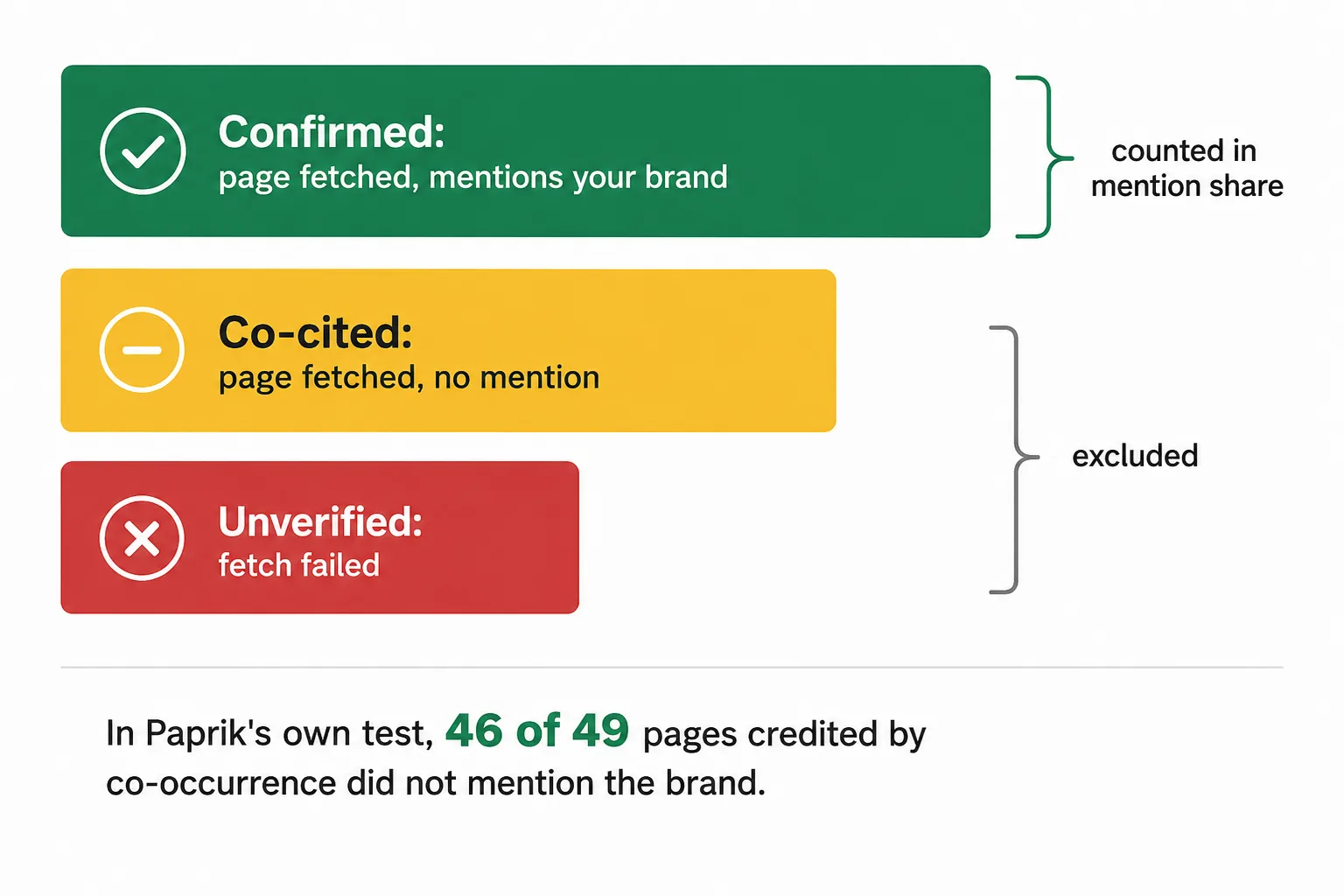
Paprik tested it on its own domain and has kept the test running since. Across six tracked brands, between 41% and 90% of the verified pages that co-occurrence credited with a brand's mentions do not mention that brand, and for Paprik itself the figure is roughly nine in ten - the full study is in the co-citation problem. The cause is plain once you look: answers to comparison and listicle prompts cite about a dozen sources at once, so a brand named in paragraph two and a citation attached to paragraph five sit side by side with nothing connecting them. Proximity is not attribution.
So every page in Paprik's Visibility Sources view carries an evidence tier. Confirmed means the page was fetched and mentions your brand. Co-cited means it was fetched and does not. Unverified means the fetch failed. Mention share ignores Co-cited pages.
Act on unverified attribution and you spend a quarter optimising pages that never mentioned you, which is an expensive way to use an article allowance.
Paprik vs Writesonic at a glance
Paprik | Writesonic | |
|---|---|---|
Entry price | $49/month, Solo | $79/month annual, $99 monthly |
Working tier | $199/month, Pro | $199/month annual, $249 monthly, Basic |
AI platforms, self-serve | Any 3 of 7 on Pro | The same 3 on every tier |
Google AI Mode | Pro | Enterprise |
Perplexity, Claude, Copilot | Available in your 3 | Enterprise |
Maximum platform coverage | 7 on the menu, 3 at once | 10 on Enterprise |
Prompts at $199 | 100 | 100 |
Markets | Around 35 countries | 1, Enterprise for more |
Sentiment | Every plan | From $399 |
Action layer | Full, on Pro | Enterprise, 10 actions a month at $399 |
Off-page classified by access model | Yes | Off-page actions on Enterprise |
Content generation | Uncapped on Pro | 15 to 50 articles a month |
Attribution evidence tiers | Confirmed, Co-cited, Unverified | Not offered |
Factual accuracy auditing | Enterprise | Not offered |
Seats | Unlimited on every plan | 1, 2 or 3, extras at $50 each |
Brands or projects | 1 Solo, 2 Pro | 1, 1, then 2 on Growth |
Site audit | Crawlability only | 10 to 50 audits, up to 2,500 pages |
Traditional SEO tooling | None | Keyword data, SERPs, optimisation |
AI search volume data | No | Yes, 5 one-time runs self-serve |
Ads monitoring | No | Every tier |
Search Console and WordPress | Yes | Yes |
AI crawler analytics | Yes, every plan | Yes, every tier |
Compliance certifications | Not published | SOC 2 Type II, HIPAA, GDPR, SSO |
Free trial | 7 days, no credit card | Yes, no credit card |
What changes in your week
Both products end the week with something published. They differ in what decides the thing you publish.
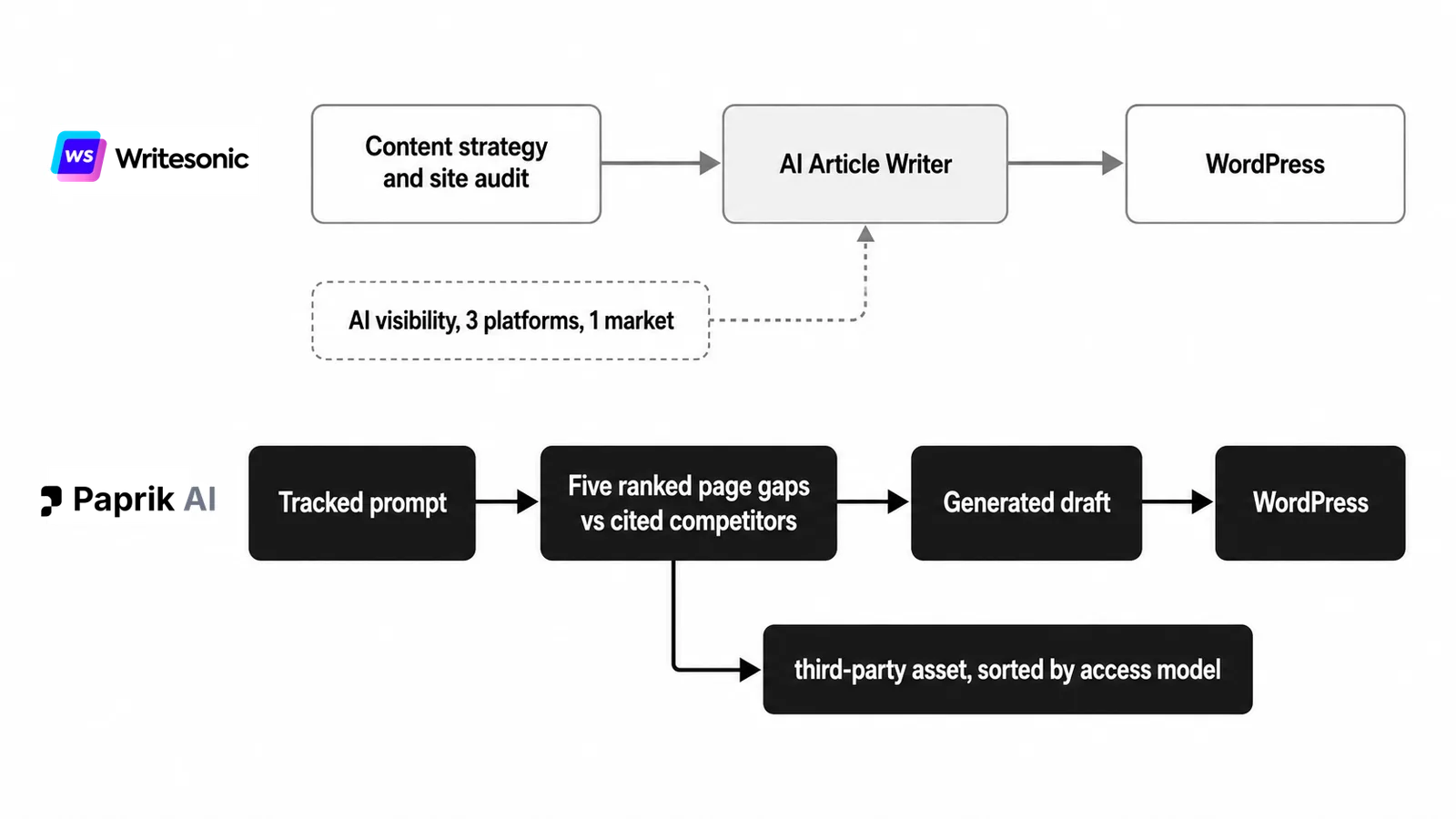
On Writesonic, the input is your content strategy plus a site audit. You get a topic, the AI Article Writer drafts it against your brand voice, the audit flags technical fixes with automatic remediation, and WordPress publishing closes the loop. It is a fast, coherent production line, and for a team whose real problem is that they publish four pages a quarter, it will move more numbers than any tracker.
What decides the topic, though, is largely the SEO layer. The AI visibility side contributes three platforms in one market, and below $399 it contributes no prioritised actions at all.
On Paprik, the input is the prompt set. Each tracked prompt maps to pages, each page gets ranked gaps computed against the competitor pages being cited for that exact prompt right now, and the draft is generated from that diagnosis and grounded in the brand documents you have uploaded rather than in model assumptions. The third-party track runs in parallel, producing the Reddit reply or the guest post outline for platforms sorted by whether they are open to you. Search Console and WordPress connect the same way, so the publish step matches.
The practical difference is what happens when a competitor overtakes you on one prompt. On Paprik you regenerate, see the five gaps on the page responsible, and draft the fix. On Writesonic below Growth you see the ranking change and decide what to do about it yourself.
What each one costs
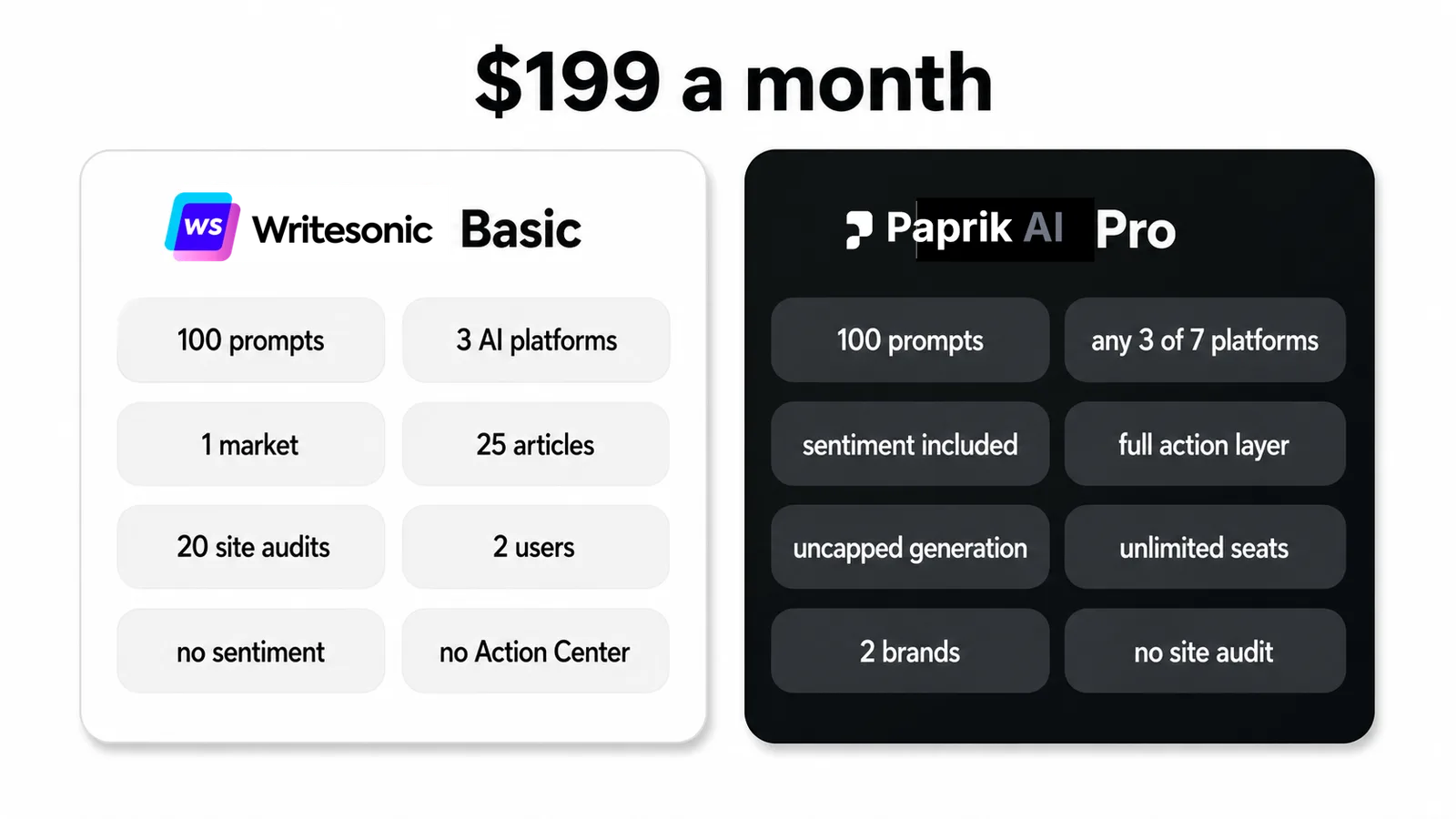
At $199 the two products cost exactly the same and buy opposite things.
What you need | Writesonic | Paprik |
|---|---|---|
100 prompts tracked | $199, three platforms | $199, any 3 of 7 |
Sentiment analysis | $399 | $49 |
Google AI Mode, Perplexity or Claude | Enterprise | $199 |
Any prioritised action layer | $399, capped at 10 a month | $199, uncapped |
Five people with logins | $399 plus $100 | $199 |
A second brand tracked | $399 | $199 |
50 articles a month | $399 | Uncapped on Pro |
A technical site audit | $199 | Not available |
Writesonic's headline prices are annual, at $79, $199 and $399, with monthly billing at $99, $249 and $499. Paprik is $49 and $199 monthly with two months free on annual billing.
The row that decides most evaluations is the fourth one. If you are buying an AI visibility tool in order to change your AI visibility, Writesonic asks $399 for ten actions a month and an Enterprise contract for the real thing. Paprik asks $199 and does not count them.
The row that should give you pause is the last one. Writesonic's $199 plan includes 20 site audits at 1,200 pages each with automatic fixes, and Paprik has nothing comparable. Its crawlability checks show which pages AI bots requested and what your server actually returned, which catches a 404 served to an AI crawler but is not a technical SEO audit.
Where Writesonic is the better choice
You need SEO and AEO in one platform. Writesonic carries keyword data, Google SERP data, site audits up to 2,500 pages with automatic fixes, and content optimisation, none of which Paprik has in any form. A team running one search programme across both channels has a real reason to consolidate, and consolidating removes a tool, a login and a reporting reconciliation.
Content volume is your actual constraint. Fifty articles a month on Growth, with brand voices, uploaded source data and direct publishing, is a production line. If your bottleneck is that nobody has written anything in six weeks, that capacity matters more than which engines you can see.
You want AI search volume data or ads monitoring. Writesonic's AI search volume dataset is built on billions of AI conversations and answers a question no account-level tracker can, which is what people actually ask rather than what you assume. Its ads monitoring across ChatGPT and Google AI runs on every tier. Paprik has neither.
You have compliance requirements. Writesonic publishes SOC 2 Type II, HIPAA and GDPR compliance with SSO and access control on Enterprise. Paprik publishes none of these, and an organisation that needs them should not shortlist it.
Running both is coherent for a larger team: Writesonic as the SEO and content engine, Paprik as the AEO measurement and off-page layer. Below that, you are paying twice for content generation.
Which one should you buy
If you are | Buy |
|---|---|
Running SEO and AEO as one programme | Writesonic |
Blocked on content production volume | Writesonic |
Needing keyword data, SERP data or a technical site audit | Writesonic |
Buying under a compliance requirement | Writesonic |
Tracking Perplexity, Claude, Copilot or Google AI Mode | Paprik |
Wanting a prioritised action layer without an Enterprise contract | Paprik |
Watching how AI describes you, not just how often | Paprik |
Working an off-page citation gap on Reddit, review sites and comparison pages | Paprik |
Selling into more than one country or language | Paprik |
Putting a whole team on the tool | Paprik |
Four steps settle this faster than a feature list.
Write down the AI platforms your buyers actually use, then check which tier tracks them. This single question eliminates one of these products for most buyers before price enters the conversation.
Decide whether your bottleneck is knowing what to write or having someone write it. Writesonic solves the second. Paprik solves the first and then also writes it.
Ask what the action layer costs on the plan you can afford. Ten actions a month is a demo, not a programme.
Take one prompt where a competitor is cited and you are not, and follow each tool to a published page. Count the steps, and note which of them your plan actually unlocks.
Key Takeaways
All three Writesonic self-serve plans track the same three AI platforms, ChatGPT, Gemini and Google AI Overviews, so Perplexity, Claude, Copilot and Google AI Mode require Enterprise even at $399, while Paprik Pro lets you pick any three of seven at $199.
Writesonic's Action Center is an Enterprise feature, and the $399 plan includes a capped trial of ten actions a month, where Paprik runs the full on-site and off-page action layer uncapped on Pro.
Sentiment analysis starts at $399 on Writesonic and is included on every Paprik plan, including the $49 tier.
At the same $199 price the two products buy opposite things: Writesonic buys content capacity and a technical site audit, Paprik buys platform choice, sentiment and an action layer.
Attribution by co-occurrence is unreliable: in Paprik's ongoing verification, roughly nine of every ten pages credited with driving its mentions do not mention the brand at all.
Choose Writesonic when you are running SEO and AEO as one programme, are blocked on content volume, or need compliance certifications. Choose Paprik when the platforms your buyers use and the ability to act on what you find both sit above the Writesonic plan you can afford.
How Paprik compares to the rest of the field: Paprik vs Peec, Paprik vs Profound, Paprik vs Semrush and Paprik vs Otterly. Or start from the best AEO tools in India guide. New to the terminology? AEO vs GEO: What's the Difference?
Paprik is an AEO platform that tracks how your brand shows up in AI answers across seven engines, identifies which pages actually drive your citations, and generates and publishes the on-site and off-page content needed to change the outcome. Seven-day free trial on every plan, no credit card, at paprik.ai.