Paprik vs Semrush: which AI visibility platform should you use for AEO?
Semrush's AI toolkit scores you on prompts it selects. Paprik measures the prompts you choose, then generates the fix. A detailed comparison.
Author
Founder
Abhilash is the Founder of Paprik AI. He writes about AEO, AI search visibility, and how brands can win in AI-driven discovery.
TL;DR: Semrush's AI Visibility Toolkit measures your AI presence against a prompt set it selects and stops at recommendations. Paprik measures the prompt set you select, then tells you whether AI mentions you in those prompts, what AI says about you is true, which page caused each mention, what the engine searched for behind your prompt, and whether AI crawlers reached your site, before generating the content to fix what it finds. Semrush is the better buy if you already run SEO inside it and want AI visibility reporting in the same login. Paprik is the better buy if improving AI visibility is the job.
Answer Engine Optimization (AEO) or Generative Engine Optimisation (GEO) is the practice of getting a brand cited and recommended inside AI-generated answers on ChatGPT, Google AI Overviews, Google AI Mode, Perplexity, Gemini, Claude and Copilot, rather than ranked in a list of blue links. Both products sell into that problem from opposite starting points: Semrush added an AI visibility module to a mature SEO suite, and Paprik was built from the AI answer backwards. Here is what that difference costs you in practice.
The core difference: whose prompts the score is built from
Semrush's AI Visibility Toolkit has two data layers, and the headline score comes from the one you do not control.
Report | Prompt source | Do you choose the prompts? |
|---|---|---|
Visibility Overview | Semrush's global prompt database | No |
Competitor Research | Semrush's global prompt database | No |
Prompt Research | Semrush's global prompt database | No |
Brand Performance | A query set Semrush generates for your brand | No |
Prompt Tracking | Prompts you enter, 25 on the base plan | Yes |
Four of five reports run on Semrush's database of over 317 million prompts. Prompt Tracking is the only report where you write the prompts, and it covers Google AI Mode and ChatGPT only.
That design has a genuine benefit: you get a number on day one with no setup, benchmarked against competitors on a common corpus. It also means the score you put in a board deck was computed from prompts you did not select, cannot see and cannot audit. When it moves, you cannot tell whether your position changed or the corpus did. Semrush does not publish which prompts ran, which models answered, or how mentions were weighted.
Branded prompts compound this. A prompt containing your brand name will almost always return your brand, so including them inflates the score of any company people already know and tells you nothing about whether you win in your category. Semrush treats the distinction as real elsewhere: its Perception report uses non-branded queries only, and Narrative Drivers offers branded and non-branded toggles. It does not publish how the headline AI Visibility Score and Share of Voice handle them, while describing the Brand Performance query set as a mix of both.
Paprik computes every metric from the prompt set you built. Visibility is defined as how often your brand appears excluding prompts that already mention it, and Average Position uses non-branded prompts only. When a number moves, it traces to a specific prompt, surface and date.
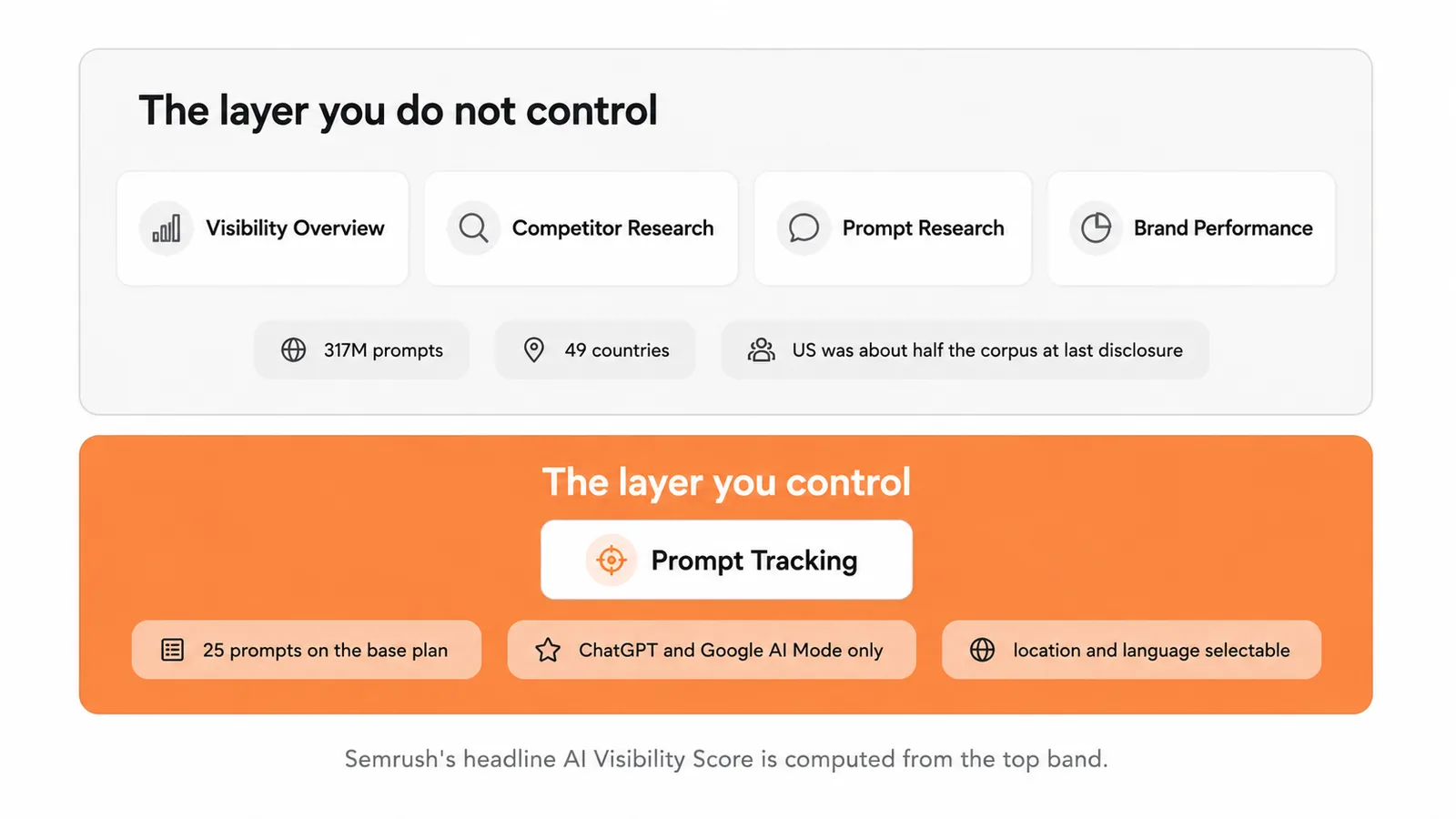
The rest of the tracking layer looks similar across both products. Both report visibility, share of voice, sentiment, average position, cited sources and competitor comparison. Both refresh daily, though Semrush's Brand Performance updates weekly. If tracking is all you need, this is a close call decided on price and on whether you already own Semrush.
Tracking is not where AEO gets won.
What Paprik can tell you that Semrush cannot
Four questions sit outside Semrush's toolkit entirely, and each one changes what you do next.
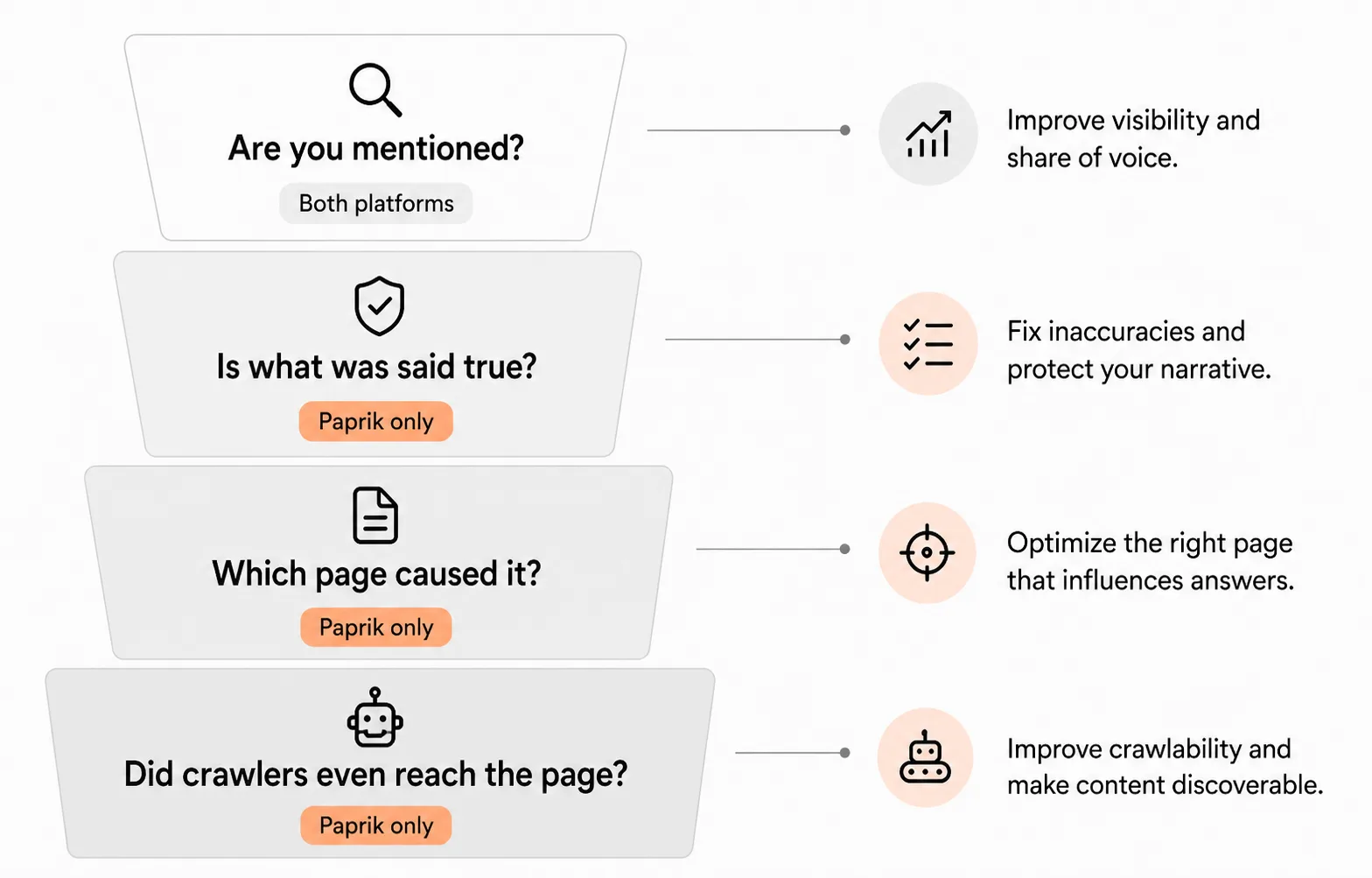
Is what AI says about your brand factually true?
A brand can be highly visible and consistently described wrongly, and no visibility metric will surface it. Sentiment does not close the gap either: a claim can be positive in tone and false in substance, like an award you never won or a certification you do not hold.
Paprik's Accuracy module verifies factual claims from AI answers against a Knowledge Hub of your own site content and documents and traces every incorrect claim back to the page that caused it. It reports how many inaccurate claims exist, what share trace to a specific page, how many domains are spreading them, and how many sit on your own site. That last number matters most, because an inaccuracy originating on your own pages is the fastest thing in AEO to fix.
Semrush reports sentiment. It does not check whether the description is true.
Which page actually caused the mention?
Most AEO tooling assumes a cited page drove a brand mention because both appeared in the same answer. That assumption fails far more often.
Paprik tested it on its own domain and has kept the test running since. Across six tracked brands, between 41% and 90% of the verified pages that co-occurrence credited with a brand's mentions do not mention that brand, and for Paprik itself the figure is roughly nine in ten - the full study is in the co-citation problem. The cause is plain once you look: answers to comparison and listicle prompts cite about a dozen sources at once, so a brand named in paragraph two and a citation attached to paragraph five sit side by side with nothing connecting them. Proximity is not attribution.
What did the engine search for behind your prompt?
Query fanout is the process by which an AI search engine decomposes one prompt into multiple sub-queries, runs them in parallel and synthesises the results. The sub-queries are where the retrieval decision happens.
Paprik surfaces the fan-out queries recorded against each tracked prompt, with frequency and last-seen date, and feeds them into on-site gap detection: it checks whether your page covers each sub-intent and flags entity gaps where the engine expects brands or concepts your page never mentions.
Semrush's Prompt Research works at the prompt level with AI Topic Volume and Topic Difficulty. It does not expose sub-queries.
Are AI crawlers reaching your pages at all?
A page AI crawlers never fetch cannot be optimised into an answer, and no amount of answer sampling will tell you that.
Paprik's Agent Analytics connects to your CDN provider and to Google Analytics 4, and reports which AI bots visited, how many requests they made, which pages they crawled, what share of requests were blocked or errored, and which AI platforms sent referral sessions to which landing pages.
Semrush's AI Search Site Audit infers AI readiness from your site configuration, and its AI Traffic Dashboard estimates referral traffic. Neither reads what actually happened.
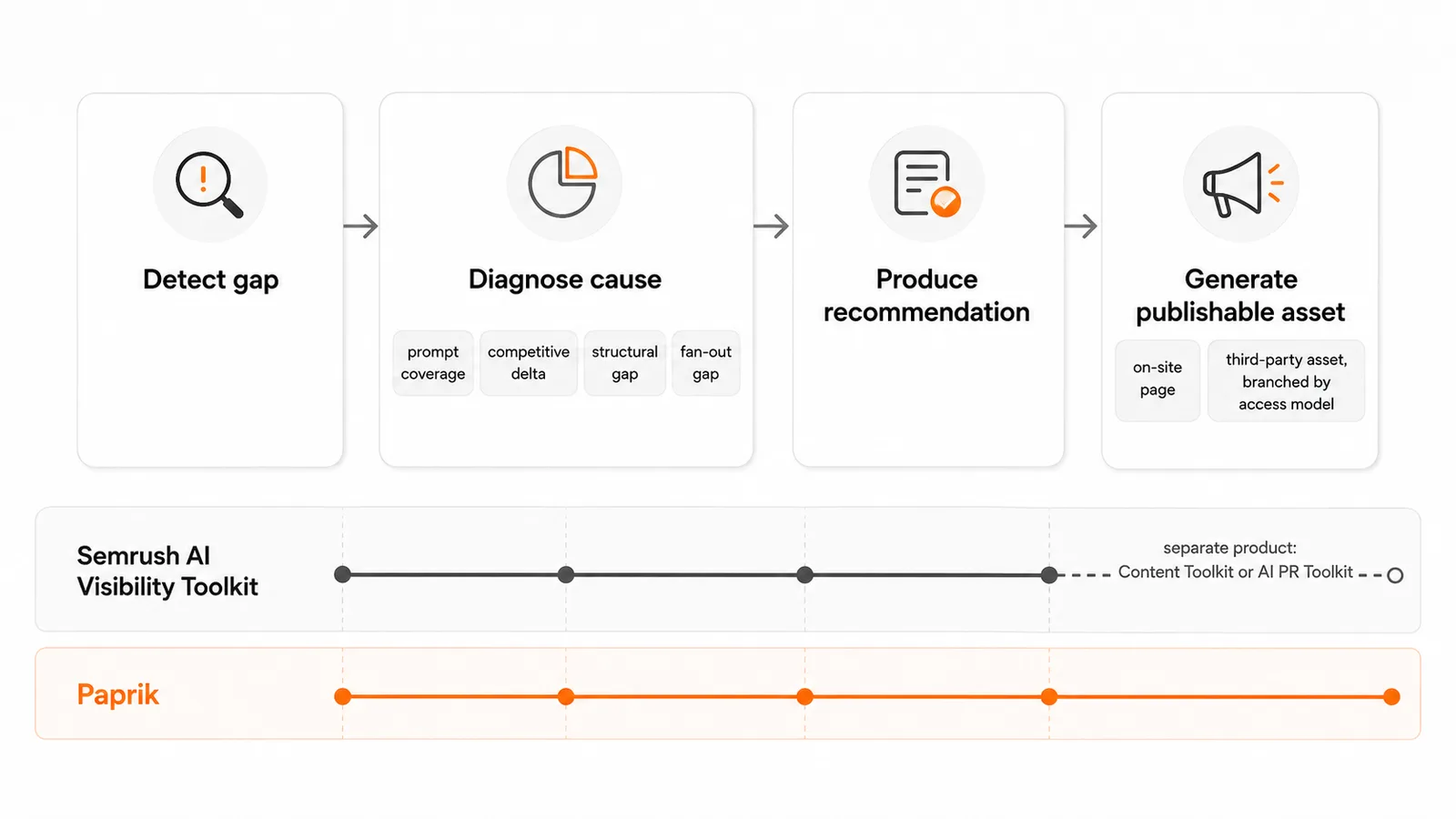
Paprik vs Semrush at a glance
Paprik | Semrush AI Visibility Toolkit | |
|---|---|---|
Entry price | $49/month (Solo) | $99/month per domain |
Mid tier | $199/month (Pro) | $99 base plus add-ons |
Tracked prompts | 20 Solo, 100 Pro, unlimited Enterprise | 25, plus $60/month per extra 50 |
Brands or domains | 1, 2, unlimited | 1, plus $99/month per extra domain |
Competitors | 5, 10, unlimited | Up to 4 |
Seats | Unlimited on every plan | From $45/month each |
Free trial | 7 days, no credit card | None on the standalone module |
Who selects the prompts behind the score | You do | Semrush does, except in Prompt Tracking |
Branded prompts excluded from visibility | Yes | Not documented for the headline score |
Factual accuracy auditing | Yes, with source tracing | No |
Attribution evidence tiers | Confirmed, Co-cited, Unverified | Not offered |
Fan-out query visibility | Yes, on ChatGPT | No |
AI crawler log analytics | Yes | No |
Off-page recommendations | Yes, classified by access model | Not in this toolkit |
Content generation | In-product, on-site and third-party | Separate product |
Agency structure | Organisations, workspaces, role-based invites | One subscription per domain |
Traditional SEO data | None | Full suite |
Compliance certifications | Not published | Enterprise-grade via Adobe |
From diagnosis to published asset
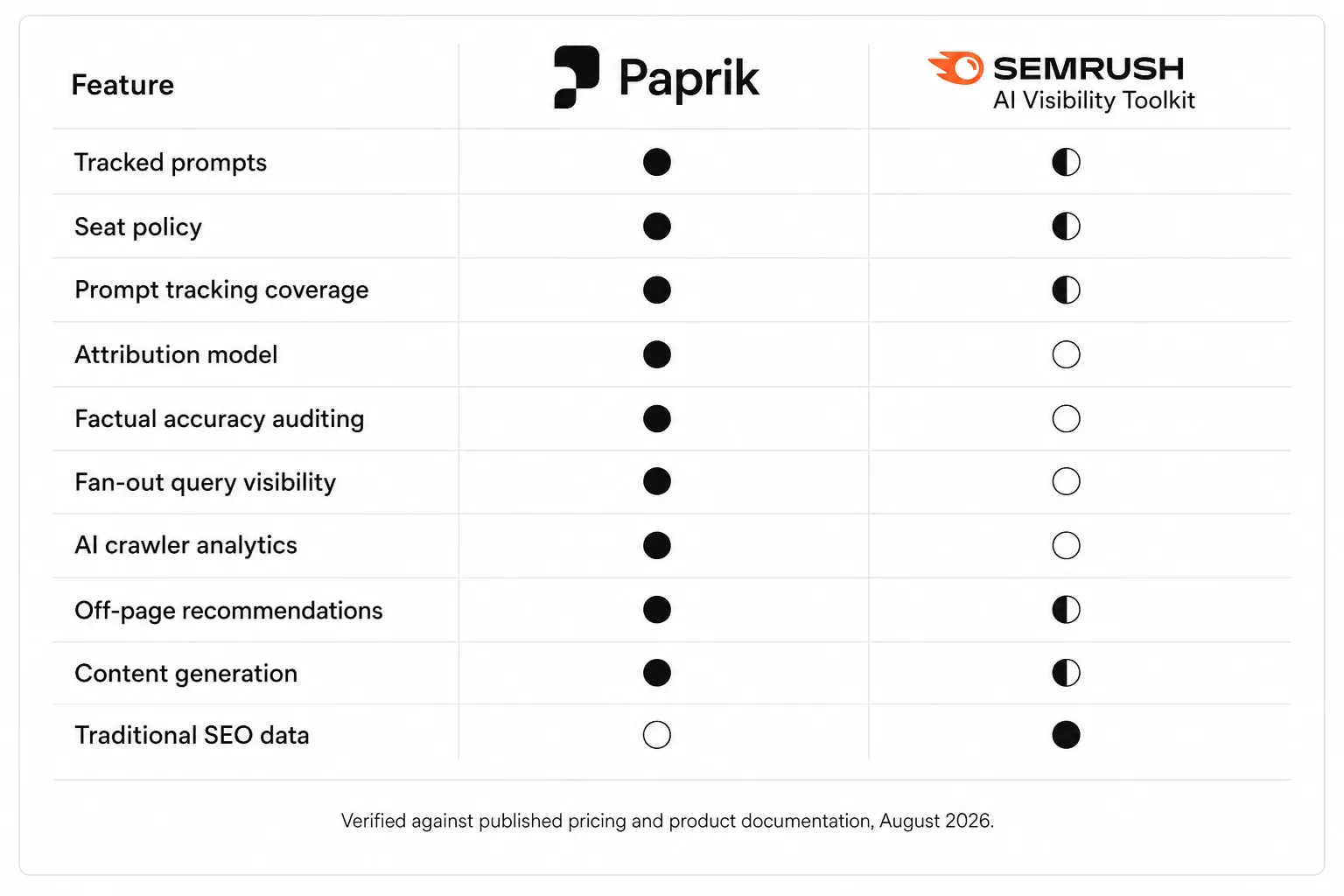
Semrush stops at recommendation. Paprik continues to the asset. This is what decides how much internal headcount each tool needs before anything changes.
Semrush's toolkit surfaces topic opportunities, source opportunities and technical AI-readiness issues, then hands them over. Content generation lives in its separate Content Toolkit, and outreach in its separate AI PR Toolkit. Reviewers have criticised the specificity of what comes back, citing recommendations at the level of "improve onboarding" or "increase brand awareness" that connect to no named prompt, page or source.
Paprik runs two execution tracks in one product.
On-site actions find the pages relevant to each tracked prompt, then compute four signals before writing anything: prompt coverage, structural comparison against the competitor pages currently being cited, structural gaps such as missing sections and page type mismatch, and fan-out coverage with entity gaps. Output is capped at five ranked gaps per page, each with its reasoning, evidence and affected prompts.
Third-party actions identify which external platforms drive citations in your category and classify each opportunity by how you can access it: self-publish, editorial pitch, partnership required, or indirect only. It not only provides you with the recommendation, but also helps you draft citable content based on your brand kit across all third party websites, including outreach emails for editorial websites.
The off-page half has no equivalent in Semrush's toolkit, and it is where most gains sit for challenger brands. Semrush's own research found ChatGPT had the lowest overlap with organic results of any platform studied, and its AI Mode study puts domain overlap with the organic top 10 at roughly 51 to 54 percent for the format appearing on 92 percent of AI Mode queries. If close to half of what gets cited is not what ranks, a toolkit whose action layer is a site audit is working the smaller half of the problem.
If you sell outside the US
Semrush covers India and 48 other countries, but its aggregated signals are weighted toward US query behaviour. At its last disclosed split, 126 million of 261 million prompts in the corpus were US prompts. Prompt Research volumes, topic opportunities and competitor gap analysis all inherit that weighting, and its flagship published research analysed 126 million prompts, all US.
Language changes the answer, not just the phrasing. A controlled study across 400 questions, four AI systems and five countries producing over 16,000 responses found that querying in the local language rather than English lifted Japanese domain citations from roughly 1 percent to 26 percent, French from 1.4 percent to 16 percent, and Spanish from about 1 percent to 7 percent. A separate analysis of 3.25 billion citations across seven models and 14 countries found comparable shifts in which sources get cited.
This is not a marginal market. India is OpenAI's second-largest, with 100 million weekly ChatGPT users as of February 2026, and Google AI Mode now serves seven Indian languages alongside English. Neither study covers India, and no published comparison runs identical prompts from US and Indian contexts, so measure your own category rather than inferring from aggregate signals.
Which is the point. Treat the aggregated layer of any AI visibility tool as category context, not as your performance. In Semrush that leaves the 25-prompt Prompt Tracking layer on two surfaces. In Paprik it is the whole product, since every metric already comes from prompts you wrote in the language your buyers use.
What each one costs
At 100 tracked prompts, two brands and five seats, Paprik costs $199 per month and Semrush costs roughly $498. The gap is metering, not base price.
Requirement | Semrush | Paprik |
|---|---|---|
25 prompts, 1 brand, 1 seat | $99/month | $49/month (20 prompts) |
100 prompts, 1 brand, 1 seat | $219/month | $199/month |
100 prompts, 2 brands, 1 seat | $318/month | $199/month |
100 prompts, 2 brands, 5 seats | $498/month | $199/month |
100 prompts, 2 brands, 10 seats | $723/month | $199/month |
Semrush charges $99 base for 25 prompts and one domain, $60 per additional 50 prompts, $99 per additional domain, and from $45 per additional user. Paprik Pro is flat at $199 with unlimited seats. If you already pay for Semrush for SEO, the marginal cost of the module is much lower than this table implies.
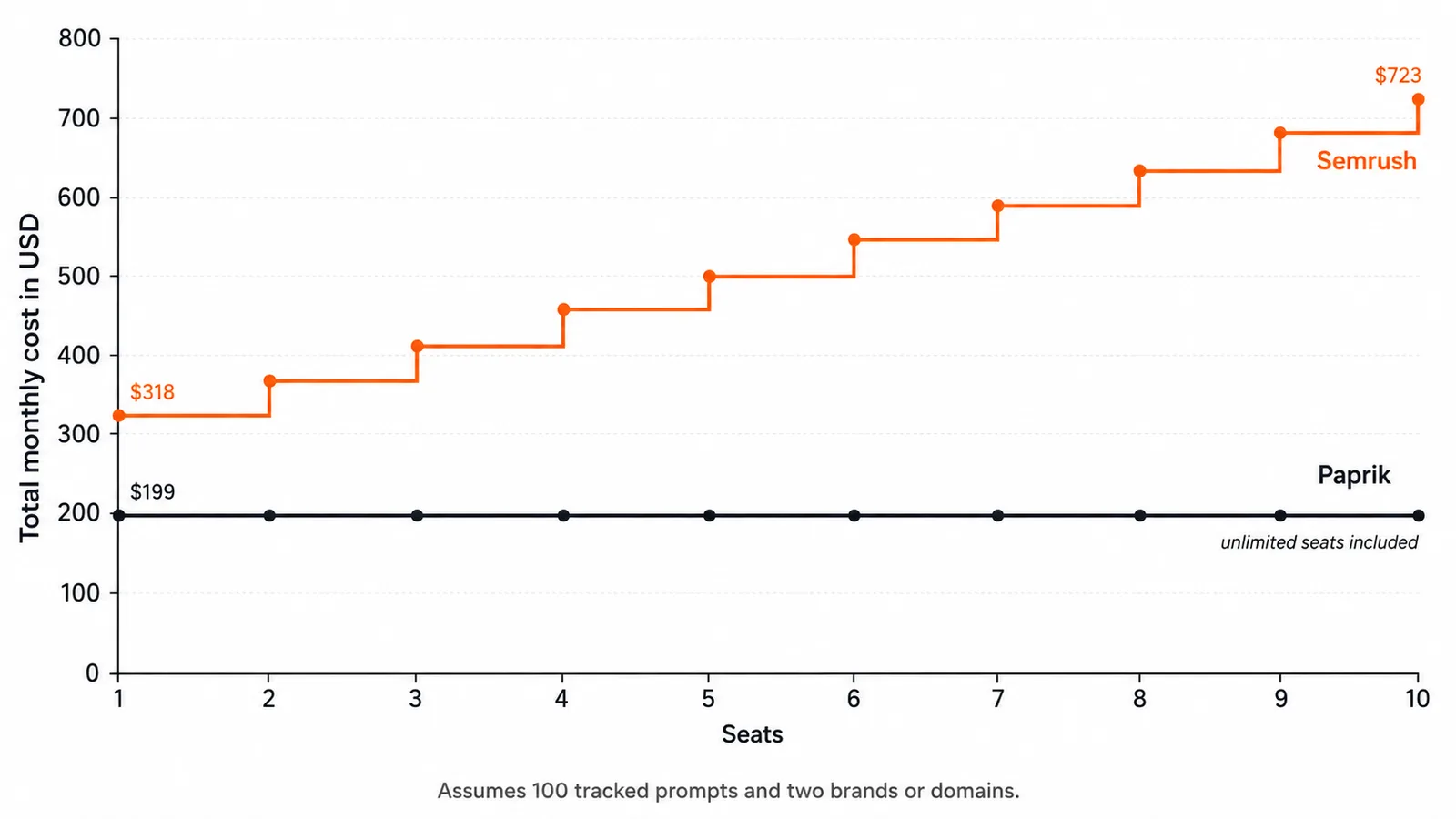
The per-prompt charge does more damage than the total. In SEO, your keyword universe is externally discoverable and tracking 200 more keywords is cheap. In AEO the prompt set is the measurement instrument, and there is no ground truth for which prompts your buyers type. Under a 25-prompt cap you must guess which questions matter before you have data on which questions matter, and the guess skews toward head prompts where incumbents already dominate. The resulting score is not wrong. It measures the wrong sample, biased toward telling you that you are losing.
Size your prompt set from your buying questions, then look at price. Most B2B categories have 40 to 80 distinct decision-stage questions once you separate comparison, recommendation and problem-definition prompts.
Where Semrush is the better choice
You already pay for Semrush. Adding AI visibility to an existing login removes a tool, a procurement conversation and a reporting reconciliation. That saving frequently outweighs feature depth.
You want AI and organic in one attribution story. Semrush's Domain Overview blends AI mentions and citations with organic keywords and backlinks. With roughly half of AI Mode's cited domains also in the organic top 10, running both from one dataset is defensible.
You need industry benchmarking, not just your own account. Index-scale data answers questions no account-level tool can. Semrush's 2026 index found the top three brands hold 82.9 percent of visibility in News and Media and 41.4 percent in Finance, which is useful for building an investment case.
You have procurement and compliance requirements. Post-Adobe, Semrush brings enterprise contracting and security review artefacts. Paprik does not publish SOC 2 Type II or HIPAA compliance, and enterprises requiring them should not shortlist it.
Running both is also reasonable. Semrush for SEO, benchmarking and technical auditing; Paprik for your prompt set, accuracy, attribution, crawler data and execution. Their two visibility scores will disagree, because they measure different samples. Treat each as a trend line inside its own tool.
Which one should you buy
If you are | Buy |
|---|---|
An SEO team adding AI reporting to existing workflows | Semrush |
An enterprise with compliance requirements | Semrush, or an enterprise AEO platform |
A growth team where AI visibility is someone's job | Paprik |
Fixing what AI says about you, not just how often | Paprik |
Working an off-page citation gap on Reddit, review sites and comparison pages | Paprik |
An agency running multiple client brands | Paprik |
Selling primarily outside the US | Paprik |
Whichever way you lean, four steps settle it faster than a feature list:
Write down 40 to 60 real buying questions first, from sales calls, support tickets and search console. Any plan that cannot hold them is undersized regardless of price.
Run five of them manually in ChatGPT and Google AI Mode, logged out, and screenshot the answers. That is your ground truth.
Ask which prompts the headline score is computed from. If the answer is a database you cannot see, that number is category context, not your performance.
Take one prompt where a competitor is cited and you are not, and follow the tool to an action. Count the steps between "you are not cited here" and "here is the asset to publish." That count is the product.
Key Takeaways
Semrush's headline AI Visibility Score is computed from a prompt set Semrush selects; only its 25-prompt Prompt Tracking layer, covering ChatGPT and Google AI Mode, uses prompts you write, while every Paprik metric comes from prompts you chose.
Four diagnostic questions sit outside Semrush's toolkit entirely: whether AI statements about your brand are true, which cited page actually caused a mention, what sub-queries the engine ran, and whether AI crawlers reached your pages.
Attribution by co-occurrence is unreliable: in Paprik's ongoing verification, roughly nine of every ten pages credited with driving its mentions do not mention the brand at all.
Semrush stops at recommendations while Paprik generates the on-site and third-party assets, which matters because close to half of what AI cites is not what ranks organically.
Semrush's $99 entry price reverses at scale, reaching roughly $498/month for 100 prompts, two brands and five seats against Paprik's flat $199 with unlimited seats.
Choose Semrush when you already own the suite, need SEO and AI visibility in one attribution story, or have compliance requirements Paprik does not publish against. Choose Paprik when improving AI visibility is the job rather than a line in the monthly SEO report.
How Paprik compares to the rest of the field: Paprik vs Peec, Paprik vs Profound, Paprik vs Otterly and Paprik vs Writesonic. Or start from the best AEO tools in India guide. New to the terminology? AEO vs GEO: What's the Difference?
Paprik is an AEO platform that tracks how your brand appears in AI-generated answers, verifies whether those answers are factually accurate, identifies which pages actually drive citations, and generates the content required to change the outcome. Seven-day free trial, no credit card, at paprik.ai.