Paprik vs Profound: which AI visibility platform should you use for AEO?
Profound is the enterprise standard; Paprik sells the audit, the software and the execution as one thing. Where each wins, with real pricing.
Author
Founder
Abhilash is the Founder of Paprik AI. He writes about AEO, AI search visibility, and how brands can win in AI-driven discovery.
TL;DR: Profound sells you software. Paprik sells you the software plus the people who run it: a paid audit that maps what your buyers actually ask AI before you commit, an optional done-for-you programme that executes the fixes, and a team in Indian business hours with a direct line to the roadmap. On features the two are close, and Profound is ahead on engine count, market coverage, prompt volume data and SOC 2. Buy Profound if you have an enterprise budget, a global footprint and a team in-house to act on a dashboard. Buy Paprik if you sell in India, or if your real problem is not knowing what AI says about you but having nobody to go and fix it.
Answer Engine Optimization (AEO), also called Generative Engine Optimization (GEO), is the practice of getting your brand cited and recommended inside AI answers on ChatGPT, Google AI Mode, Google AI Overviews, Perplexity, Gemini, Claude and Copilot, instead of ranked in a list of links. Profound is the category's enterprise standard, built in New York and priced in dollars. Paprik is built in India and sells the diagnosis, the software and the execution as one thing. Most comparisons of the two argue about features. That is the least useful way to choose between them.
The core difference: one sells you a dashboard, the other sells you the outcome
Profound gives you the best-instrumented view of AI search on the market and then hands you a to-do list. Paprik gives you a comparable view, a roadmap that says what to fix in what order, and the option of having someone else do the fixing.
That difference is structural, not a feature gap. Profound is a venture-funded US software company serving 10% of the Fortune 500. Its business is software licences at scale, and adding a services arm that maps your personas, builds your prompt bank and writes your Reddit replies would make it a different company. Paprik runs the AI Visibility Audit and a Done-For-You programme as core lines, not as onboarding.
Two things follow from that, and they decide most of these evaluations.
The first is where accountability sits. With Profound, the diagnosis is theirs and the execution is yours, or a second agency's. When visibility does not move, the dashboard and the doing sit with different parties and neither owns the number. With Paprik, one party can own both.
The second is what you can actually buy self-serve. Almost everything Profound is famous for sits above its two published tiers.
Capability | Starter, $99/mo | Growth, $399/mo | Enterprise |
|---|---|---|---|
Answer engines tracked | ChatGPT only | ChatGPT, Perplexity, Google AI Overviews | Up to 9, including Google AI Mode |
Prompts and responses per month | 50 prompts, 1,500 responses | 100 prompts, 9,000 responses | Custom |
Languages and regions | 1 and 1 | 1 and 1 | 30+ and 150+ |
Seats | 1 | 3 | Custom |
Agent credits per month | 100 | 400 | Custom |
Aim Projects, the earned and off-page layer | None | None | Yes |
Prompt Volumes searches | None | None | Custom |
API, SSO, SOC 2 | No | No | Yes |
Nearly every Profound case study you have read describes the far right column. What $399 buys is a tracker on three fixed engines, in one language, in one region, with a credit allowance on the content it writes.
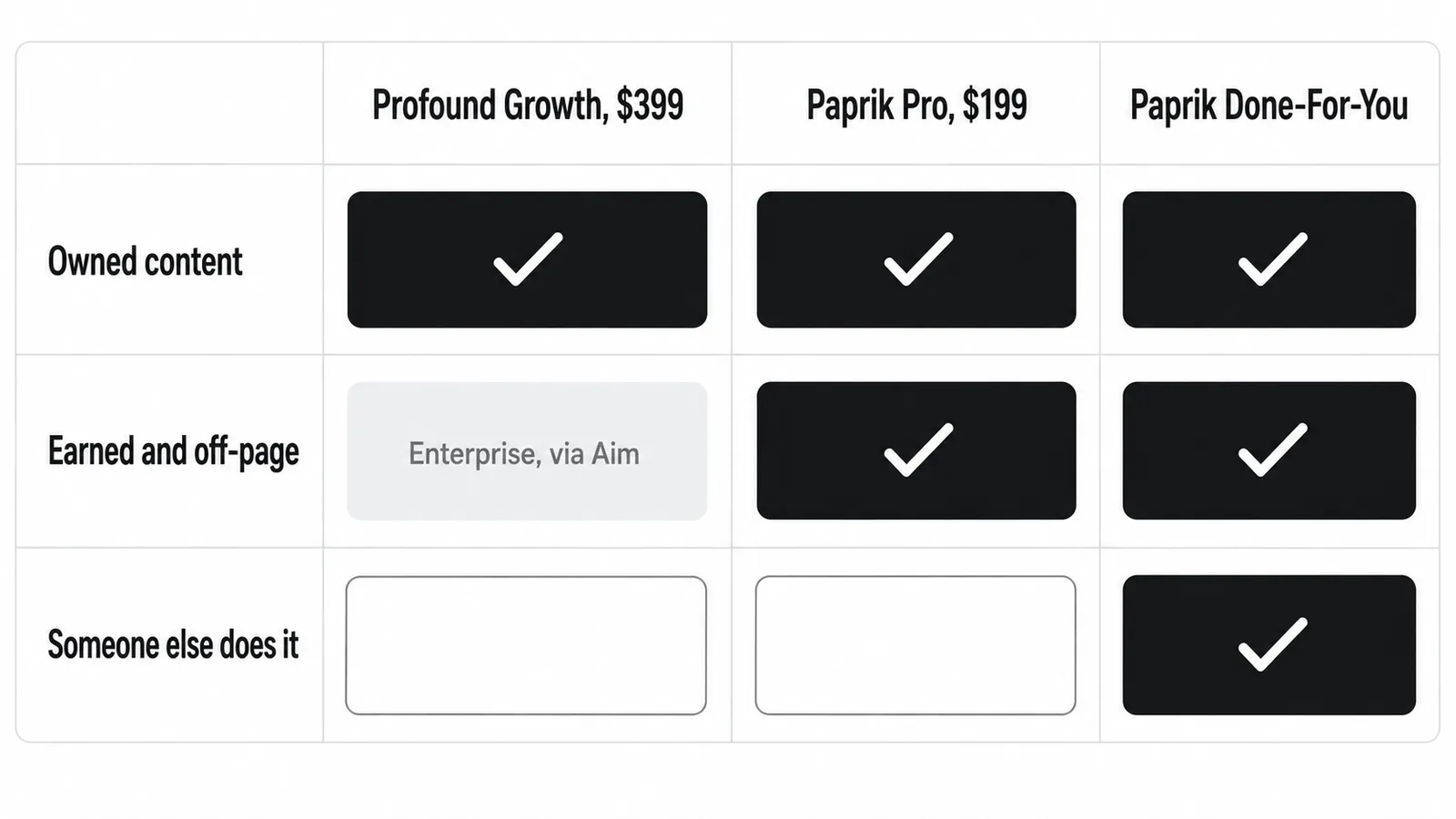
Paprik has its own ladder and you should see it before reading further. A standard plan tracks three AI platforms at a time per brand, and Accuracy, the fact-checking layer, is Enterprise. The difference is which rungs sit where: Paprik Pro at $199 picks any three of seven engines including Google AI Mode, tracks two brands, includes unlimited seats and uncapped content generation, and runs both on-site and off-page execution.
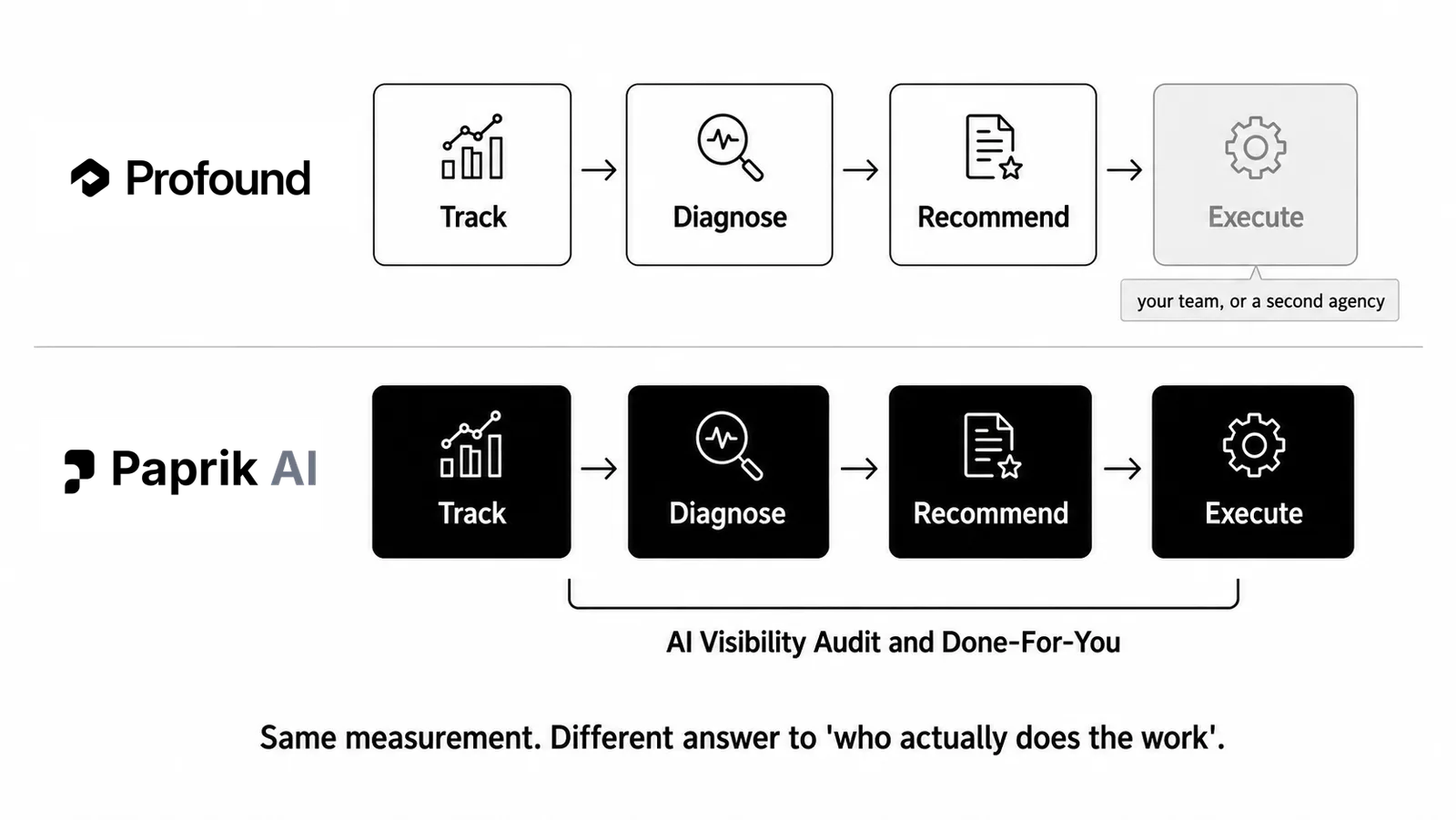
On measurement itself, these two products look alike. Both read answers from the live browsing surface rather than raw model APIs, which matters because API output reflects training data instead of live retrieval. Both run your prompts daily. Both report visibility, share of voice, sentiment, position, citations and competitors. Both surface the fan-out queries an engine runs behind your prompt. Both read AI crawler and referral traffic from your CDN or analytics. Both check whether AI is stating something false about you, though Profound ships that from its entry tier and Paprik reserves it for Enterprise.
Anyone selling you a feature-parity argument in either direction is arguing about the wrong thing.
What Paprik gives you that Profound structurally cannot
An audit that starts with your buyers, not a dashboard on day one
Profound gives you numbers on day one and leaves the interpretation to you. Paprik's AI Visibility Audit gives you a prioritised plan before you have a dashboard at all.
The audit is a paid engagement, not a pre-sales giveaway. It identifies the stakeholder personas who actually ask AI about your category, maps the real questions each of them asks and where your brand is exposed, builds a prompt bank from that mapping rather than from a keyword list, runs those prompts daily across the AI engines, and hands back a short, mid and long-term roadmap covering visibility, share of voice, accuracy and sentiment.
The reason this matters is that prompt selection is the whole measurement instrument in AEO. There is no ground truth for which questions your buyers type, no keyword volume file to import. Every tool in the category, Profound included, starts you with suggested prompts and lets you edit them, which means your score is only as good as a list you guessed at in week one. An audit run by people who have done it before is the difference between measuring the right sample and measuring confidently in the wrong direction.
It is consulting-grade work delivered by the team that also owns the tracking platform. A software vendor gives you a dashboard and no roadmap. A consultancy gives you a roadmap and no daily measurement. This is both, and because you pay for it, it gets read.
Someone who will actually do the work
Paprik will run the AEO programme end to end. Profound will not, and a US software company at its scale structurally cannot.
Done-For-You covers setup, the prompt and competitor configuration, continuous optimisation, execution of the recommendations across both your own site and third-party platforms, and monthly reporting on visibility and gaps. It is sold separately from the subscription, and it is available internationally rather than only in India.
The sales point is single accountability. If AI visibility is a board-level number for you this year, the question is not which dashboard is prettier. It is who is on the hook when the number does not move in Q3. Profound's answer is your content team. Paprik's answer can be Paprik.
This is also the honest route for teams who like Profound's product but have nobody to act on it. A $399 subscription that generates recommendations nobody has time to implement is more expensive than a service that ships the work.
Rupees, your business hours, and people you can actually reach
Profound bills in dollars, answers on US time, and routes your feature request into a global roadmap queue. For an Indian growth team those three facts cost more than the licence does.
Paprik prices in rupees for Indian customers, at ₹3,333 a month for Solo and ₹11,666 for Pro, with annual billing at ₹39,990 and ₹139,990. USD pricing is available for everyone else. The saving is real, but the procurement unlock matters more: no FX exposure, no forex markup on a corporate card, no finance team approving an overseas subscription in dollars.
Support runs in Indian business hours from people who have worked inside Indian marketing orgs and know how approvals actually run here. A US or EU vendor answers overnight, on their calendar, with playbooks written for US SaaS org charts. That is a lived-experience gap rather than a staffing one, and it shows up in how long a simple question takes to resolve.
Because Paprik is early stage, you also get senior attention as standard and a direct line into what gets built. Requests get heard and shipped in weeks instead of disappearing into a roadmap serving thousands of enterprise accounts. A mid-market Indian brand is not getting that from a company at Profound's scale, and it is the clearest advantage of buying from a smaller vendor.
The answers your buyers actually get, and the sibling companies told apart
AI answers are geo-specific, and an Indian brand measured against a globally-configured tool is often reading someone else's answer set. Different competitors surface, different publications get cited, different communities carry the conversation.
Both products can target by country and language. The gap is judgment rather than capability: knowing which Indian competitors, publications and communities actually matter in your category, and building the prompt bank around them. That lives in the audit and the service. It is worth noting that on Profound, region and language targeting beyond a single market is an Enterprise capability, while both of Paprik's paid plans track wherever your prompts point.
Group structure is the sharper version of this problem. Indian markets are full of multi-entity groups sharing one family name, and AI routinely attributes one group company's facts, figures and failures to another. Paprik distinguishes a sibling, parent or affiliate from the tracked brand even when the names are nearly identical, instead of collapsing them into one entity. This was built because a conglomerate customer hit exactly this problem. A tool designed for single-brand US SaaS has no reason to solve it, and for a large Indian group it is the difference between a usable report and an unusable one.
Which page actually caused the mention
Most AEO tools assume a cited page drove your brand mention because both appeared in the same answer. That assumption breaks more often than the category admits.
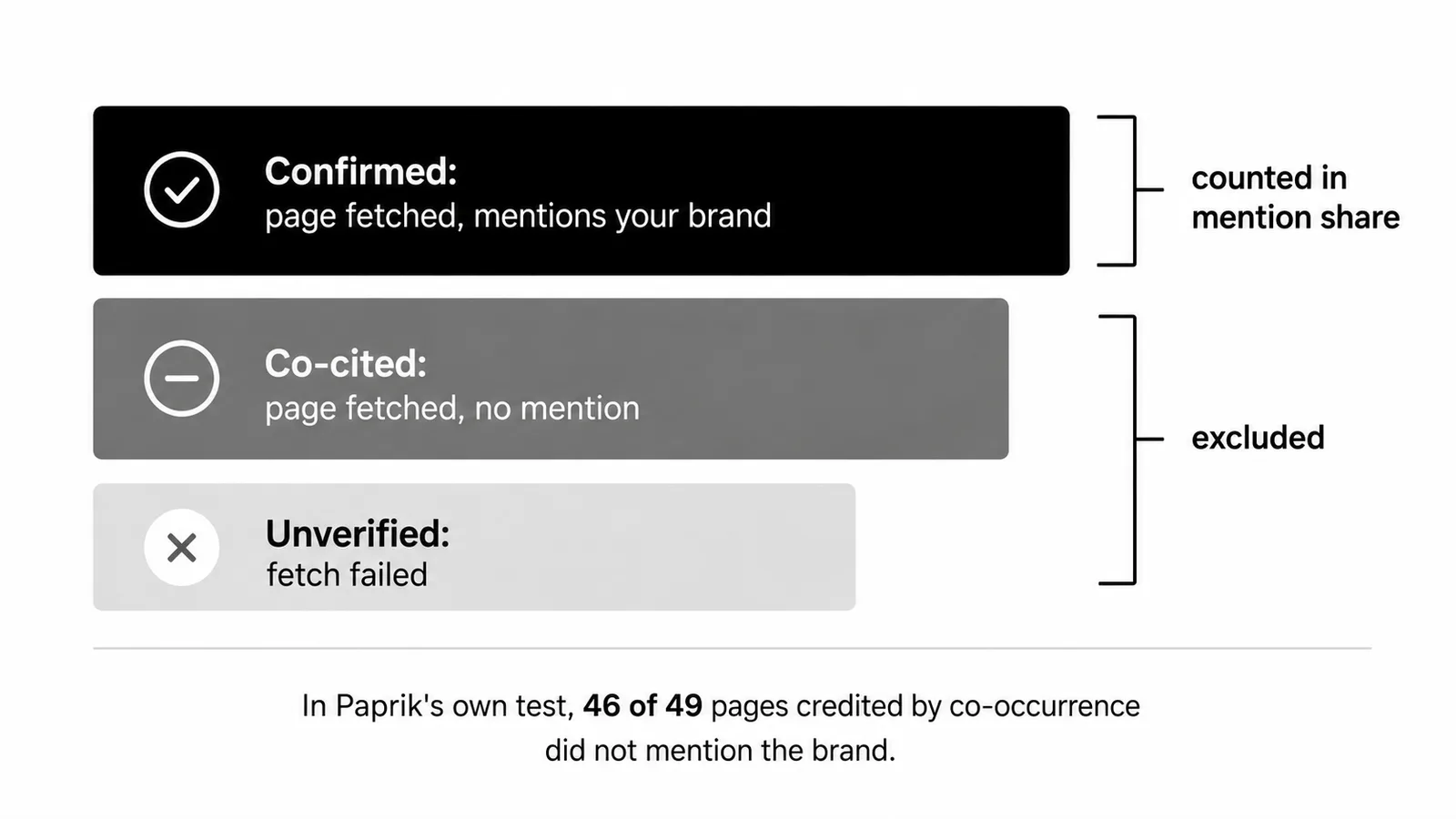
Paprik tested it on its own domain and has kept the test running since. Across six tracked brands, between 41% and 90% of the verified pages that co-occurrence credited with a brand's mentions do not mention that brand, and for Paprik itself the figure is roughly nine in ten - the full study is in the co-citation problem. The cause is plain once you look: answers to comparison and listicle prompts cite about a dozen sources at once, so a brand named in paragraph two and a citation attached to paragraph five sit side by side with nothing connecting them. Proximity is not attribution.
So every page in Paprik's Visibility Sources view carries an evidence tier. Confirmed means the page was fetched and mentions your brand. Co-cited means it was fetched and does not. Unverified means the fetch failed. Mention share ignores Co-cited pages.
Profound's Citation Authority answers a different question and answers it well: which domains carry weight in your category and how that is shifting. Use it to decide where to go earn presence. It will not tell you which page put your name in yesterday's answer, and acting on that mistake costs you a quarter of optimising pages that never mentioned you.
Paprik vs Profound at a glance
Paprik | Profound | |
|---|---|---|
Entry price | $49/month, Solo | $99/month, Starter |
Working tier | $199/month, Pro | $399/month, Growth |
Local billing in India | Yes, INR pricing | No, USD only |
Support hours | Indian business hours | US hours |
AI audit with a roadmap | Yes | No |
Done-for-you execution | Yes, available internationally | No |
Prompts at working tier | 100, shared across brands | 100 |
Engines at working tier | Any 3 of 7, your choice | 3 fixed: ChatGPT, Perplexity, Google AI Overviews |
Google AI Mode in working tier | Yes | No |
Engines tracked at once | Up to 7 | Up to 9 |
Brands tracked on working tier | 2 | 1 |
Seats on working tier | Unlimited | 3 |
Content generation | Yes, uncapped | 100 or 400 credits a month |
Off-page and earned actions | Yes | Enterprise only |
Sibling and group company handling | Yes | No |
Influential pages | Yes | No |
Factual accuracy auditing | Yes | Yes |
Fan-out query visibility | Yes | Yes |
AI crawler and referral analytics | Yes | Yes |
Real user prompt volume data | No | Yes |
Regions and languages | Unlimited | 2 |
Compliance certifications | None | Yes |
Free trial | Yes | Only on Growth plan |
What changes in your week
Both products carry a diagnosis through to a publishable asset. They split on which half of AEO that asset belongs to, and on who is expected to write it.
Profound's Agents own the on-site loop and are excellent at it. Templates cover refreshing pages losing citation share, generating FAQs in the format engines prefer, briefing competitive research and writing new articles, each researched against what is currently cited before drafting, with a human approval step and direct publishing to your CMS. A drag-and-drop builder lets a marketer wire up custom workflows, and Sheets runs them across hundreds of rows at once. If your problem is that your own site does not answer the questions your buyers ask, this is the strongest execution layer in the category.
Earned and social work lives one tier up. Aim is the layer that spots the roundup you were left out of, the Reddit thread answering your highest-volume prompt without naming you, and the reviews shaping your AI summary, then turns each into a project with tasks. Projects are Enterprise only.
Paprik runs both tracks on Pro. On-site actions find the pages tied to each tracked prompt, then work out how well the page covers the prompt, how it compares structurally to the competitor pages currently being cited, what is structurally missing, and which fan-out sub-queries and entities the page never addresses. You get a maximum of five ranked gaps per page, each with its reasoning and the prompts it affects. Third-party actions find which external platforms drive citations in your category, then sort each opportunity by how you can get in: self-publish, editorial pitch, partnership required, or indirect only. Strategy and draft both branch on that, which is what stops the product from writing you a guest post pitch for a site that does not take them.
Both tracks are Pro and above. On Solo the actions layer is switched off entirely, so treat Solo as measurement only.
Then there is the third option neither tier chart shows. With Done-For-You, what changes in your week is that this work leaves your week. The recommendations get implemented by the people who generated them, and you read a monthly report on visibility and gaps.
What each one costs
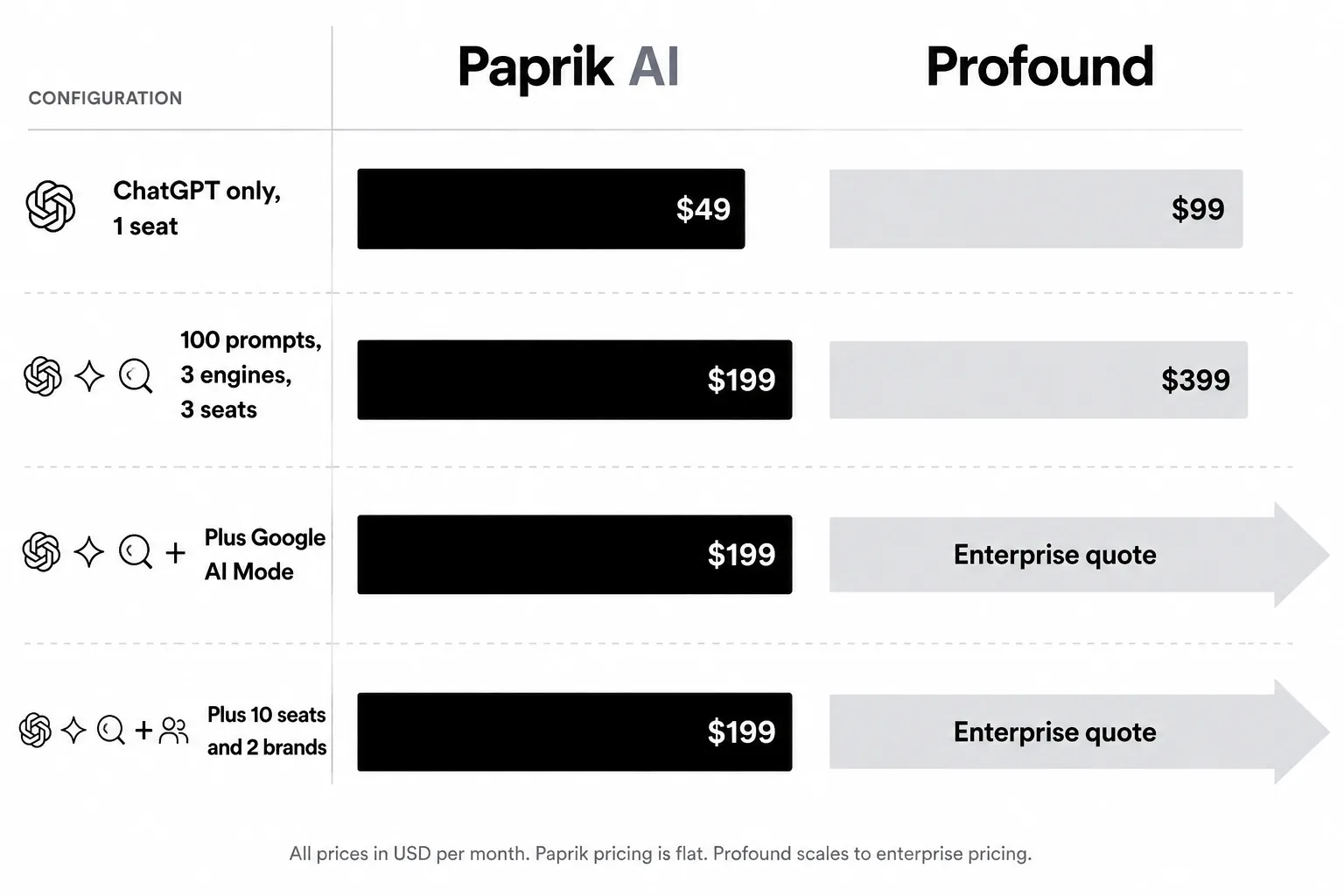
Profound costs $50 more at entry and roughly double at the tier you will actually work in, and then it stops being a price comparison, because adding a person, a brand or Google AI Mode puts you in a sales cycle.
What you need | Profound | Paprik |
|---|---|---|
ChatGPT only, 1 seat, entry tier | $99/month, 50 prompts | $49/month, 20 prompts |
100 prompts, 3 engines, 3 seats | $399/month, engines fixed | $199/month, any 3 of 7 |
Same, with Google AI Mode tracked | Enterprise quote | $199/month |
Same, 10 people with logins | Enterprise quote | $199/month |
Same, second brand tracked | Enterprise quote | $199/month, 100 prompts shared |
Content generation | 400 credits a month | Uncapped on Pro |
Both list monthly prices and both give two months free on annual billing. In rupees, Paprik is ₹3,333 and ₹11,666 a month.
Profound wins the entry comparison on volume: $99 buys 50 tracked prompts against Paprik Solo's 20 at $49. If ChatGPT-only tracking for one brand is the whole job, you get more measurement per dollar there. That flips at the next tier and does not flip back.
Two details to size before you commit. Paprik Pro's 100 prompts are shared across both brands rather than 100 each, which is workable for most B2B categories but worth checking against your question list. And Profound meters the two things you use more of as a programme matures: seats, at one and three, and generated content, at 100 or 400 credits a month. Paprik caps neither. A credit balance turns every draft into a small internal negotiation, and teams under a meter run fewer experiments, which is the wrong instinct in a discipline where the feedback loop already runs three weeks.
The three Enterprise-quote rows are the real finding. None of those requirements is unusual. Two brands, five people and Google AI Mode is an ordinary setup for a Series A company, and it costs $199 at Paprik and a scheduled call at Profound.
Where Profound is the better choice
You need to watch more surfaces, or more markets, than three. Profound Enterprise tracks up to nine engines at once, including Grok and DeepSeek, which Paprik does not cover at all, and supports 30+ languages and 150+ regions. Paprik's menu is seven engines with three tracked simultaneously per brand on a standard plan. If you are covering eight countries or five engines, Profound is built for that and Paprik is not.
You want fact-checking without an enterprise contract. Profound's FactCheck surfaces inaccurate claims about your brand and the pages spreading them, from the Starter tier up. Paprik's equivalent, Accuracy, is an Enterprise feature. If catching AI getting your brand wrong is the reason you are buying, Profound sells you that today at $99.
You have compliance and procurement to clear. Profound is SOC 2 Type II compliant with SSO and role-based access control, and it raised a $96M Series C at a $1 billion valuation in February 2026, which answers the vendor-longevity question procurement will ask. Paprik publishes neither SOC 2 Type II nor HIPAA. It is also a smaller company, so what you gain in senior attention you give up in formal SLAs and support depth. If you need certifications and a 24-hour contractual response, do not shortlist Paprik.
You need to know what people actually ask. Prompt Volumes is panel data from opted-in consumers showing the real queries people send AI engines, broken out by region and demographic. Paprik has nothing that answers this, and neither does anyone else. Treat the numbers as directional, since engines reformulate queries and follow-ups inflate counts, but directional beats guessing.
Running both makes sense at the top of the market: Profound for dataset breadth, engine coverage and the board deck, Paprik for daily prompt work and execution. Below an enterprise budget, running both just means paying twice for tracking.
Which one should you buy
If you are | Buy |
|---|---|
An enterprise brand with an AEO budget and a procurement process | Profound |
Tracking eight markets in six languages | Profound |
Buying primarily to catch AI stating false facts about you | Profound |
Sizing real demand before committing to a category | Profound |
An Indian brand paying in rupees | Paprik |
An Indian group or conglomerate with sibling brands AI keeps confusing | Paprik |
Sure you need AEO but unsure which questions to measure | Paprik, starting with the audit |
Without anyone in-house to implement the recommendations | Paprik Done-For-You |
A growth team where AEO is one person's job, not a department | Paprik |
Tracking Google AI Mode on a fixed budget | Paprik |
An agency running client brands without a sales cycle | Paprik |
Four steps settle this faster than any feature list.
Decide who is doing the work before you compare dashboards. If the honest answer is nobody, a cheaper licence does not help you and a service does.
Write down 40 to 60 real buying questions, from sales calls, support tickets and search console. Any plan that cannot hold them is undersized whatever it costs. If you cannot produce that list, that is what the audit is for.
Check which engines each tier tracks and how many at once. This is where both vendors ladder hardest, and it moves the price by a factor of two or more.
Take one prompt where a competitor is cited and you are not, and follow each tool to a published asset. Count the steps, then count how many of them somebody on your team actually has time to take.
Key Takeaways
Profound sells software and hands execution back to you, while Paprik sells the audit, the software and an optional done-for-you programme, which is a structural difference a venture-funded US vendor cannot copy without becoming a different company.
Almost everything Profound is known for, including Google AI Mode, the Aim earned-media layer, Prompt Volumes searches, multi-region tracking and SOC 2, sits above its $399 Growth tier.
For Indian buyers, rupee billing, support in local business hours and a direct line to the roadmap remove more friction than the licence saving does, and none of the three is available from a US vendor at any price.
Profound fixes which engines each tier watches, while Paprik Pro lets you pick any three of seven including Google AI Mode.
Attribution by co-occurrence is unreliable: in Paprik's ongoing verification, roughly nine of every ten pages credited with driving its mentions do not mention the brand at all.
Choose Profound when you need nine engines, many markets, prompt volume data, fact-checking on a self-serve budget, or compliance Paprik does not publish against. Choose Paprik when you sell in India, when nobody in-house has time to implement the fixes, or when you do not yet know which questions to measure.
How Paprik compares to the rest of the field: Paprik vs Peec, Paprik vs Semrush, Paprik vs Otterly and Paprik vs Writesonic. Or start from the best AEO tools in India guide. New to the terminology? AEO vs GEO: What's the Difference?
Paprik is an AEO platform built in India that tracks how your brand shows up in AI answers across seven engines, identifies which pages actually drive your citations, and generates the on-site and off-page content needed to change the outcome. It is also sold as a paid AI Visibility Audit and a done-for-you programme for teams who would rather have the work done than have it recommended. Seven-day free trial on every plan, no credit card, at paprik.ai.