How Is AI Visibility Calculated? What the Percentage Means and Where It Goes Wrong
AI visibility is the share of AI answers to your buyers' questions that name your brand, worked out per day and per engine and then averaged. How the number is built, why one check can't produce it, and the decisions about what counts as a mention that quietly move it.
Author
Founder
Abhilash is the Founder of Paprik AI. He writes about AEO, AI search visibility, and how brands can win in AI-driven discovery.
There's a moment on most calls with a prospective client when the dashboard is on screen and someone points at the number. "Where does this 9% come from? What does that mean? How do you calculate that?" It's the right question. And more so in a new category.
Here is the short answer. AI visibility is the share of AI answers to your buyers' questions that name your brand. You ask a fixed set of questions to each AI engine every day, check each answer for your brand, work out the share for each day, and average those daily shares over the period.
The calculation, step by step
Pick the questions your buyers ask. These are the instrument. Choose the questions people ask before they've picked a brand ("best dictation app for Mac", "best CRM for small startups" etc.), not the keywords you rank for. Our guide on how to track AI visibility covers how to choose them.
Ask every engine, every day. The same questions, to ChatGPT, Google AI Overviews, AI Mode, Gemini, Copilot and whichever other engines matter to your buyers. Our guide on which AI engines matter in India covers how to choose AI engines in India.
Read each answer and decide whether it names you. This is where most of the judgement sits, and it gets its own section below.
Work out each day's share. Answers that named you, divided by answers that day.
Average the daily shares over the period.
Calculate visibility per AI engine and across AI engines
A simplified example, for one engine and three days, with 19 questions a day:
Day | Answers | Named you | Daily share |
|---|---|---|---|
Monday | 19 | 2 | 10.5% |
Tuesday | 19 | 1 | 5.3% |
Wednesday | 19 | 3 | 15.8% |
Visibility |
|
| 10.5% |
Why average the days instead of adding everything up? Because engines don't answer every question every day. If one engine fails on half the questions on Tuesday, adding up the raw answers would quietly make Tuesday count for less. Averaging the daily shares keeps every day equal, so a bad collection day doesn't bend the trend.
Why one check in AI can't produce this number
Most teams first check their AI visibility by typing one question into ChatGPT. It feels like they know if their brands AI visibility. But that is just one draw from a number that moves every day.
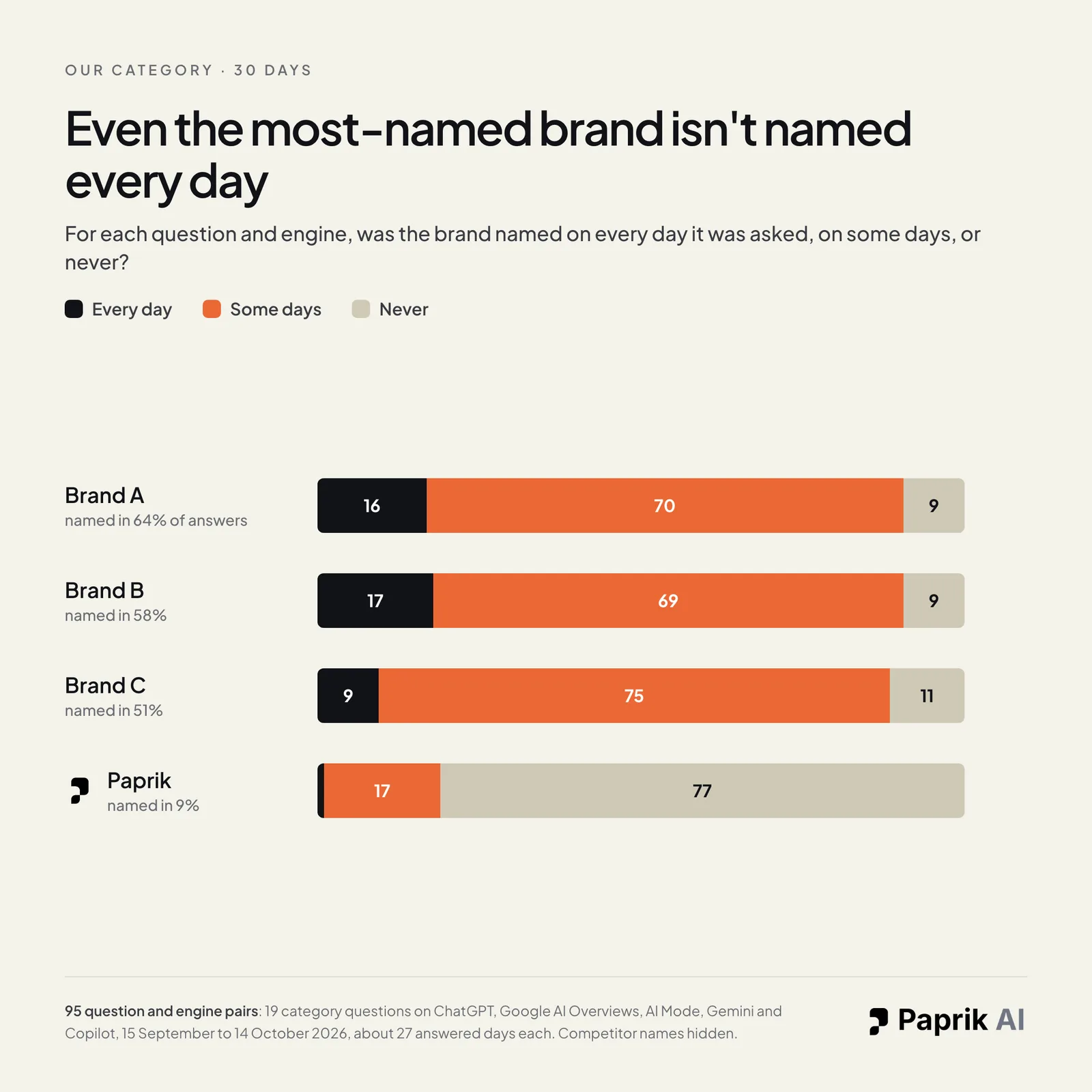
Take the most-named brand in our category. Over 30 days it was named in 64% of answers. Yet on only 16 of the 95 question-and-engine combinations was it named every single day. On 70 of them, it was named on some days and not others.
The daily figure swings too. On Gemini, the same brand, on the same 19 questions, was named in 42% of answers on its worst day and 79% on its best. Neither day was wrong. Both were samples.
Engines also disagree with each other. Over the same 30 days that brand was named in 77% of ChatGPT's answers and 58% of Copilot's. An all-engines figure is useful as a summary, but the decisions are made engine by engine.
This is also why personalisation doesn't break the measurement. Engines reshuffle a fairly stable shortlist from answer to answer rather than inventing a new one for each person. We tested that in whether AEO tracking means anything if AI personalises every answer. Repeated daily sampling is what turns that reshuffling into a stable number.
Keep branded and category questions apart
A question that names your brand ("Is Paprik AI a good tool?") names you in the answer almost by definition. Mixed in with category questions, it lifts your visibility without saying anything about whether buyers who haven't heard of you will find you. Report the two separately. The category figure is the one that tells you whether you're being recommended.
Visibility is one of several numbers
Visibility says whether you're named. It doesn't say how much of the conversation you hold, which sources the answers relied on, or what the answers said about you. Share of voice, citation rate, sentiment and accuracy answer those, and they move independently. We cover all five in how to track AI visibility.
A good visibility number, then, is one where you know the questions, the engines, the number of days, and the rule for what counts as a mention.