Market cap does not buy AI visibility. Here is what does.
We read 4,096 answers from seven AI engines about Indian companies, collected over ten days. Across the 32 largest, what a company is worth explains almost nothing about how often AI names it.
Author
Founder
Abhilash is the Founder of Paprik AI. He writes about AEO, AI search visibility, and how brands can win in AI-driven discovery.
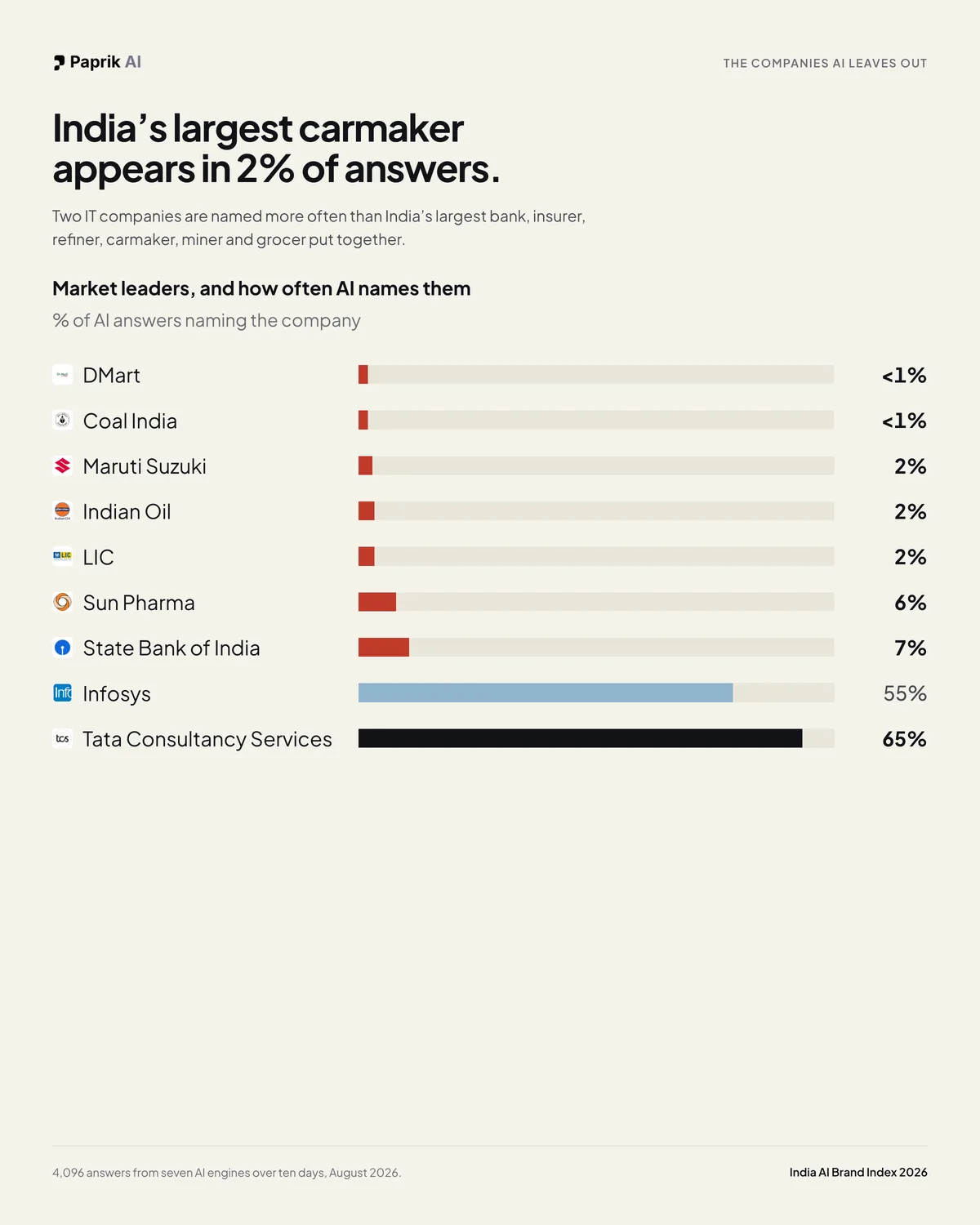
Maruti Suzuki builds around 2 in every 5 cars sold in India. But when you ask an AI engine about Indian business and it appears in 2% of answers. Coal India, the largest coal producer on earth, comes in under 1%.
We found that while building the India AI Brand Index: We collected 4,096 complete answers from ChatGPT, Gemini, Claude, Copilot, Perplexity, Google AI Mode and Google AI Overviews, collected on ten separate days, with every company named in each one recorded.
Size of a company explains almost nothing
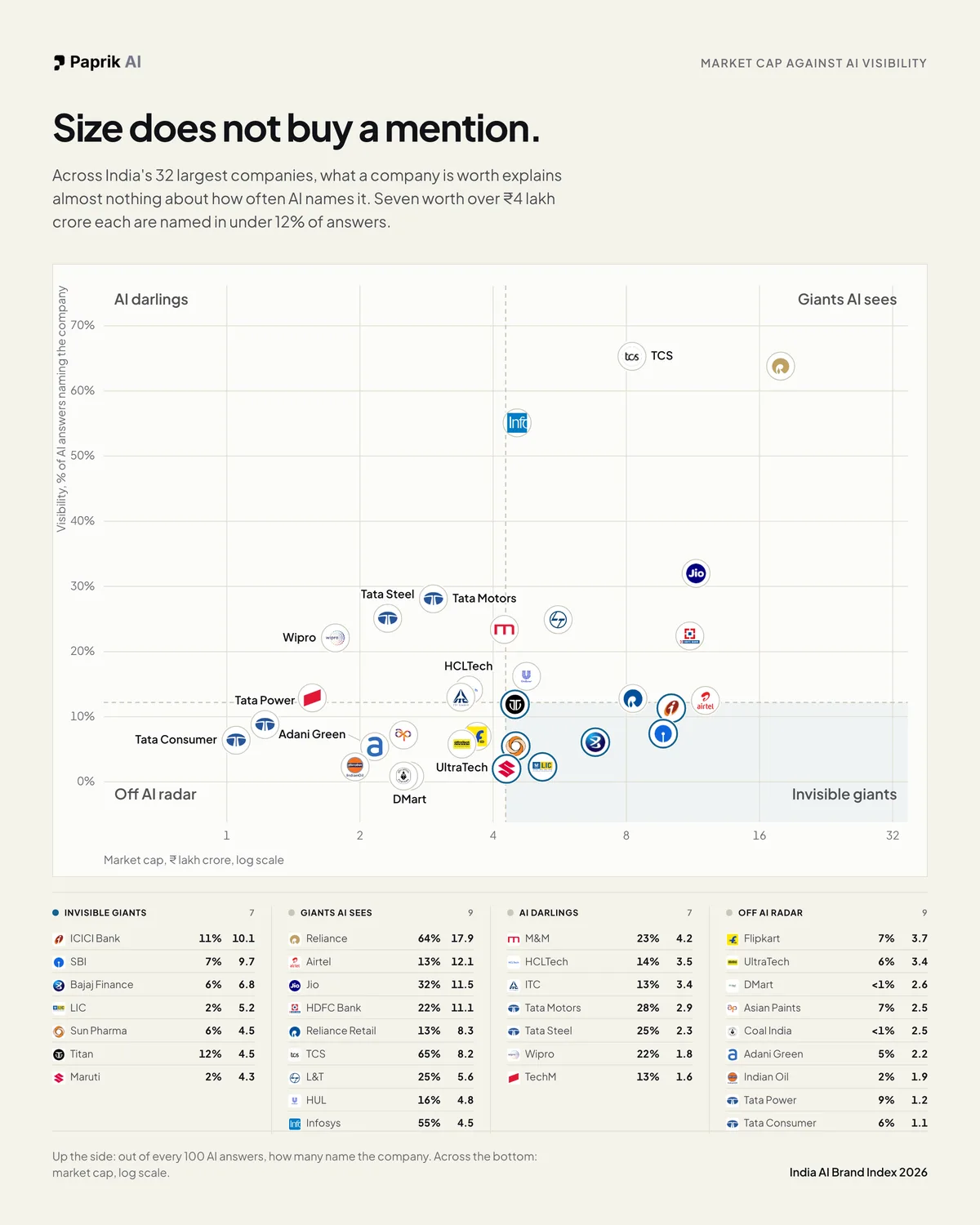
The obvious explanation for Maruti is that AI favours large companies and it somehow does not qualify. But across the 32 largest Indian companies we tracked, market cap and how often AI names a company have a rank correlation of 0.34.
The cleanest case is two banks. HDFC Bank and ICICI Bank are within 9% of each other in market cap. HDFC Bank is named in 22% of answers, ICICI Bank in 11%. One is named twice as often as the other, and nothing about their size accounts for it.
Seven companies each worth over ₹4 lakh crore are named in under 12% of answers: ICICI Bank, SBI, Bajaj Finance, LIC, Sun Pharma, Titan and Maruti. About ₹45 lakh crore of Indian company value that AI engines rarely name. We have been calling them the invisible giants.
What the engines are actually reading
If size does not explain the gap, the sources might. When an AI engine backs a claim with a citation, it names where the claim came from, and we recorded those too.
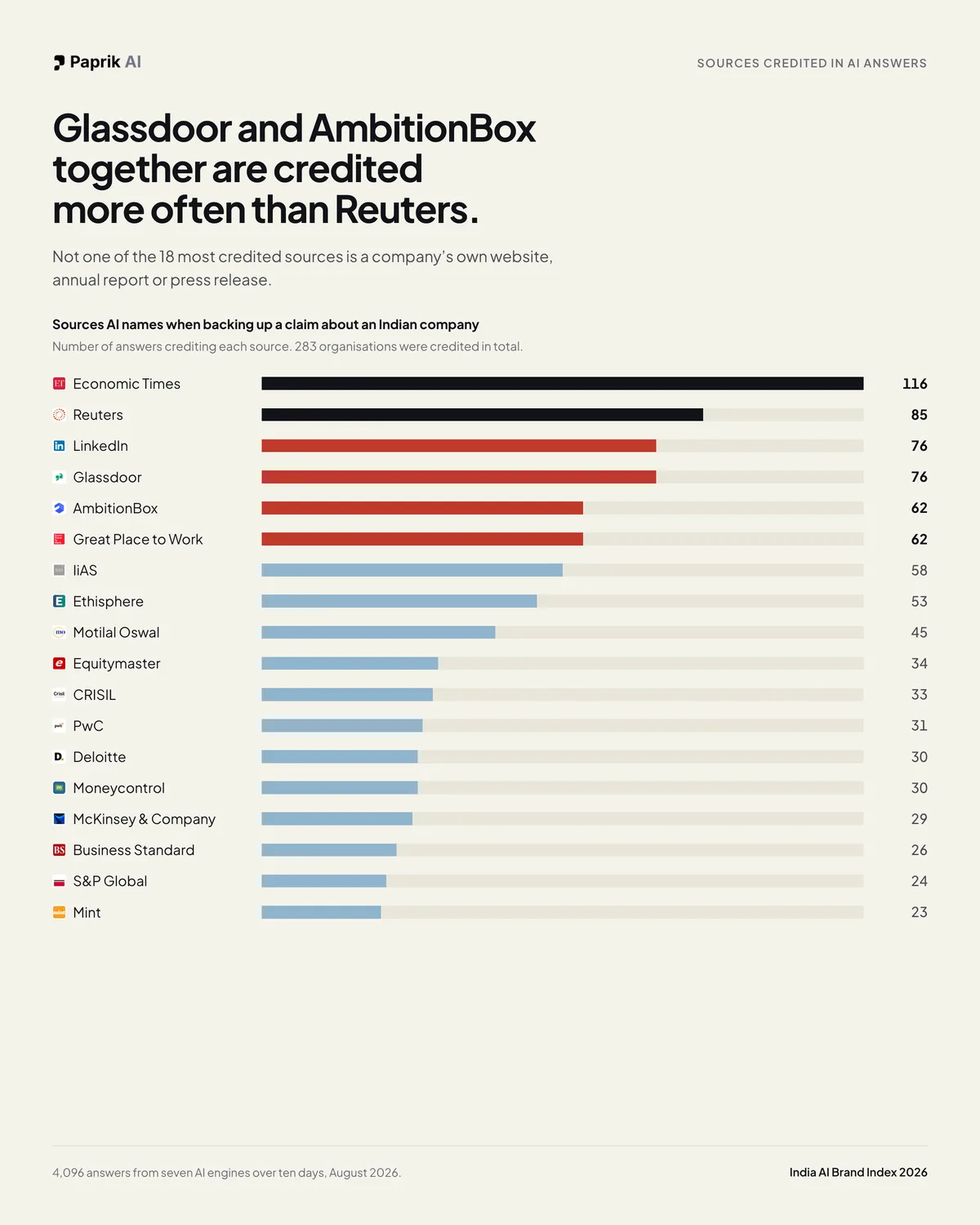
The Economic Times was credited most often, then Reuters. The next four places went to LinkedIn, Glassdoor, AmbitionBox and Great Place to Work. Glassdoor and AmbitionBox together were credited more often than Reuters. IiAS, the proxy advisory firm, outranked PwC, Deloitte, McKinsey and S&P Global.
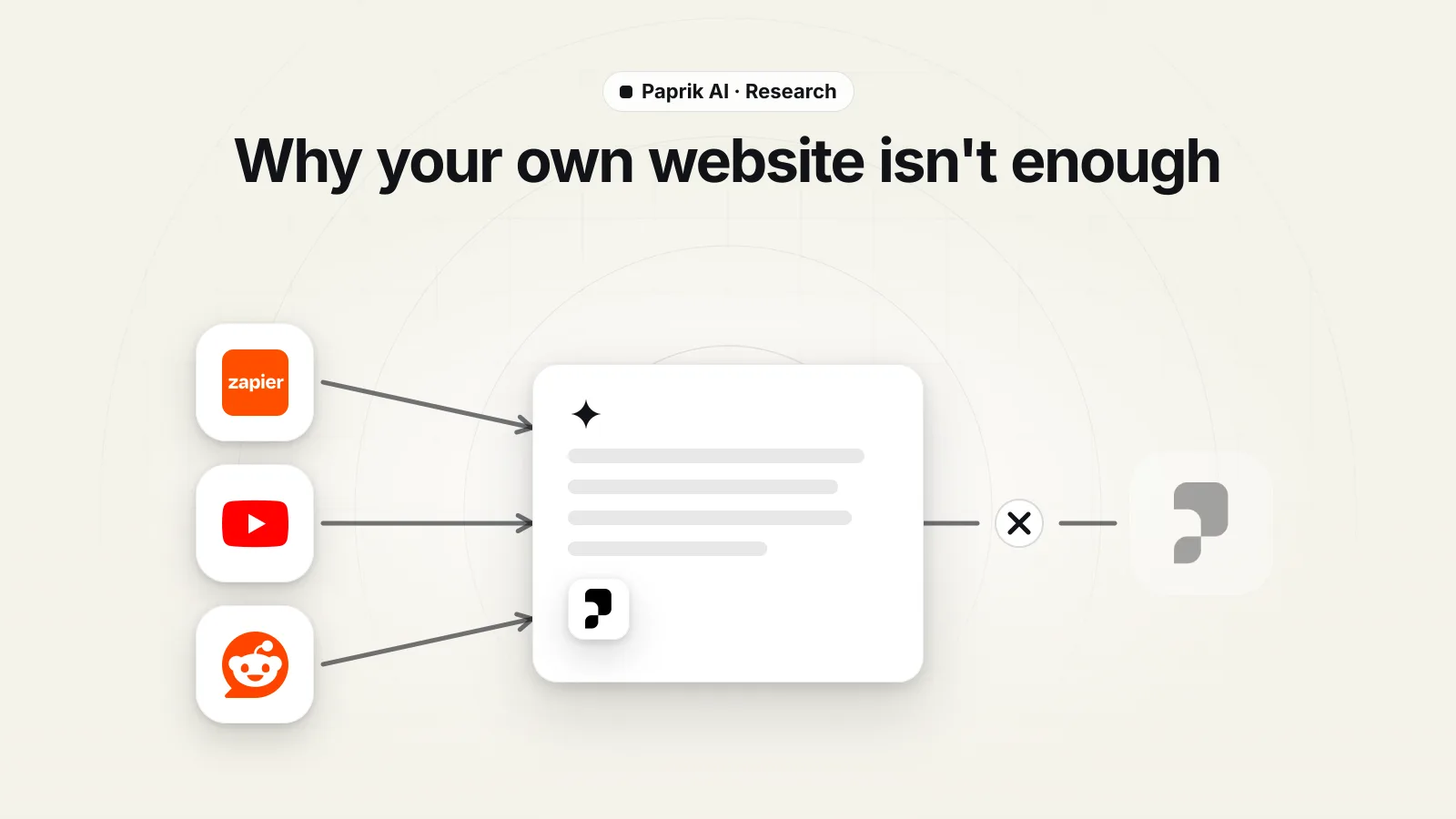
Not one of the 18 most credited sources was a company's own website, annual report or press release.
That is the mechanism. AI visibility tracks how much other people have written about a company in English, not what the company is worth. The names AI leaves out mostly sell inside India, several are state owned, and all of them generate less English-language third-party coverage per rupee of value than an IT exporter does.
What this changes for a marketing team
Three things follow, and none of them is the usual SEO advice.
The asset producing your AI visibility is largely text you do not own and cannot edit. Employee reviews, ranking bodies, trade press and analyst notes carry more weight in these answers than anything published on your own domain.
Your engine coverage is not uniform. Claude names 15.6 companies in a typical answer and Perplexity 6.8, so a company outside the two or three obvious names is competing for roughly six places on one engine and sixteen on another. For the biggest names the choice of engine barely matters. For everyone else it decides whether they appear at all.
And a single check tells you very little. Ask the same engine the same question on two consecutive days and only 47% of the companies named will match.
The full report covers every engine, the business houses, where criticism lands, and the sources behind the answers.