Do You Need a Separate AEO Plan for Every AI Engine?
Two AI engines answering the same questions share between 1 and 6 of their 10 most-cited sites, and each sticks to its own list week after week. What carries over between ChatGPT, Google's AI engines, Gemini and Copilot, and what needs its own plan.
Author
Founder
Abhilash is the Founder of Paprik AI. He writes about AEO, AI search visibility, and how brands can win in AI-driven discovery.
Do you really have to do separate work to get your brand mentioned in every AI engine?
The question matters because answer engine optimisation budgets, like every other marketing budgets, are finite. If the engines lean on the same sources to answer your users' questions, one list of websites to work on covers all of them. If they don't, then you will have to work separately for each engine. So we looked at two things: which sources each of the major AI engine cites and how consistently it sticks to them.
TL;DR
Across 10,708 answers to the same 53 questions, any two engines had at most 6 of their top 10 cited sites in the same week common.
Google's AI Overview and AI Mode shared 6. ChatGPT shared 4 to 5 with AI Mode and fewer than 2 with AI Overview. Copilot shared 1 or 2 with every other engine.
From one week to the next, each engine kept 7 to 8 of its own top 10.
The lists still move over months. In our longer history, ChatGPT kept only about 4 of its top 10 sites after three months.
Questions that name a brand are the exception: there, the engines share 4 to 8 of their top 10.
Two AI engines share only 1 to 6 of their top 10 sources
For every engine and every week, we listed the 10 sites it cited in the most answers. Then we compared those lists between AI engines, on the same questions asked on the same days.
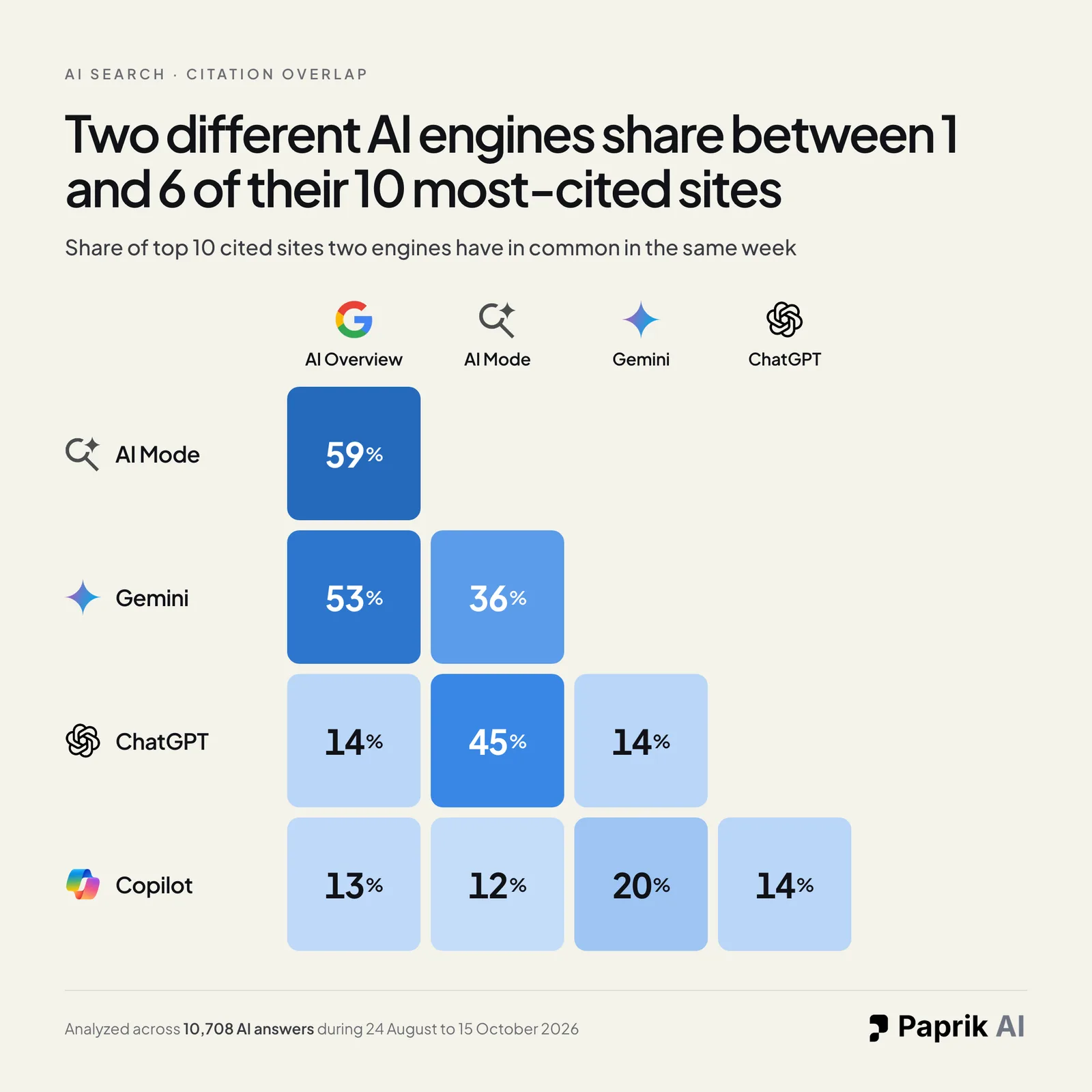
The grid splits into roughly three groups.
Google's engines sit together. AI Overview and AI Mode shared 6 of their 10 most-cited sites, which fits with both being built on Google Search and its way of choosing citations. Gemini shared about half of AI Overview's list.
ChatGPT sits on its own, with one partial bridge. It shared 4 to 5 sites with AI Mode, and fewer than 2 with AI Overview, Gemini or Copilot. Being well placed on the sites ChatGPT trusts tells you little about your position in Google's AI Overview, because ChatGPT finds its sources differently.
Copilot sits furthest from everyone, sharing 1 or 2 sites with each of the other four engines.
If you take one engine's top 10 sites as your to-do list, fewer than half of those sites carry over to another AI engine in most cases.
Each engine leans on a different kind of site
The overlap is low because each engine draws on a different part of the web. The clearest way to see it is through the big community platforms.
Engine | YouTube | ||
|---|---|---|---|
AI Overview | 66% | 33% | 32% |
AI Mode | 61% | 24% | 24% |
Gemini | 1% | 0% | 22% |
ChatGPT | 0% | 0% | 1% |
Copilot | 0% | 1% | 0% |
Share of answers citing each platform at least once, 24 August to 15 October 2026.
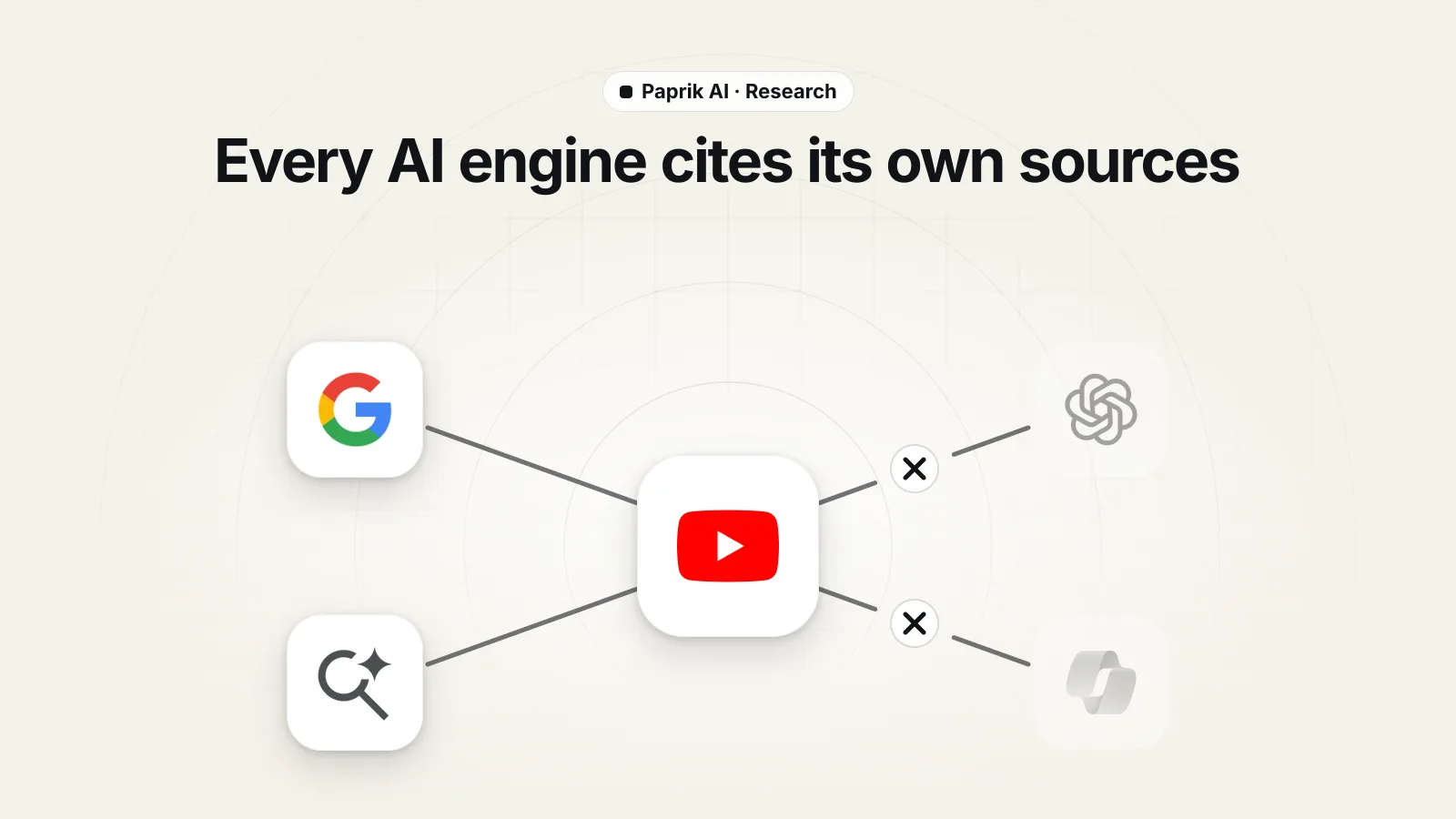
YouTube shows up in about two-thirds of AI Overview answers and almost none of the answers from ChatGPT, Gemini or Copilot. LinkedIn is cited by Google's two search engines and nobody else. Reddit is cited by Google's engines and Gemini, and close to never by ChatGPT or Copilot. A video strategy that works well for AI Overview does next to nothing for ChatGPT.
Underneath the platforms, all five engines cite companies' own websites most: between 7 and 9 of every 10 citations go to a company's site, documentation or blog. The difference is which companies they pick, and what fills the rest. For Google's engines, about 1 in 5 citations goes to a community platform. For Copilot, about 1 in 6 goes to news and media sites. For ChatGPT, about 1 in 10 goes to review sites.
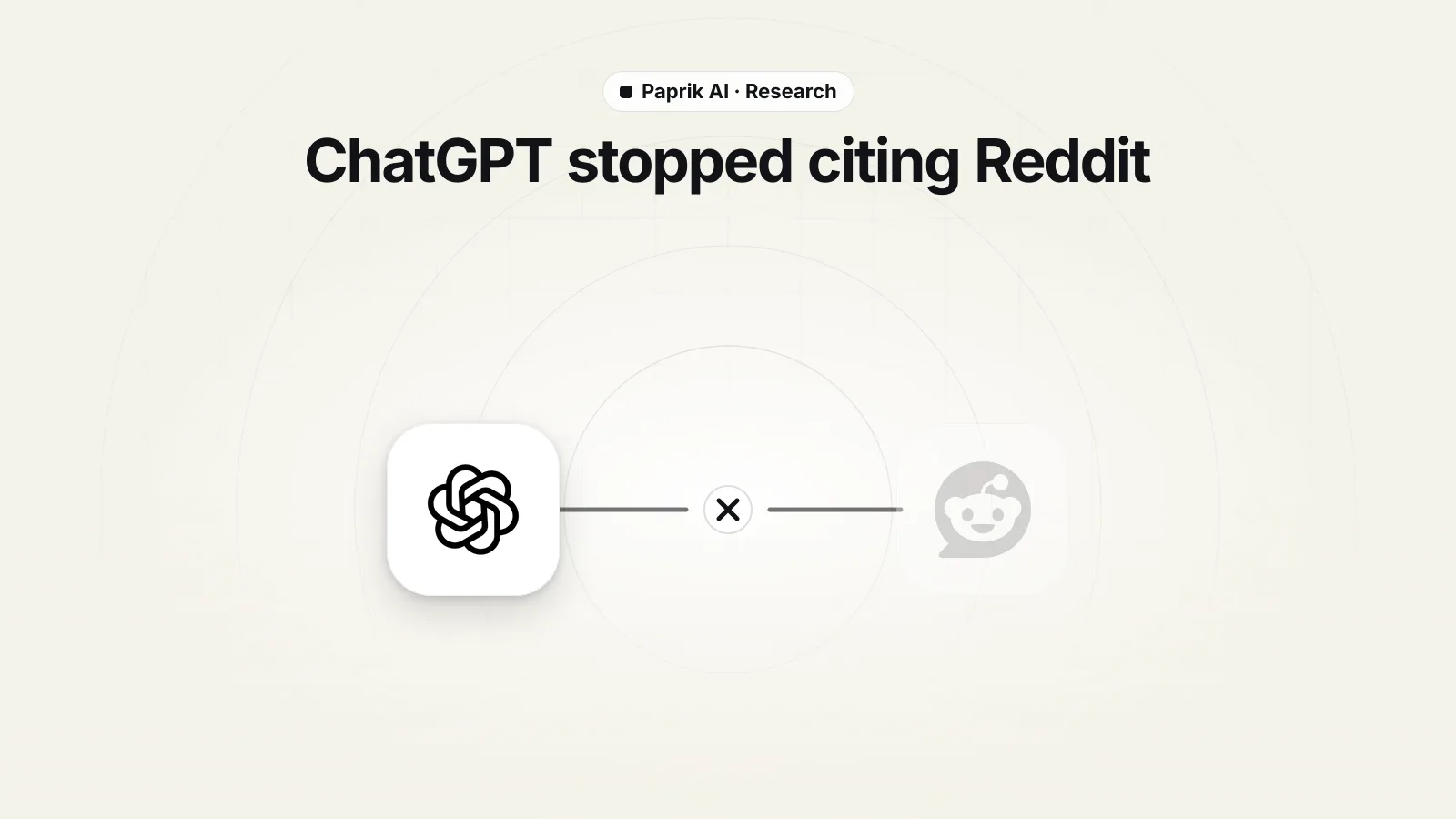
We've written before about how quickly one engine's taste can change: ChatGPT went from citing Reddit in most of its answers in May to almost none by August, while Google kept citing it.
But each AI engine sticks to its own preferred sources
A low overlap could mean the engines are just random, that the top 10 shuffles every day and any two lists would disagree. So we checked how much each engine's own top 10 changed from one week to the next, on the same questions.
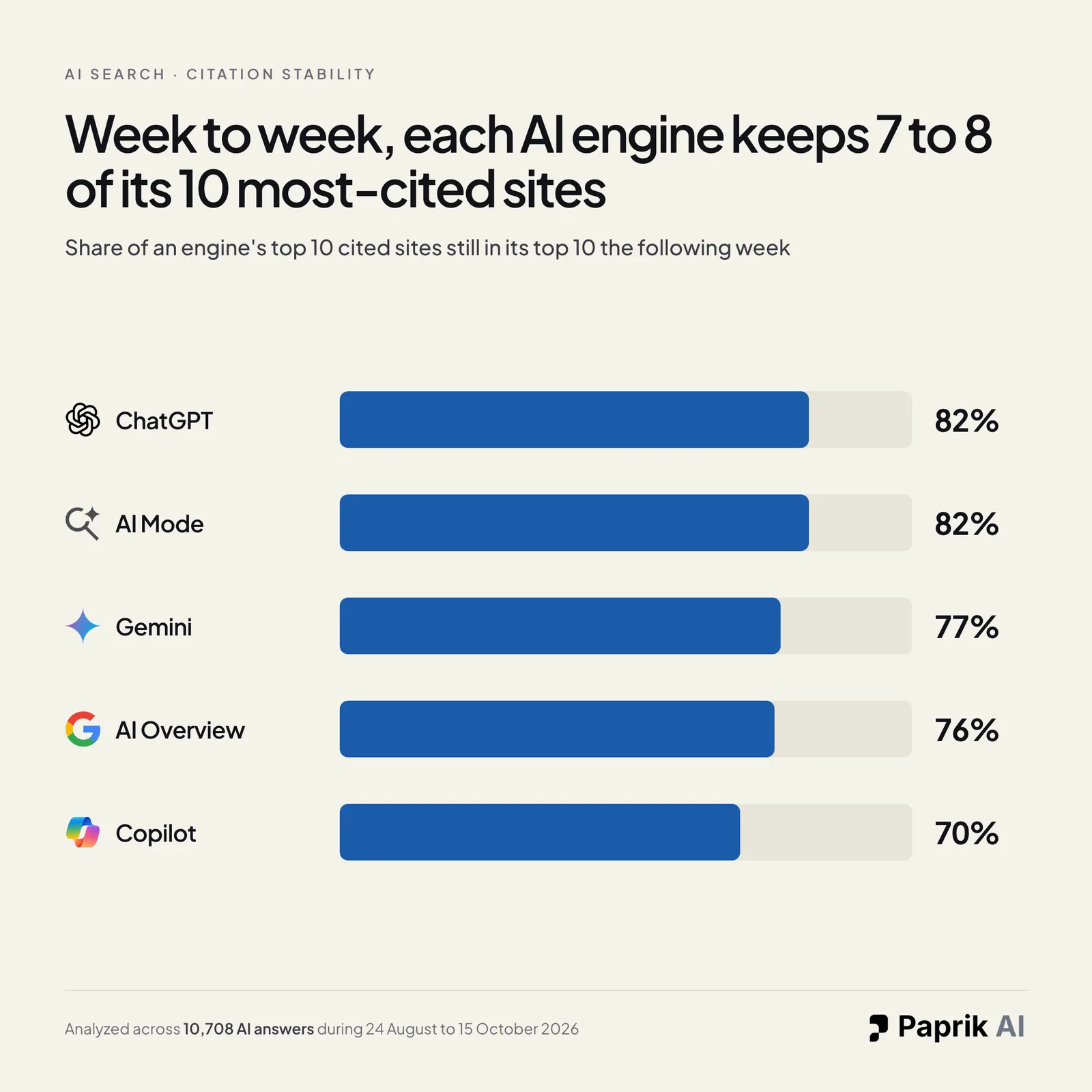
Every engine kept 7 to 8 of its 10 most-cited sites from one week to the next. The changes mostly happen at places 7 to 10, where a few sites are cited in a similar number of answers and swap places. Four of the top five usually stay put.
An engine that keeps 8 of its 10 sources a week later, and shares fewer than 2 of them with another engine, is following preferences of its own. That consistency is what makes planning per engine worth the effort.
Copilot is the least consistent, and it varies most by category. In one of the categories we track it kept about 5 of its 10 sites from week to week, in the other about 9. Its list in the first category rotates through many small tech blogs, each cited in only a handful of answers.
The lists still move over months
Consistent week to week doesn't mean fixed. Because these 2 to 3 sources rotating every week tend to compound over a longer period of time. Five to seven weeks apart, ChatGPT, Gemini and Google's two search engines still kept 6 to 7 of their top 10. Over three months, in our longer history from May to July, ChatGPT kept only about 4. AI Overview held on to about 7 and AI Mode about 6.
That's the Reddit story again, at a smaller scale and across every site. A list of target sites built from one quarter's data starts going stale within weeks.
Branded questios are the exception
All of the above is about category questions: "best tools for X", "how do I do Y", "which app should I use for Z". These are the top of the funnel questions where a buyer hasn't picked a brand yet.
Branded questions, which are your bottom of the funnel questions, that name a brand behave differently. For branded questions, any two engines shared 4 to 8 of their top 10 sites. The shared sites were mostly the company's own website, Wikipedia and the major business newspapers.
That splits your AEO work in two. Work on your own site, your Wikipedia presence and coverage in the main press helps across engines when someone asks about you by name. Work to get recommended in category answers has to be done engine by engine.
What this means for your AEO plan
Split the work by question type. For branded questions, build one foundation: your own site, Wikipedia, the main press. For category questions, plan per engine.
One separate plan for Google's AI (AI Overviews, AI Mode and Gemini). They share most of their sources. Gemini gets about half the benefit already from the work you do on AI Overviews and AI Mode.
ChatGPT needs its own plan. Some of your work for AI Mode carries over but by and large, ChatGPT behaves differently from other AI engines, and as one of the largest AI engines in India after Google, it deserves its own plan and tracking.
Plan Copilot separately, and check it more often. It shares little with the other engines and changes its list the most.
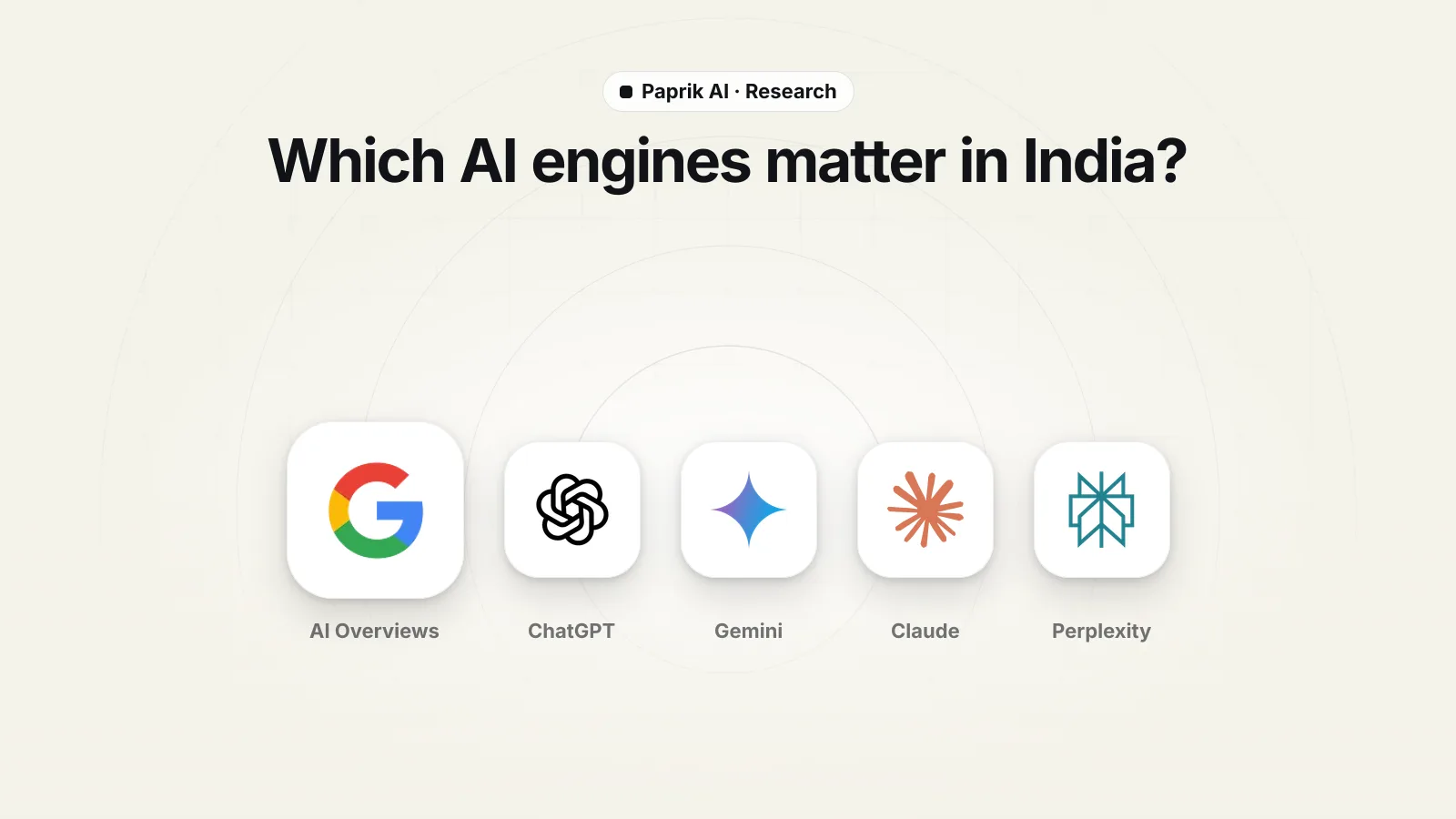
Decide which engines matter before splitting effort five ways. For most Indian brands, Google's AI surfaces serve most of the answers, with ChatGPT second.
Re-check each engine's list every month. The lists hold for a few weeks and drift over a quarter. Our guide on how to track AI visibility covers the method.
There isn't one list of sites that gets a brand into AI answers. There are at least three, and each one keeps moving.
Research methodology
We asked the same 53 questions to five AI engines: ChatGPT, Google AI Overview, Google AI Mode, Gemini and Microsoft Copilot, every day from 24 August to 15 October 2026.
We kept the 10,708 answers that came back complete and cited at least one source, and dropped days when an engine failed to answer properly.
For each engine and week, we ranked websites by the number of answers that cited them, counting all pages of a site as one, and took the top 10.
Engines were compared on the same questions asked on the same days, and each engine was compared with itself on the same questions one week apart.
The three-month figures come from our longer history of the same kind of questions, May to July 2026, and the brand-name comparison from a smaller set of questions that name a company.