If Your Competitors Do AEO Too, Is There Still an Edge?
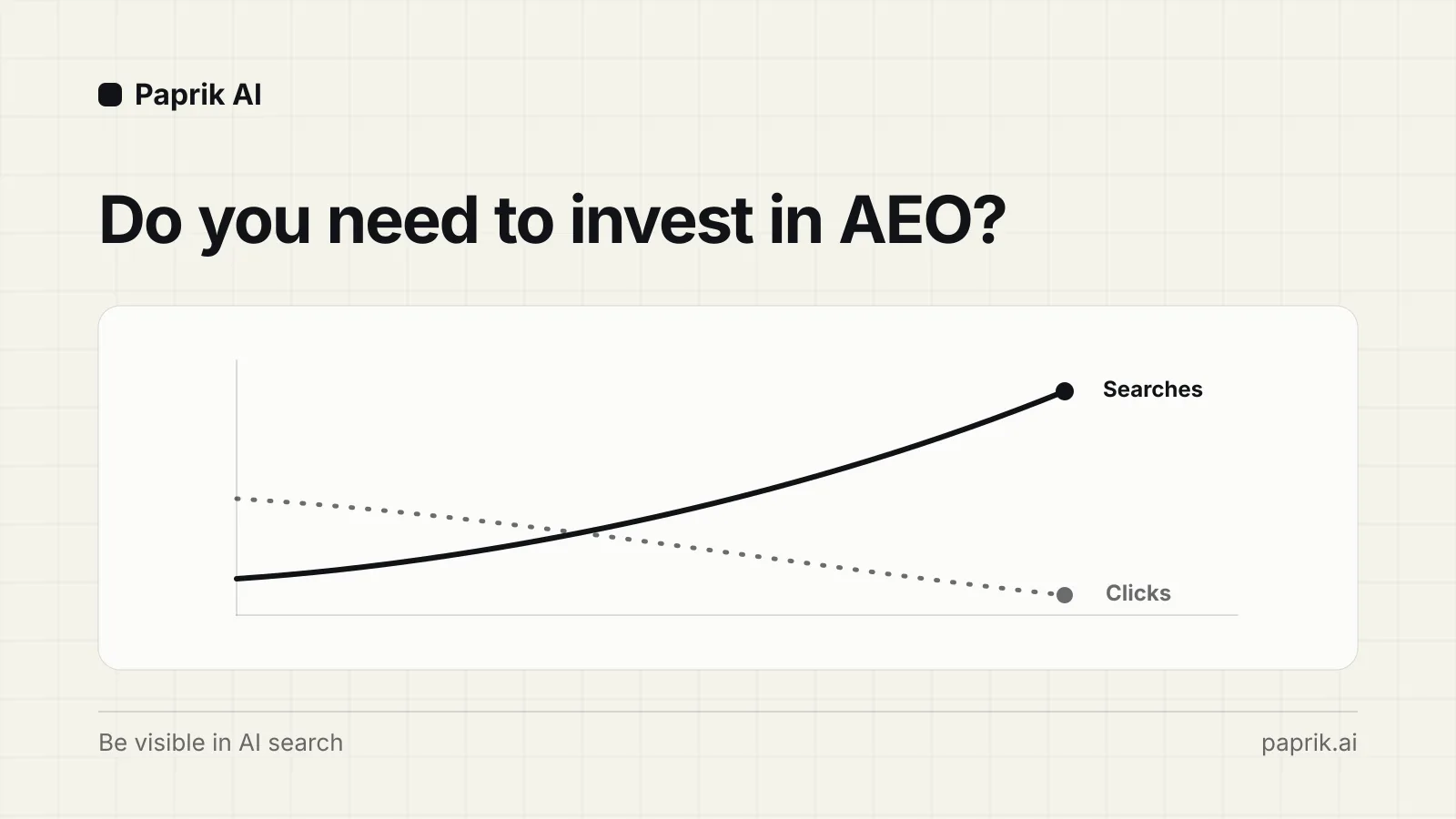
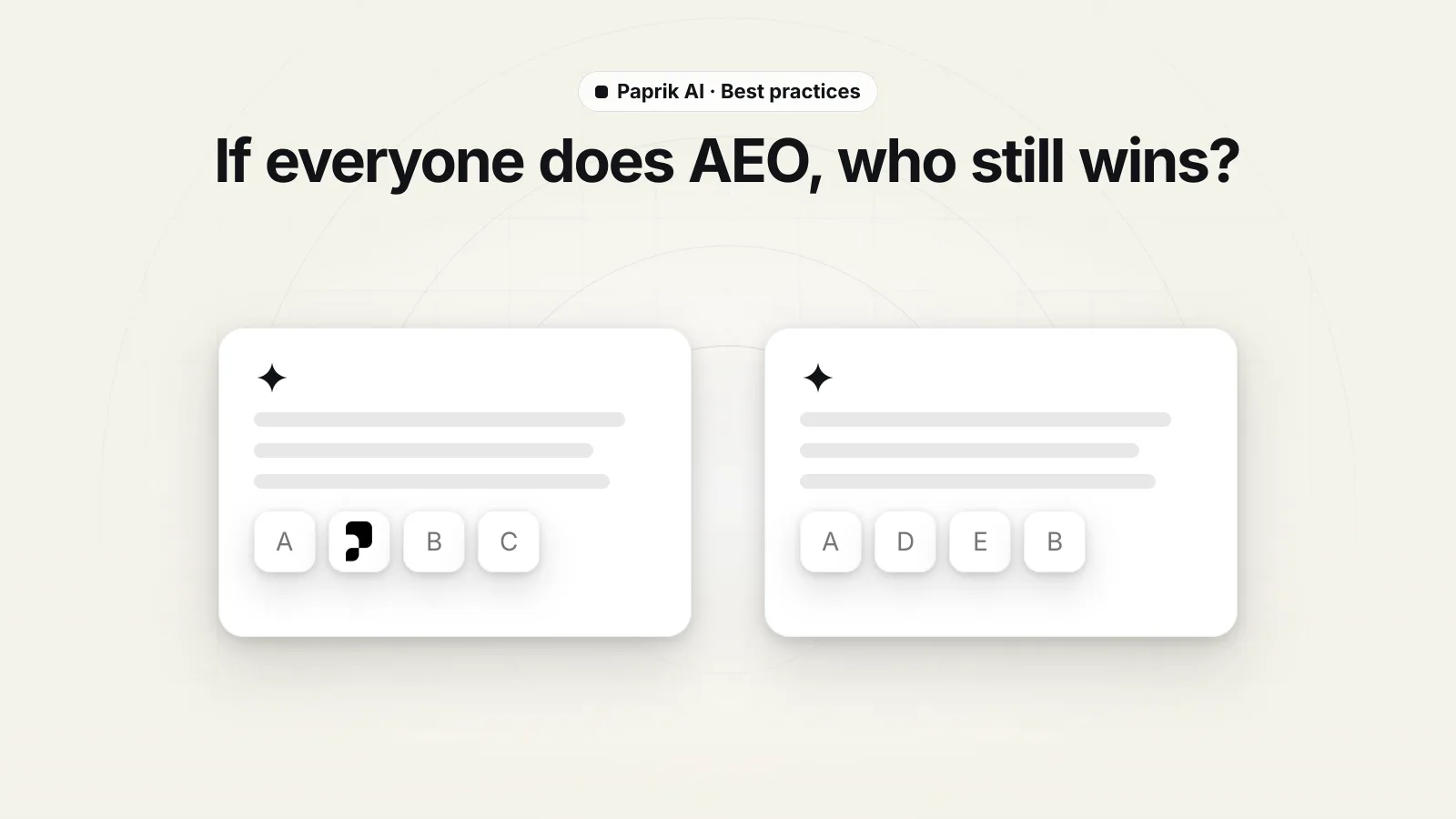
If you and your competitors both do AEO, it only cancels out when you sell the same thing to the same buyer. In our own category, where every brand does AEO, AI still picks different brands for different questions and gives each one a different reason.
Author
Founder
Abhilash is the Founder of Paprik AI. He writes about AEO, AI search visibility, and how brands can win in AI-driven discovery.
A customer asked me a fair question during a recent pitch: “If we do AEO and all our competitors do it too, won't the advantage just cancel out?”
I think this comes from a fundamental misunderstanding of how AEO works. People imagine it as a checklist or secret recipe: follow a few steps, get your brand into AI recommendations and fight competitors for a handful of fixed spots.
But AEO isn't about forcing your brand into AI answers. It's about helping AI understand what you're genuinely good at and when your brand is the right fit for a customer's question.
So even if everyone does AEO, the advantage doesn't necessarily disappear. It shifts from simply doing AEO to how well you've differentiated your brand and how accurately AI understands that differentiation.
In other words, we're back to what marketers have been talking about for decades: positioning.
And we can actually test this. We compete in a category where all five competitors we track sell AEO software themselves.
Here's what AI recommends when everyone is doing AEO.
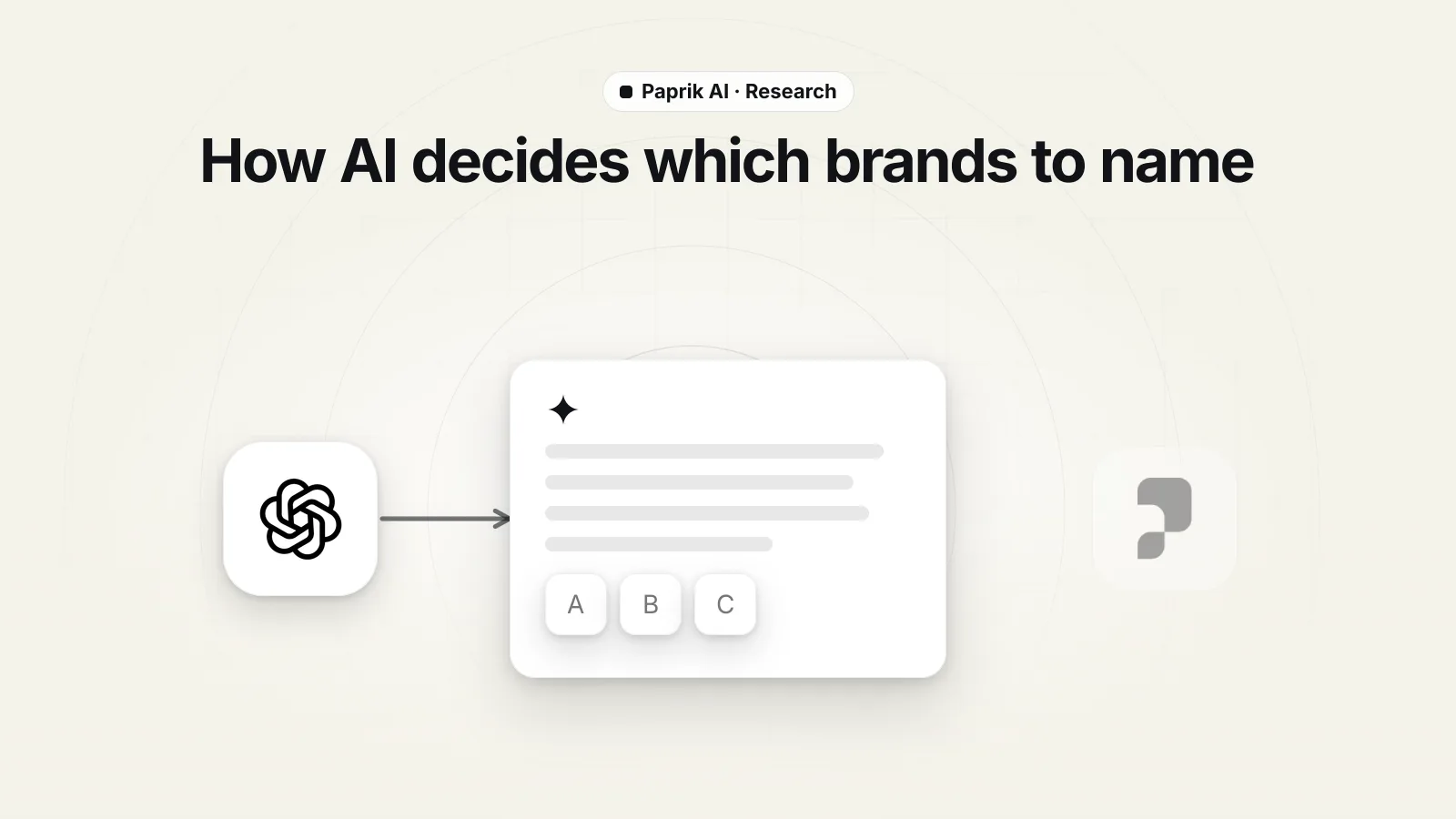
AI picks different brands for different questions
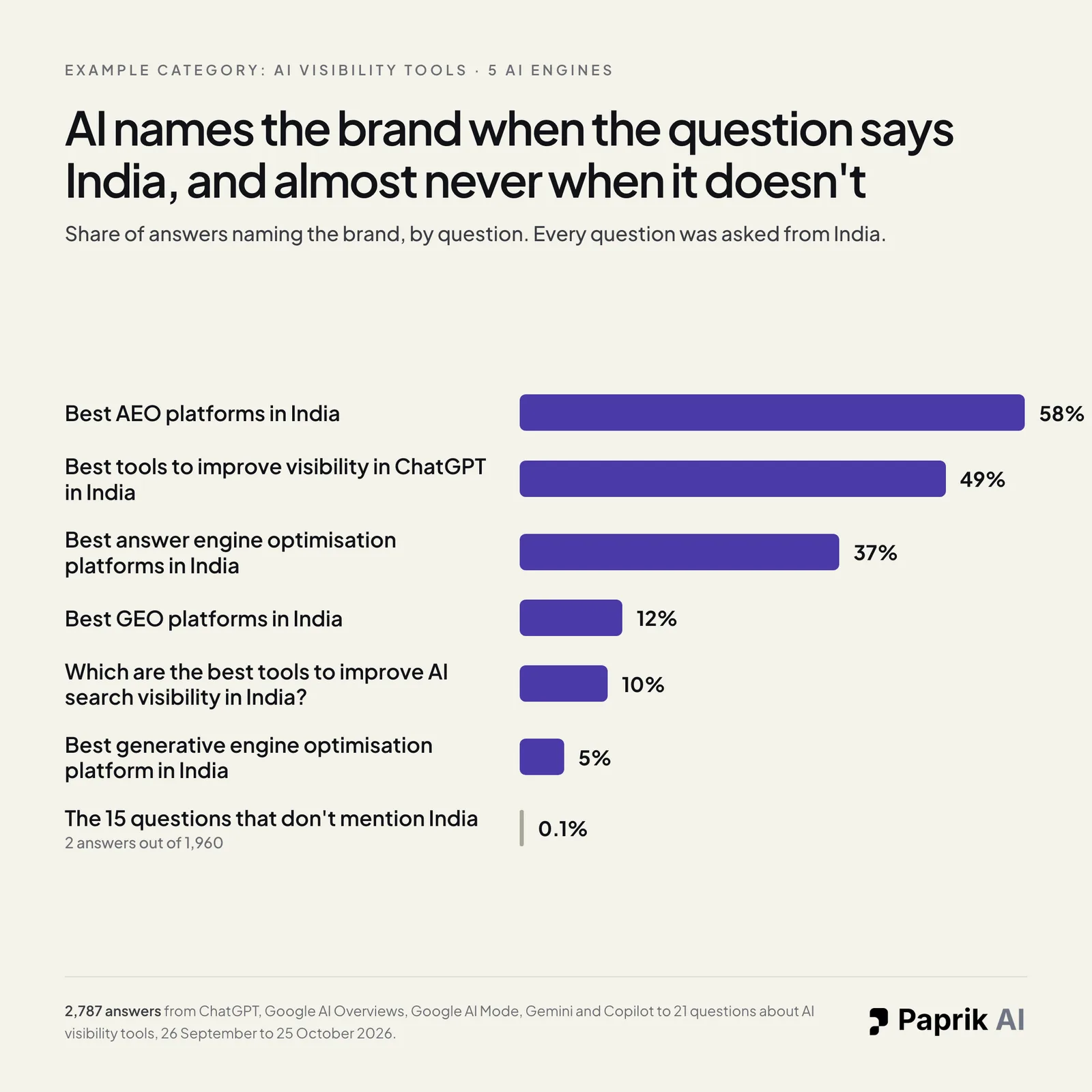
If AEO cancelled out, AI would give the same list of brands no matter what the buyer asked. But it doesn't. AI names us in 58% of answers to "Best AEO platforms in India" and in 49% of answers to "Best tools to improve visibility in ChatGPT in India". Remove "in India" from that second question, and we appear in less than 1% of answers. Across the 15 questions that don't mention India, we appeared in just 2 of 1,960 answers, even though all of them were asked from India.
We're built for brands in India. AI has understood that, so it recommends us when a buyer asks for a tool for India. For global questions, it recommends other brands, and that's fair. So the first edge is simple: be the clear answer to the questions you fit. A competitor's AEO can't take that away from you, because it comes from who you are.
The words matter too. We appear in 58% of answers to "Best AEO platforms in India", but in only 12% of answers to "Best GEO platforms in India". It's the same buyer asking the same thing with a different word. AI just hasn't connected us to "GEO" yet. Once everyone does AEO, this is where the work is: finding the questions and words where buyers would want you, but AI doesn't name you yet.
AI gives each brand a different reason
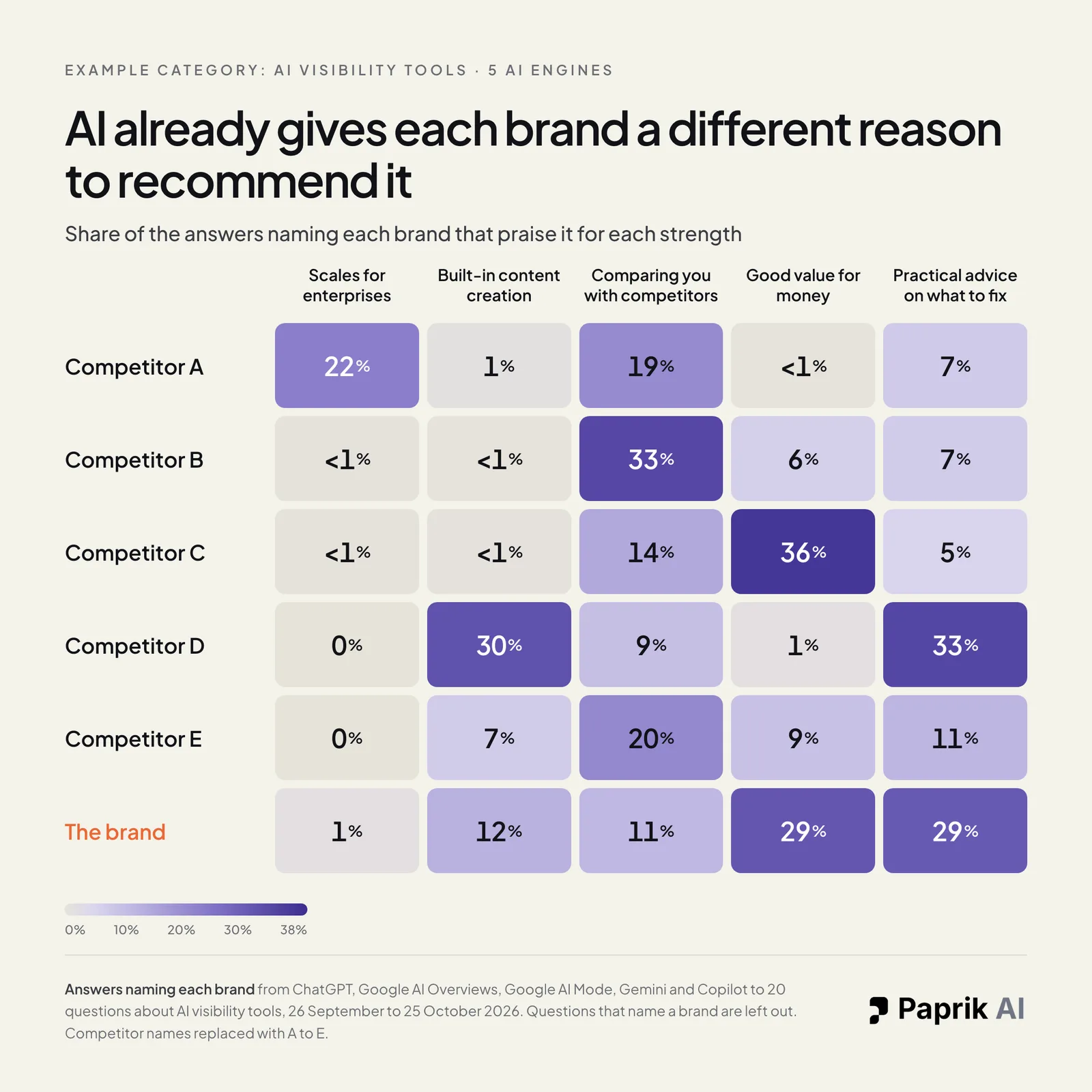
Now look at why AI recommends each brand. Each one is praised for something different: Competitor A for working well at enterprise scale (22% of its answers), B for comparing you with your competitors (33%), C for value for money (36%), and D for content creation (30%) and practical advice (33%). We're praised most for value for money and for practical advice on what to fix, 29% each.
All five companies do AEO, yet AI doesn't treat them as the same. It has a different reason to recommend each one, and those reasons match what each company is known for. So a large enterprise and a small team on a budget get different recommendations, which is better for both.
Where two brands are praised for the same thing, they compete head to head. We share value for money with C and practical advice with D. Here, AI leans towards the brand with more proof it can find: reviews, case studies, comparisons and a clear pricing page.
The lists made room for one more brand
The customer then asked a sharper question: "If we get onto the list, someone has to drop off. If they're doing AEO too, why would they?" That's true when a list has a fixed number of places. But we got onto these lists while every brand already on them was doing AEO.
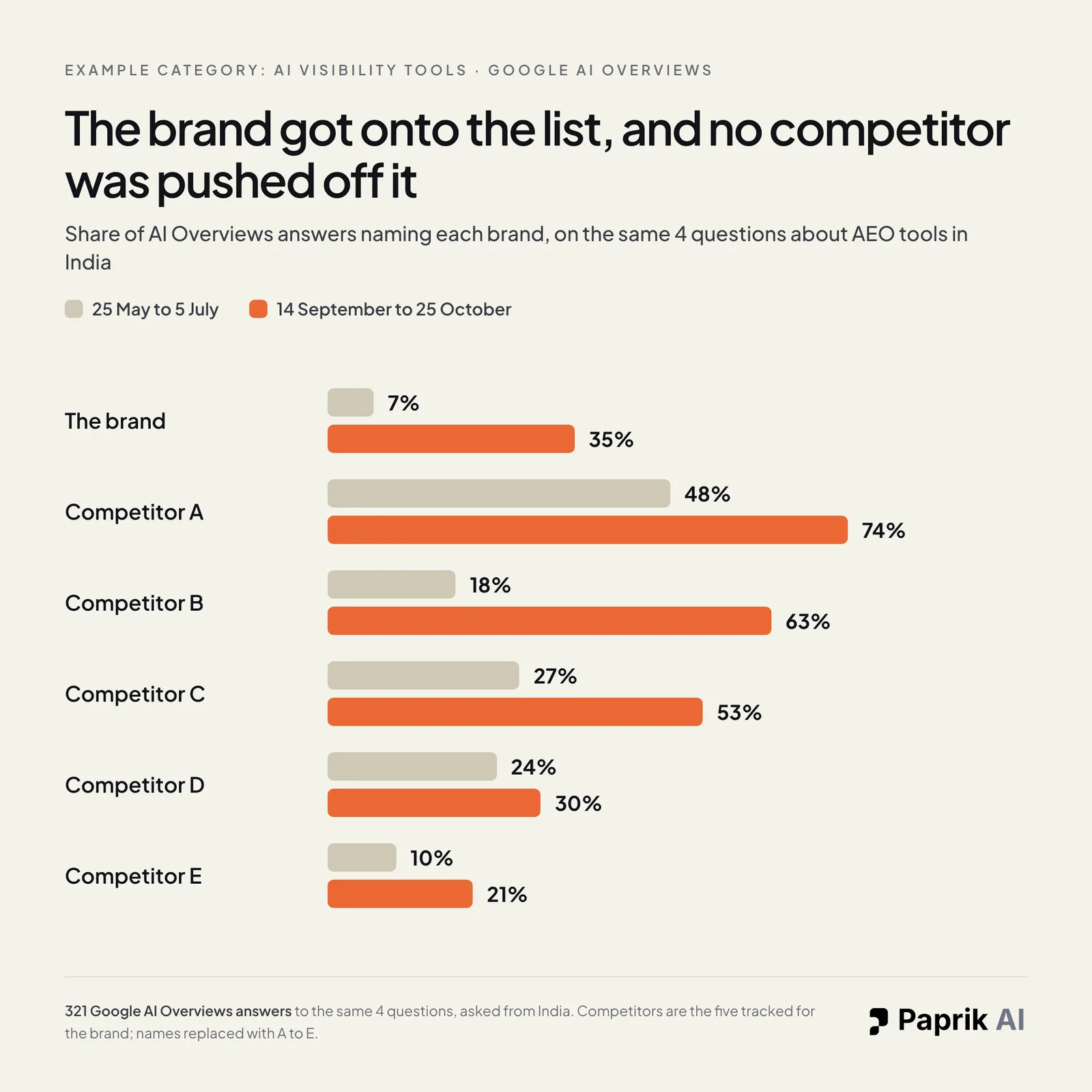
We've tracked four questions about AEO tools in India since May. In Google AI Overviews, we went from 7% of answers in June to 35% by October. Nobody dropped off. All five competitors were named more often too. In June, an average answer named 1.3 of these six brands. By October, it named 2.7. The list simply got longer. Google AI Mode showed the same pattern, except for one competitor that fell from 11% to 4%.
Doing AEO doesn't guarantee a place either. On ChatGPT, one of the five competitors appeared in 31% of answers to these questions in June and in none in October. Our data can't tell us why. But it shows that no place on an AI list is permanent, even for a company that sells AEO. And when a list is full, AI gives the place to the brand it thinks fits the question best.
Why everyone doing AEO doesn't cancel out
People expect AEO to cancel out because they picture it as pushing your name into more answers. If that's all it was, everyone doing it would cancel out, like a room where everyone starts talking louder. You can push your name this way, because AI can still be fooled by repetition and planted content. But it isn't reliable and it doesn't last.
The AEO that works gives AI a clearer picture of each brand: who it's for, what it's good at and where it operates. When every brand does that, AI gets better at matching brands to buyers, and the brands stand further apart. The three charts above show exactly that.
Here's how I put it now: AEO isn't about making AI recommend you when it shouldn't. It's about making sure AI doesn't overlook you when it should.
Where the edge comes from once everyone does AEO
What AEO gets you | Once everyone does AEO |
|---|---|
Being findable: AI knows you and describes you correctly | No longer an edge, because everyone has it |
Being considered for the questions you fit | Still an edge, won one question at a time |
Being chosen for the right reason | The biggest edge left |
Take two car brands. AI sees one as affordable and the other as safe. Both can do AEO and get mentioned more often. But if the affordable brand also makes safe cars, its edge comes from AI knowing that. And AI only knows it when it can find proof, such as crash-test ratings and owner reviews.
AI also has reasons not to recommend you. When asked directly whether we're a reliable choice, a third of answers point out that we don't have a long track record yet. More mentions won't fix that. More customers, results and time will, once AI can read about them on other sites.
How to compete when your competitors do AEO too
List the questions you have a credible right to win. Not every question in your category, only the ones where your market, price or use case matches what the buyer is asking.
Measure each question on its own, engine by engine. Averaged across our 21 questions, we'd look like a 9% brand, and that average hides both the 58% and the zeros. How AI visibility is calculated explains where averages go wrong, and engines differ enough that each one needs its own plan.
Ask each question the ways your buyers ask it. Try AEO and GEO, "tools" and "platforms", with your market and without it. If you're missing for one wording, AI hasn't connected you to it yet.
Find the reason AI gives for you and for each competitor. See what AI praises each of you for and what doubts it raises. Answer the doubts with proof on the sites AI reads, which are mostly not your own. Paprik's Perception view lays this out against each competitor.
Keep checking. One competitor went from 31% of ChatGPT's answers to none in four months. A one-time audit would have missed it.
AEO on its own isn't your competitive advantage. Your strengths are. AEO makes sure AI can see them when it's helping your customers decide.